Argentina Climbs to Fifth Place Among Peru's Suppliers, Overtaking Mexico
Translated from the Spanish original. Read the original

Director of Pulso Internacional
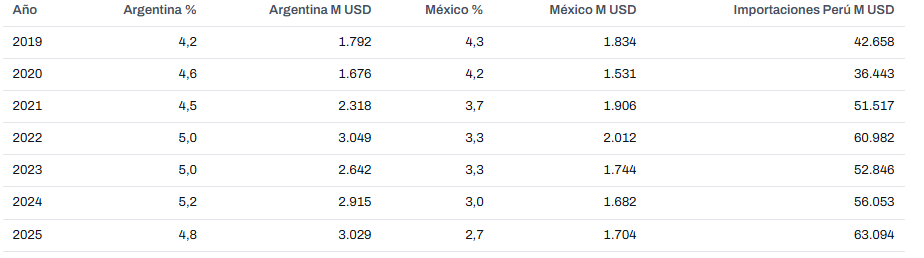
Peru's sixth Trade Policy Review at the World Trade Organization (WTO), covering the period 2019-2025, offers an interesting picture of the evolution of that country's foreign trade. In its official report, the Peruvian Government states that Argentina «increased its share from 4% to 5%, displacing Mexico and ranking as Peru's 5th supplier of goods». Only China, the United States, the European Union and Brazil sell more to Peru. The WTO Secretariat's report allows us to refine the figure: Argentina's share of Peruvian imports rose from 4.2% in 2019 to 4.8% in 2025, with a peak of 5.2% in 2024. Mexico took the opposite path, from 4.3% to 2.7%. The curves crossed in 2020 and the gap has kept widening ever since.
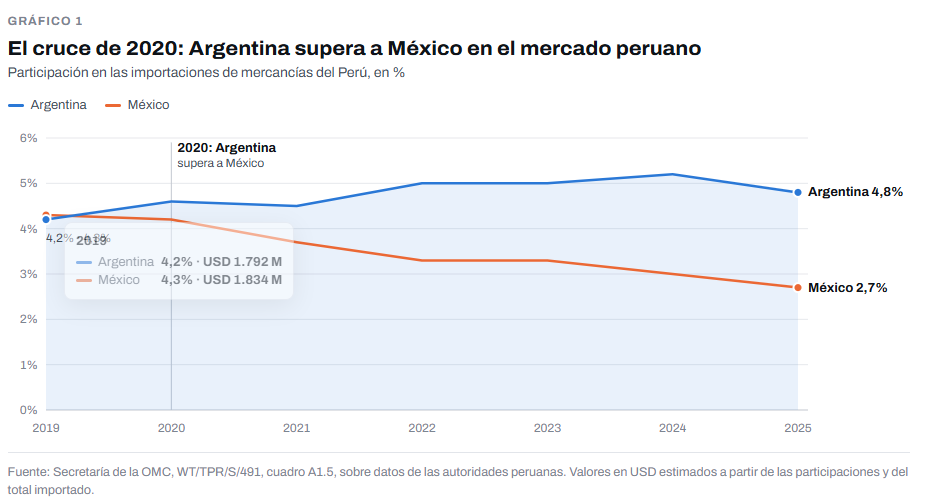
Source: WTO Secretariat, WT/TPR/S/491, table A1.5, based on data from the Peruvian authorities. Values in US$ estimated from the shares and the total imported. Prepared by Pulso Internacional
In terms of value, the difference is more telling. Using Peru's total imports as a base, Peruvian purchases from Argentina went from around US$1,792 million in 2019 to US$3,029 million in 2025: an increase of 69%, at an annual rate of 9.1%, against 6.7% per year for Peruvian imports as a whole. Over the same period, Mexican sales to Peru fell from US$1,834 million to US$1,704 million. Argentina not only kept pace with the expansion of the Peruvian market: it gained ground on almost all of its competitors in the region.
Source: WTO. Indec. Prepared by Pulso Internacional
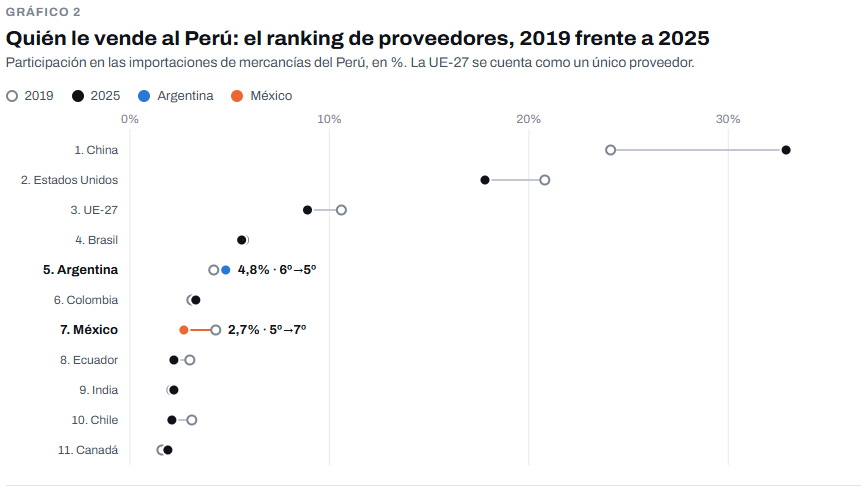
Source: WTO Secretariat, WT/TPR/S/491, table A1.5. The Peruvian Government's report (chart 3.8) rounds the same figures: Argentina 4% → 5%.
COUNTRIES SUPPLYING GOODS TO PERU, CHANGE 2019-2025
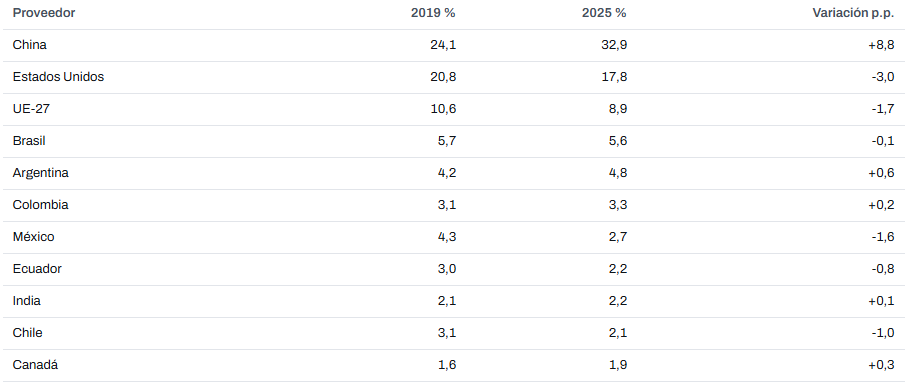
Source: WTO Secretariat
What Argentina sells to Peru
The INDEC table of Argentine exports to Peru in 2025 shows a sizable but concentrated basket. Of the US$2,549 million FOB shipped, 72.5% corresponds to agri-food products and 24.8% to manufactured goods, led by the automotive complex. Five tariff lines account for three out of every four dollars: corn kernels (US$943 million, 4.6 million tons), diesel pick-up trucks of up to 5 tons (US$382 million), crude soybean oil (US$374 million), soybean meal and pellets (US$141 million) and frozen shrimp (US$82 million).
ARGENTINE PRODUCTS EXPORTED TO PERU 2025
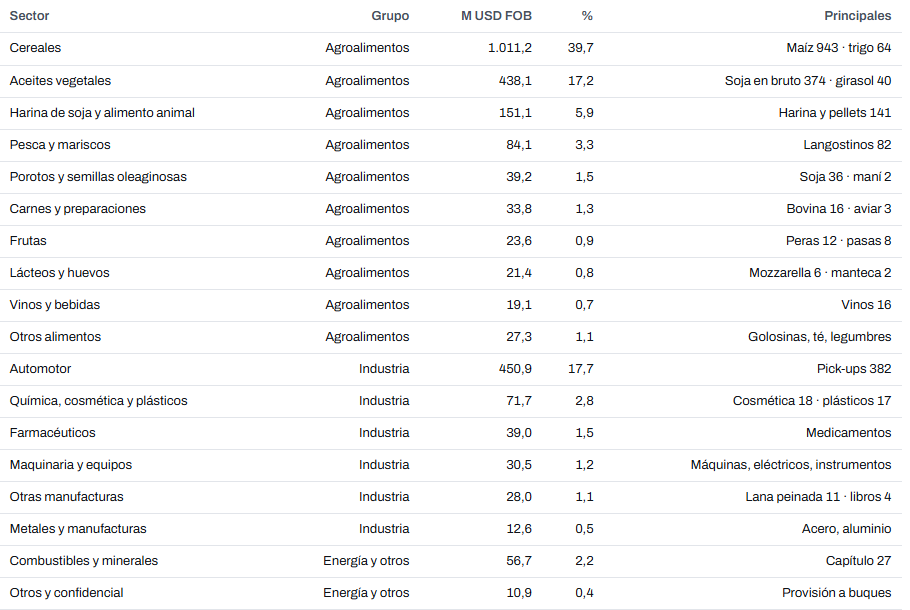
Source: INDEC
Behind the major categories there is a long tail worth looking at: fresh pears (US$12.4 million), bottled wines (US$15.4 million), frozen and fresh beef (US$15.6 million), combed wool tops (US$11.2 million), raisins (US$8.5 million), pet food (US$7.6 million), mozzarella (US$6 million) and more than 70 pharmaceutical lines that, taken together, amount to around US$39 million. These are small businesses in the overall total, but they are the ones that speak of added value, brands and SMEs.
The sectors that drove the rise
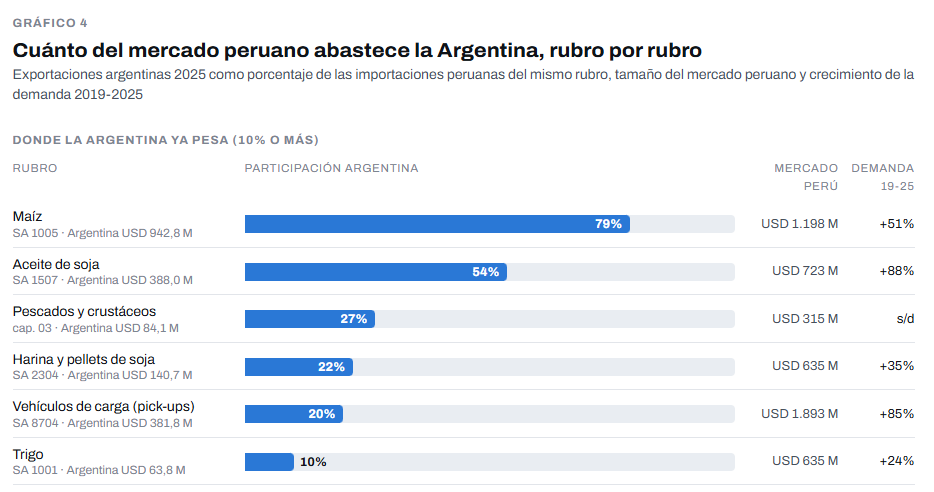
INDEC's 2025 table does not include a historical series, but cross-referencing it with the structure of Peruvian imports published by the WTO Secretariat makes it possible to reconstruct where the jump came from. Argentina gained share because its supply is concentrated precisely in the categories where Peruvian demand grew the most between 2019 and 2025.
- Yellow corn. Peruvian purchases of corn rose 51%, from around US$795 million to US$1,198 million. Argentina supplies close to 8 out of every 10 dollars. The driver is the poultry industry, which accounts for 55.5% of the value of Peruvian livestock production, according to the WTO.
- Soybean oil. Peruvian imports nearly doubled (+88%, to US$723 million) and Argentina covers more than half, with crude oil as the star product and a growing portion of packaged refined oil.
- Pick-up trucks and cargo vehicles. Peruvian purchases of goods vehicles grew by around 85%, to US$1,893 million. In 2025, capital goods, including vehicles, rose 18.5%, according to the Peruvian Government. Argentina holds a fifth of that market.
- Shrimp and seafood. At US$82 million, Argentine shrimp is already the fifth product in the basket and represents more than a quarter of what Peru imports in fish and crustaceans.
The Observatory of Economic Complexity (OEC) confirms the trend with its own data: Argentine exports to Peru grew at an annualized rate of 16.3% between 2018 and 2023, from US$1,200 million to US$2,550 million, with corn, pick-up trucks and soybean oil in that order.
Source: Indec
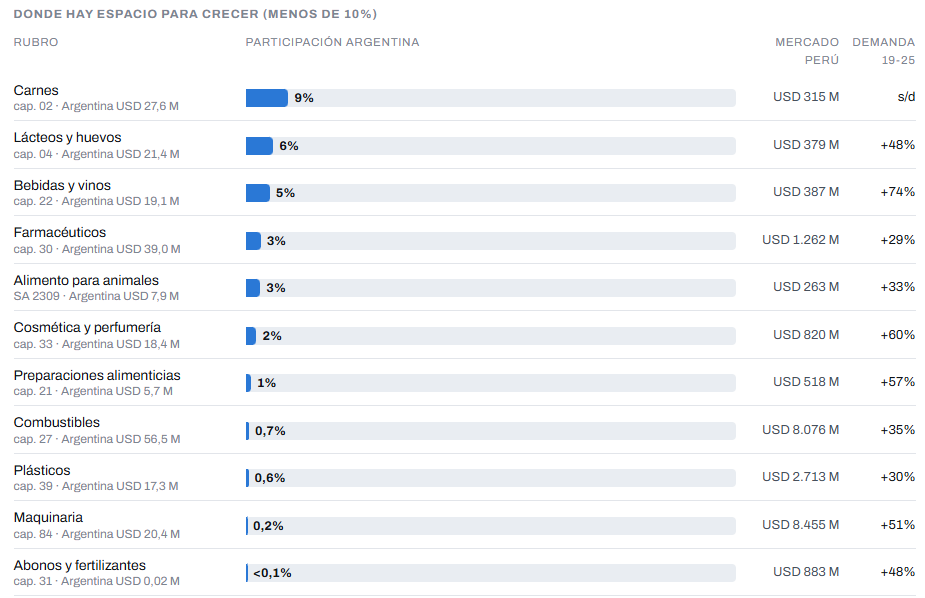
Sources: INDEC (Argentine exports FOB 2025) and WTO Secretariat, WT/TPR/S/491, tables 4.1, A1.3 and A1.5 (Peruvian imports CIF). The share is an estimate: it compares FOB values with CIF values, so it tends to slightly underestimate Argentina's weight. Growth is approximate and is calculated with shares published to one decimal place.
The chart can be read in two ways. At the top are the categories where Argentina is already a leading player and where future growth will depend on Peruvian demand continuing to expand. At the bottom is the margin still to be conquered: markets worth hundreds or thousands of millions of dollars, several of them with double-digit growth, where the Argentine presence is still marginal.
A Peru that exports record volumes and opens up to the world
Argentina's rise is taking place in a market that has grown. According to the Government's report, Peruvian exports of goods and services reached US$99,010 million in 2025, the fifth consecutive record, with average growth of 10.9% per year since 2019. Total trade went from US$104,000 million to US$172,000 million and the degree of openness rose from 44% to 50% of GDP. In 2025 alone, goods exports grew 23% and imports, 11%.
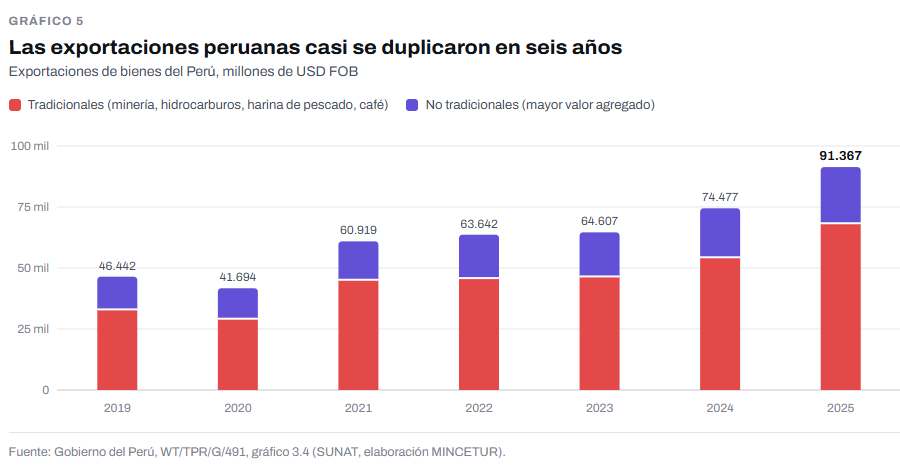
Source: Government of Peru
Peru closed 2025 with public debt at 30.1% of GDP, reserves equivalent to 28% of output, average inflation of 3.6% over the period and investment grade from all three rating agencies (Baa1, BBB and BBB-). Its country risk averaged 166 basis points between 2019 and 2025, against 446 for the Latin American average. The Ministry of Economy projects annual growth of 3.2% between 2026 and 2029, which would place it at the head of the region, with mining, infrastructure and agricultural exports as the engines.
Agriculture is the other big story: agricultural exports doubled to USD 14,806 million and the agricultural surplus climbed from USD 2,326 million to USD 7,505 million. Peru is today the world's largest exporter of blueberries and a leading player in coffee, cocoa, grapes and avocados. That boom needs inputs that Argentina produces: grains to feed poultry, fertilizers, machinery, packaging, genetics.
The WTO Secretariat provides the counterpoint. Exports remain highly concentrated (mining and agriculture rose from 71.5% to 77% of the total), the fiscal position has deteriorated since 2022, informality exceeds 70% of employment and poverty rose from 20.2% to 25.7%. Logistics costs, the report recalls, remain 40% above those of the world's four largest trading economies. For an Argentine exporter, these data are not a brake, but they are a guide: Peru is buying more, but the cost of getting there still weighs.
Peru's bet on trade promotion and investment
Both reports agree that Peru has sustained, for more than 30 years, an open-trade policy with stable rules. The average tariff has held at 2.2%, with just three rates (0%, 6% and 11%) and 70% of tariff lines duty-free. On that basis, during the period under review the Government deployed a package of promotion and facilitation instruments that are worth knowing, because they define how business is done in Lima.
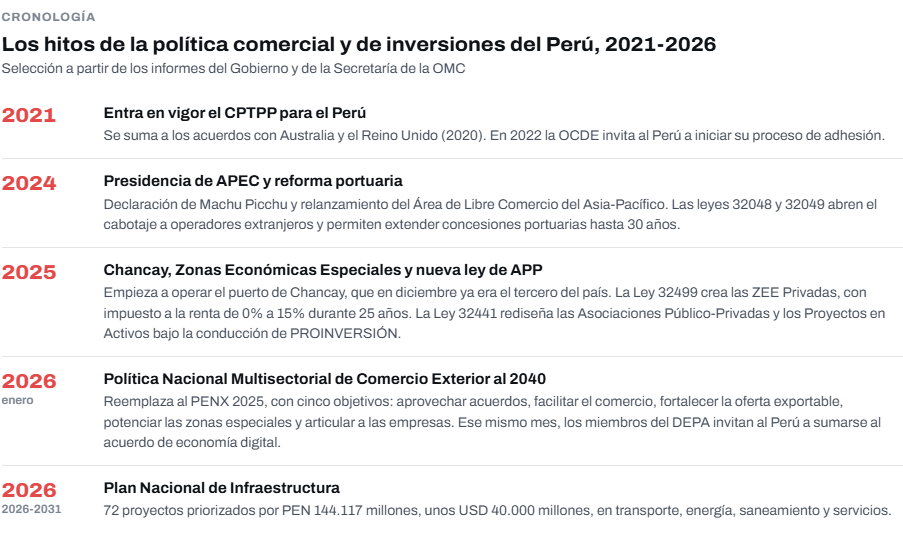
Source: WT/TPR/G/491, sections 3 and 4; WT/TPR/S/491, sections 2 and 4.
On facilitation, the Foreign Trade Single Window (Ventanilla Única de Comercio Exterior, VUCE) has accumulated more than 136,000 users and 8 million procedures, with a 33% reduction in processing times and estimated savings of PEN 1,600 million. Peru reports having fulfilled 97.1% of its commitments under the WTO Trade Facilitation Agreement, and the digital certificate of origin went from being a rarity (0.005% of those issued in 2019) to representing 16% in 2025. Today Peru exchanges digital certificates with Mexico, Chile and Colombia. With Argentina, not yet.
On promotion, PROMPERÚ manages the Country Brand and a network of trade offices; the Internationalization Support Program co-finances up to 90% of export projects by micro, small and medium-sized enterprises; the Export Productive Route assisted 613 companies in 22 departments and the Ella Exporta program assisted 189 women-led companies. The drawback regime was maintained at 3% of the FOB value, after the planned cut was abandoned.
On investment, the framework is among the most open in the region: national treatment enshrined in the 1993 Constitution, entry of foreign capital without prior authorization in almost all activities, and 25 bilateral investment protection agreements in force, among them the one signed with Argentina in 1996. The stock of foreign direct investment grew from USD 29,200 million in 2019 to USD 34,200 million in 2025, with the United Kingdom, Spain, Chile, the United States and Colombia as the main origins. Argentina does not appear among them, which shows a vacant space for engineering firms, mining services, software, agtech and food companies.
«Any supplier, domestic or foreign, may participate on equal terms and without any limitation in the Peruvian public market.»
Report by the Government of Peru to the WTO, on the new General Public Procurement Law (Law 32069)
The balance: Argentina sells eight times what it buys
There is one fact that Argentine trade diplomacy cannot lose sight of. According to Peruvian figures, Peru bought about USD 3,029 million from Argentina in 2025, but sold it barely about USD 350 million: Argentina is Peru's 5th supplier, but it absorbs only 0.4% of its exports. Argentina's surplus is around USD 2,700 million.
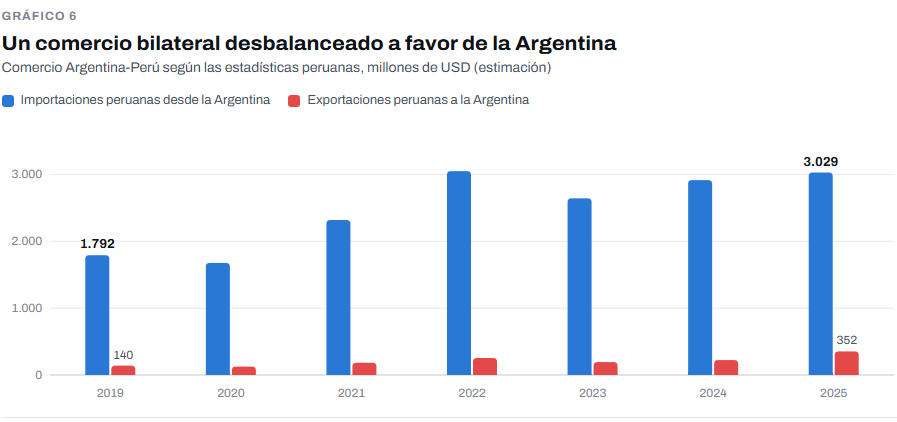
Source: own estimate based on WT/TPR/S/491, tables A1.4 and A1.5 (shares applied to the totals). Peruvian exports to Argentina are published with shares of 0.3% to 0.4%; the figures are approximate.
The Peruvian Government reports that it has made progress in trade negotiations with new partners, among them Argentina, and in the optimization of Economic Complementation Agreement No. 58 (ACE 58) with MERCOSUR. A more balanced relationship, with more Argentine purchases of Peruvian fruit in the off-season, inputs and services, and with more cross-investment, is the best card to play in negotiating a deepening of the agreement that includes services, investment, digital trade and public procurement.
Where Argentina can grow: ten bets
With the INDEC table as a starting point and Peruvian demand as a compass, these are the sectors with the most room to grow. The rating combines the size and growth of the Peruvian market, Argentina's current share and the competitiveness of the domestic supply.
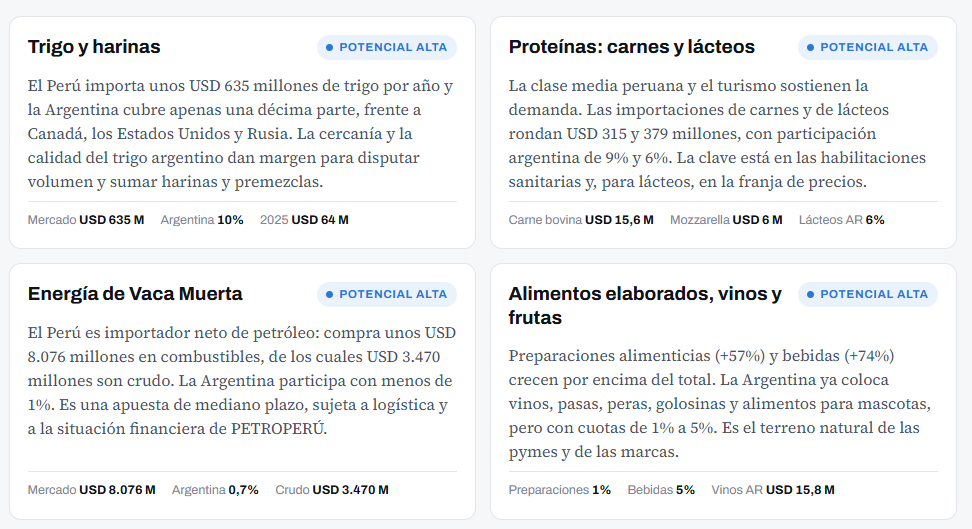
Source: Compiled by Pulso Internacional
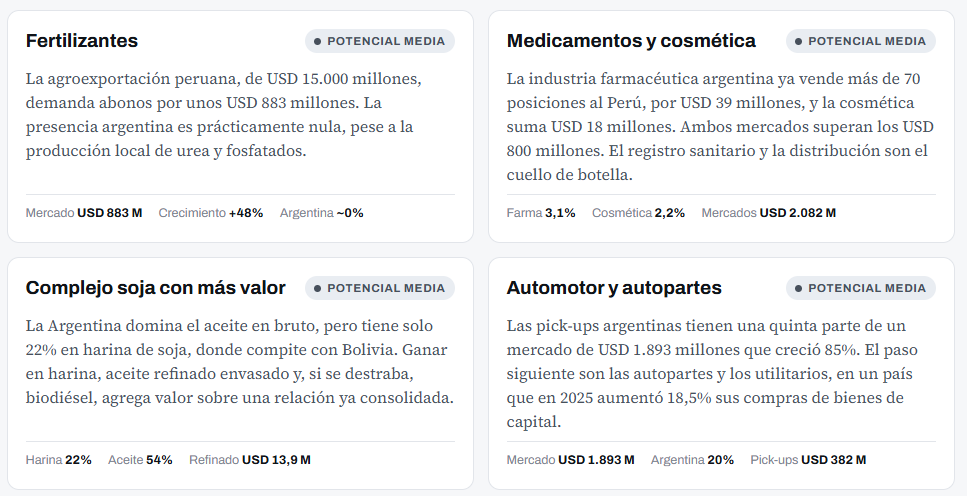
Source: Pulso Internacional
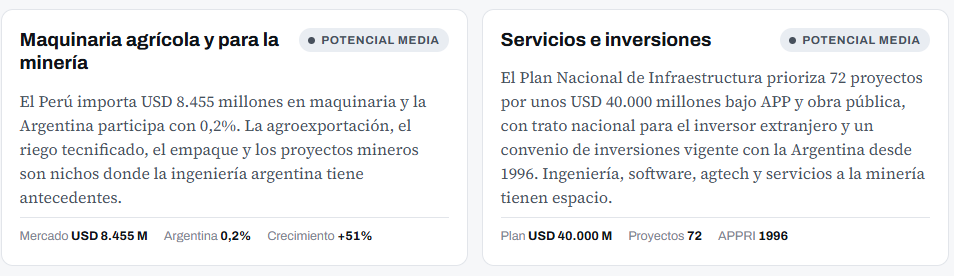
Source: Pulso Internacional
The agenda for winning market share
Tariff access is already settled: under ACE 58, 99.9% of tariff lines are duty-free for Argentina and the average preferential tariff is 0%. But that advantage is shared by the United States, Canada, Chile, the European Union, Mexico and the Andean partners, which also have agreements with Peru. The next stage is played out on a different field.
Modernize ACE 58
Take advantage of the negotiation that Peru itself reports in order to add chapters on services, investment, digital trade and public procurement, where Peru already admits foreign suppliers on equal terms.
Digital certificate of origin
Connect Argentine issuance with Peru's VUCE, as Mexico, Chile and Colombia already do. It reduces times and costs for every shipment.
Unblock biodiesel
Peru has maintained antidumping and countervailing duties on Argentine biodiesel for more than ten years, and they are now in dispute before the WTO (DS614). Eliminating them would reopen a natural market for the soy complex.
Sanitary agenda
Speed up, with Peru's SENASA, the approvals of plants and products in meat, dairy, fruit and seeds, where demand is growing and Argentina's share is low.
Price band
Closely monitor the Peruvian Price Band System, which covers corn and dairy products. During the period it worked mainly as a reduction for corn, but its cap rose from 15% to 40%.
Targeted promotion
Missions and business rounds in Lima, presence at food fairs, alliances with importers and distribution chains, and an offering of gastronomy and wines that speaks to Peruvian cuisine.
Pacific logistics
Explore routes and services through Callao and Chancay, ranked 4th and 5th among the most competitive container ports on South America's west coast according to the World Bank, and the air connectivity of the new Jorge Chávez airport.
Reciprocity and investment
Buying more from Peru and attracting Peruvian investment strengthens the negotiating position. On the Argentine side, the PPPs of the National Infrastructure Plan and SEZs such as Chancay open up room for engineering and services companies.
The message of the WTO review is clear: Peru will remain an open, growing market with predictable rules, which in the coming years will add mining, infrastructure and agricultural exports. Argentina has already shown that it can gain positions there. The challenge now is for 5th place not to depend only on corn, oil and pick-up trucks.
Director of Pulso Internacional
Lawyer specializing in international trade and productive investment, with more than 25 years of experience in international trade negotiations as an adviser to governments and to companies going international. At Pulso Internacional we analyze foreign trade, bringing clarity and international context so that your company can export and invest more.
Related analysis
Indonesia Signs Trade Agreement with the EU and Competes with Mercosur in That Market in 2027
November 22, 2026 · 4 min
Catamarca Bets on Lithium Mining and Transparency in Mining Royalties
November 21, 2026 · 4 min