The EU's New Technical Regulation on Deforestation and Its Impact on Argentine Exports
Translated from the Spanish original. Read the original
By Gabriel Martínez
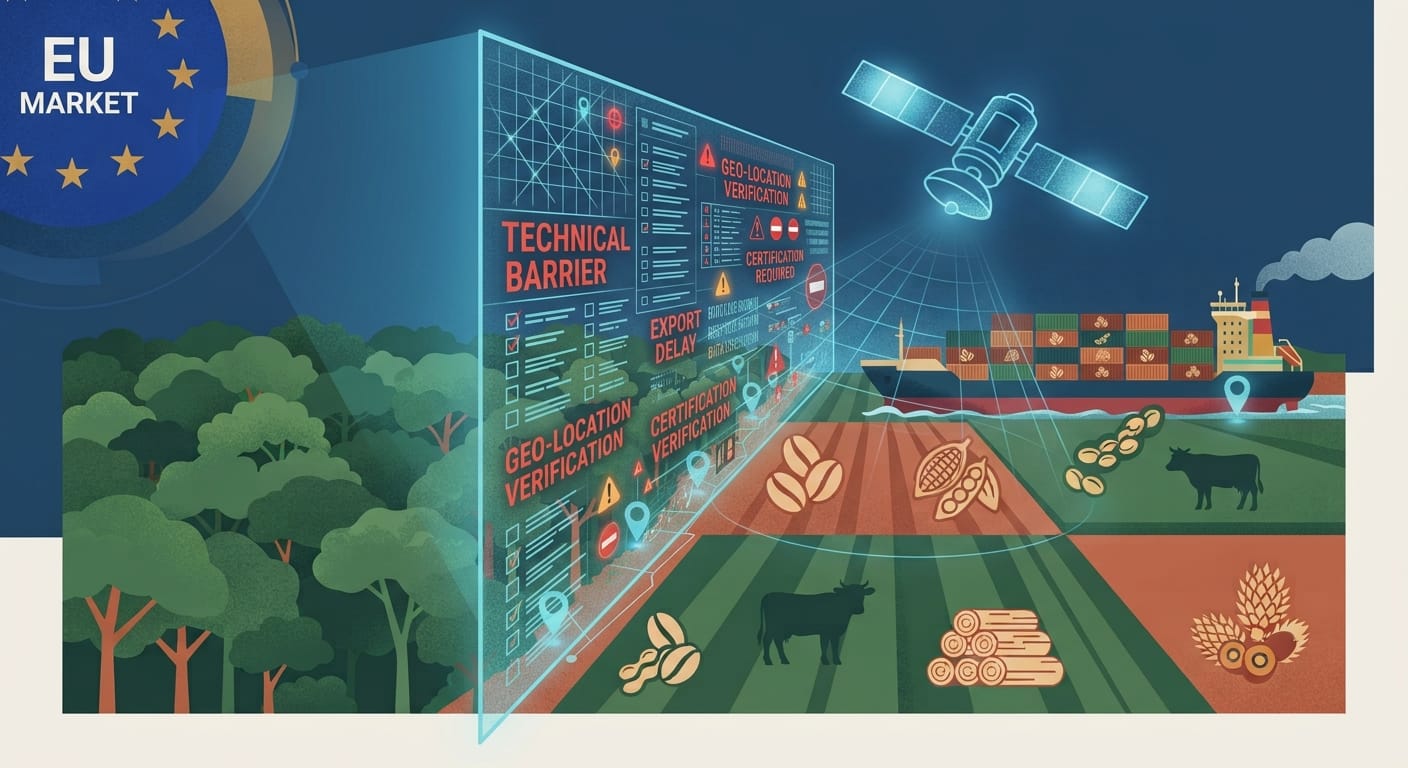
The European Union (EU) is the world's largest importer of agrifood products, with extra-EU purchases that exceeded USD 200,000 million in 2025. This dominant position has allowed it to deploy a vast arsenal of environmental measures that it applies both to its domestic production and to that of its external suppliers. Although these requirements are justified under the supposed principle of "non-discrimination," in practice they create a competitive asymmetry: while European farmers have subsidies from the Common Agricultural Policy (CAP) to implement them, most exporting countries lack that financial backing. As a result, these regulations end up operating as protectionist non-tariff barriers.
From equivalence to the precautionary principle: the European paradigm shift
Historically, compliance with European standards was resolved through the principle of equivalence (as defined by the WTO). Today, however, the EU demands strict compliance with the parameters of its own legislation (“compliance”). These rules tend to exceed international standards and rest more on a precautionary approach than on scientific evidence, which has opened a heated debate over the extraterritoriality of European regulation. In fact, both panels and the Dispute Settlement Body of the World Trade Organization (WTO) have ruled against the bloc on several occasions under the Agreement on Technical Barriers to Trade (TBT).
Regulation (EU) 2023/1115 (EUDR) and its scope
On May 31, 2023, the European Parliament and the Council of the European Union adopted Regulation (EU) 2023/1115 (known as the EUDR), on the placing on the market and export of commodities and products associated with deforestation and forest degradation. This rule introduces a new certification scheme that requires the European importer to provide georeferenced traceability to ensure that the goods covered by the regulation come from land free of deforestation after December 31, 2020. After several postponements and revisions, the regulation will enter into application on December 30, 2026 for large and medium-sized companies and on June 30, 2027 for EU micro and small enterprises. For foreign companies, regardless of their size, the EUDR will enter into application on December 30, 2026.
Unlike other environmental requirements whose enforcement falls to official bodies at the points of entry into the EU, the EUDR establishes a system of legal responsibility known as "due diligence" that falls exclusively on European importers. They will have to require their foreign suppliers to provide private certifications attesting not only to compliance with the European regulation's deforestation-free parameters, but also to respect for the legislation of the country of origin (such as national rules on forest management and land use).
Although the current universe of products covered by the EUDR (which must carry a private certification showing that they were not produced in areas deforested after 12/31/2020) spans seven global commodities and their derivatives—subject to a review scheduled for June 30, 2030—the Argentine exports affected are concentrated in three main chains:
- Soy and derivatives: beans, oil, cakes and, above all, soybean meal (Argentina's main export product to the bloc).
- Cattle and derivatives: fresh, chilled or frozen beef, offal, and preparations and products processed from bovine meat.
- Wood and forest products: logs, sawn wood, boards, furniture, wood pulp, paper and printed matter.
(Note: The four remaining commodities—cocoa, coffee, oil palm and rubber—carry marginal weight in Argentina's direct export offer, being limited mostly to manufactured goods made with imported inputs).
Operational requirements for the export chain
For a European importer to bring Argentine goods into the bloc and market them, exporters must guarantee three fundamental pillars:
- Exact geolocation: Provide the geographic coordinates (polygons or points, depending on the size of the plot) of all the farms or forestry operations where the raw material originated.
- Environmental cut-off date: Verify, through satellite imagery, that those plots did not undergo forest clearing after December 31, 2020.
- Legality at origin and Due Diligence Statement (DDS): Demonstrate that production complied with Argentina's environmental, labor and land-use planning laws (such as the Native Forests Law). Before each shipment, the importer must enter this information in a DDS on the European Commission's portal.
Added to this is the impact of the risk classification: the European Commission placed Argentina in the "standard risk" category (like Brazil and Paraguay). This entails the possibility of customs checks on 3% of shipments, unlike shipments from countries rated "low risk" (such as Uruguay), which are subject to 1% of checks. Likewise, as regards physical segregation, storage facilities, meatpacking plants and processing industries are prohibited from mixing traced production with goods of unknown origin or originating after a clearing if the final destination is Europe.
The local response: from regulatory challenge to competitive advantage
To avoid losing markets, Argentina's soybean and meat agribusiness sectors developed VISEC, a private, non-profit platform that cross-references public databases (such as SENASA's RENSPA) with satellite maps to issue verifiable traceability statements. It is important to note that VISEC is not a certifying body and does not issue certificates itself. It is a digital traceability and data management platform that prepares and validates the information exporters need in order to give importers the data they require to comply with Regulation (EU) 2023/1115 (EUDR). The companies that will issue the deforestation-free certificates, based on the information provided by VISEC, will be duly approved and announced by the platform.
Other traceability platforms that compete with VISEC and have been approved by the Secretariat of Agriculture in the Directory of Registered Schemes to comply with the EUDR are:
• TRACESTORY: A private platform for soybeans, beef, leather and the forestry industry.
• Santa Fe Produce Sustentable: A tool promoted by the government of Santa Fe, focused on beef.
• Bosques Verificados: A scheme aimed specifically at the forestry industry.
Thanks to the early development of tools such as VISEC, which had the backing of European cooperation programs such as AL-INVEST Verde and became a benchmark case in the region, Argentina has a traceability infrastructure ready to be audited. Paradoxically, this head start could allow it to gain market share in Europe against more lagging regional competitors, turning a demanding regulatory obstacle into a relative commercial opportunity.
A key advance has been the European Commission's establishment of two Repositories: one on legislation and one on the traceability schemes of producing countries. The first makes the robust national legislation visible to the importer, and the second facilitates the recognition of national schemes, instead of resorting to European traceability companies. This achievement reflects a convergence of the diplomatic and commercial pressure from producing countries (led by Mercosur and the large tropical exporters), the demands of European importers themselves, and the technical design of multilateral bodies such as the International Trade Centre (ITC).
Related analysis

Argentina Climbs to Fifth Place Among Peru's Suppliers, Overtaking Mexico
November 22, 2026 · 11 min
Indonesia Signs Trade Agreement with the EU and Competes with Mercosur in That Market in 2027
November 22, 2026 · 4 min