Argentina and Innovation at the G20
Translated from the Spanish original. Read the original

Director of Pulso Internacional
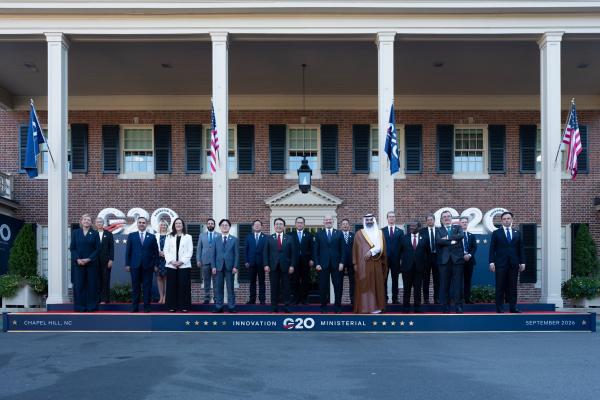
In the second week of September 2026, the city of Durham, North Carolina, hosted the G20 Innovation Ministerial Meeting of the G20 under the presidency of the United States. The meeting convened by the US Department of Commerce brought together ministers and representatives of the twenty largest economies on the planet to shape a common agenda around artificial intelligence, global value chains and industrial innovation systems. Argentina took an active part in these meetings through the presence of the Secretary of Innovation, Science and Technology, Adriana Baravalle. The lines of work that emerged from the ministerial meeting have direct implications for the country's industrial policy and international integration in the coming years.
The context: why the G20 on innovation matters now
The choice of Raleigh-Durham was no accident. Research Triangle Park, the innovation ecosystem surrounding the city, which brings together institutions such as Duke University, the University of North Carolina and North Carolina State University, represents one of the most successful models of public-private collaboration in the English-speaking world. The area is home to more than 7,000 companies in biotechnology, pharmaceuticals, technology and related sectors.
Holding the ministerial in that setting was, in itself, a statement of intent about the kind of innovation policy that Washington seeks to promote within the forum: systemic, rooted in the territory and production-oriented.
The strategic competition between the United States and China has shifted its focus from tariffs to control of technology and artificial intelligence. In that context, the G20 on innovation is a space in which both countries participate and where the major economies seek to set standards, allocate responsibilities and, ultimately, define who will be part of the global value chains of the next industrial stage.
The ministerial's central lines of work
According to the official coverage by the US Department of Commerce, the ministerial structured its agenda around three main pillars: the governance of artificial intelligence for economic development, the strengthening of value chains in strategic sectors and cooperation on national innovation systems. Each of these pillars has its own technical logic, but all three converge on a central political question: how to distribute the benefits of technological transformation among economies with asymmetric capabilities.
The document that drew the most attention was the AI Prosperity Compact, a framework of commitments aimed at ensuring that the development of artificial intelligence generates broadly distributed economic benefits and is not concentrated exclusively in the large providers of digital infrastructure. The compact sets out principles of interoperability, access to training data and accountability mechanisms for high-impact AI systems. In addition, the G20 AI Prosperity Objectives set concrete targets for AI adoption among SMEs, the training of specialized human capital and regulatory frameworks that are compatible across jurisdictions.
Source: US Department of Commerce, G20 Innovation Ministerial, September 2026.
The value chain agenda was perhaps the most concrete in terms of industrial policy. The participating countries identified priority sectors —semiconductors, clean energy technologies and critical minerals— as the nodes where multilateral cooperation is indispensable to reduce systemic vulnerabilities. This point is especially relevant for Argentina: the country holds the world's second-largest lithium reserves and growing capabilities in the green hydrogen value chain, which positions it as a potentially strategic player in at least two of those three sectors.
Argentina's position: an active presence at a defining moment
The Argentine government reported that the national delegation strengthened its innovation, science and technology agenda during the first day of the ministerial, with bilateral meetings and participation in the thematic working groups. Argentina's stance was built around three vectors: adding value to natural resources through technology, developing capabilities in applied artificial intelligence for productive sectors, and integrating the country's universities and research centers into international cooperation networks.
This positioning is consistent with the strategy the country has been consolidating since 2025 in terms of international integration: leveraging the nearshoring and friend-shoring cycle to move up global value chains, not as a supplier of unprocessed commodities, but as a processing node with differentiated technical capability. Participation in the G20 innovation track is, in this sense, one piece of a broader diplomatic and productive architecture.
Far from being a bureaucratic detail, Argentina's presence in the working groups on the AI Prosperity Objectives means adhering to an emerging regulatory framework that will define interoperability standards and conditions of access to global technology platforms. The gap between regulatory ambition and concrete implementation will depend, to a large extent, on the country's ability to translate those commitments into domestic public policy coordinated among the Ministry of Economy, the Secretariat of Innovation and agencies such as INTI and CONICET.
Background: Argentina's track record in the G20 innovation agenda
Argentina's participation in the G20's innovation forums has significant precedents. During Argentina's presidency of the forum in 2018, the country promoted the future of work and digital transformation agenda, succeeding in incorporating the debate on the impact of automation on emerging economies. That experience laid institutional foundations —working groups, position papers, contact networks— that Argentine diplomacy has capitalized on in successive presidencies.
In the 2025-2026 cycle, with the South African presidency followed by the US presidency, Argentina had to navigate a more complex landscape: the tension between the agendas of the G7 countries and the priorities of the Global South regarding technology transfer and access to financing for innovation. The AI Prosperity Compact seeks to bridge those positions, although its effectiveness will depend on the implementation mechanisms agreed in the months following the ministerial. It is important to closely follow the evolution
Own elaboration based on official documents from the G20 and the Argentine Ministry of Foreign Affairs.
Implications for the productive agenda
For the Argentine private sector, the conclusions of the Durham ministerial open both an opportunity and a demand. The adoption of the G20 AI Prosperity Objectives means that national regulatory frameworks will have to converge toward interoperability standards that, in practice, will affect technology companies, fintech, precision agribusiness and advanced manufacturing. Firms that anticipate this regulatory convergence will have a competitive advantage in export markets; those that ignore it will face growing non-tariff barriers. On the side of critical minerals and industrial value chains, the ministerial consolidated the political signal that G20 partners prefer to deepen productive linkages with allied economies rather than depend on single suppliers. This de-risking logic is, for Argentina, a concrete window of opportunity: the country has the geological, technical and institutional conditions to position itself as a strategic supplier of lithium, copper and eventually green hydrogen.
Sources
- US Department of Commerce — G20 Innovation Ministerial
- US Department of Commerce — Week of the G20 Innovation Ministerial
- US Department of Commerce — The AI Prosperity Compact (September 2026)
- US Department of Commerce — The G20 AI Prosperity Objectives (September 2026)
- Argentina.gob.ar — Day 1: Argentina strengthens its innovation, science and technology agenda at the G20
Director of Pulso Internacional
Lawyer specializing in international trade and productive investment, with more than 25 years of experience in international trade negotiations as an adviser to governments and to companies going international. At Pulso Internacional we analyze foreign trade, bringing clarity and international context so that your company can export and invest more.
Related analysis
European Assessment of the EU-Mercosur Agreement: In 4 Months, European Exports Grow 9%
November 5, 2026 · 2 min
Why Has the US Increased Its Investment in Germany?
November 3, 2026 · 5 min