Why Has the US Increased Its Investment in Germany?
Translated from the Spanish original. Read the original

Director of Pulso Internacional
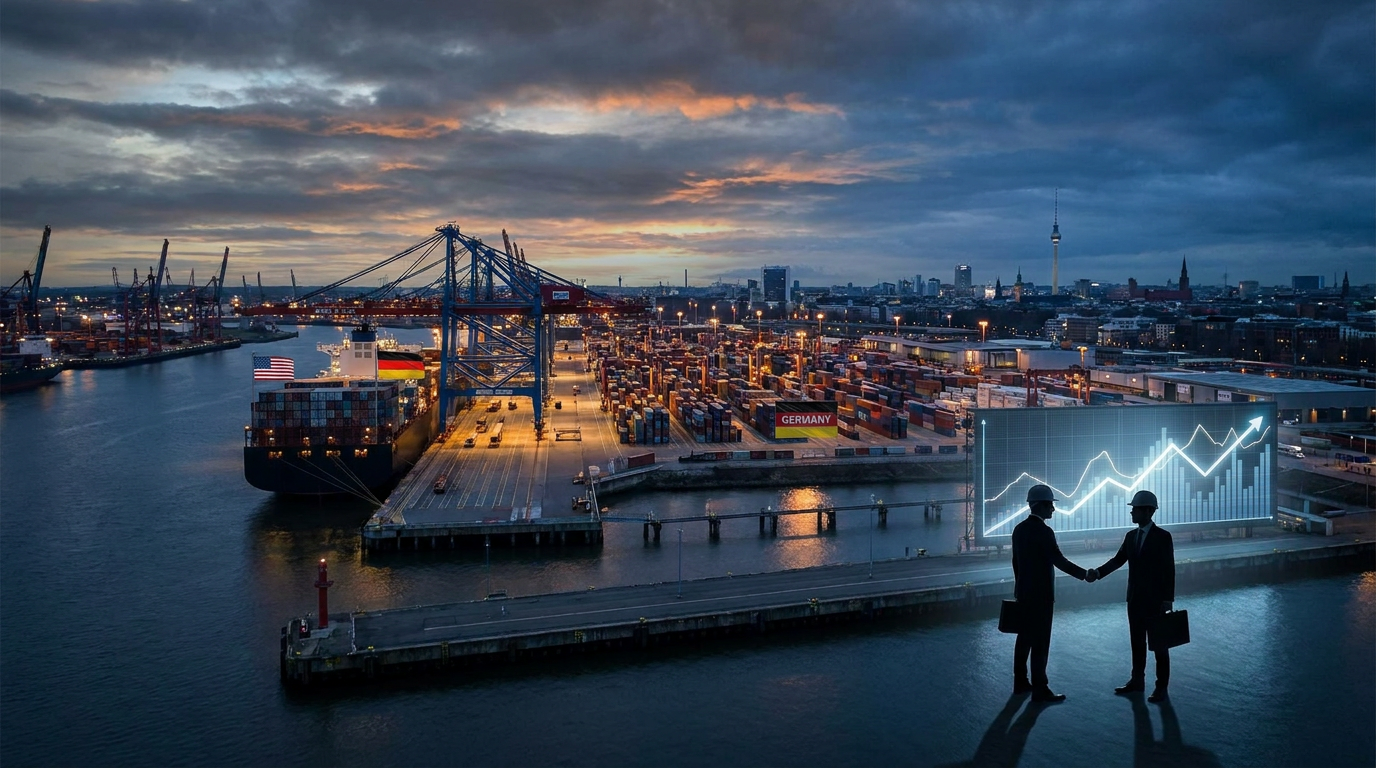
Foreign direct investment (FDI) from the United States in Germany is undergoing a profound change. What until the middle of the last decade was a flow dominated by the automotive sector, industrial chemicals and consumer goods is today being redirected toward three strategic sectors: semiconductors, artificial intelligence and defense.
As reported by the magazine Der Spiegel, an analysis by the financial data provider Pitchbook for the business daily Handelsblatt found that in 2025 a total of 76 acquisitions and investments were recorded in German industrial and manufacturing companies with US participation, the highest figure since the analysis began in 2022. According to the data, total transactions in 2025 amounted to approximately 29,500 million dollars. This is almost double the 2022 figure. As of August 19 this year, an additional 23,900 million dollars had already been added. The most prominent recent case is the acquisition of the fan manufacturer EBM-Papst by the US company Madison Air for 5,400 million dollars. The US company Apple has expanded its largest European innovation center in Munich, the capital of the state of Bavaria, while North Rhine-Westphalia has received new investments from Microsoft in recent years.
In addition, as the owners of German SMEs grow older, they are not finding generational succession. By 2029, 500,000 SMEs are expected to change owners. FDI doubled in 2025. One in 5 foreign companies in Germany is US-owned.
The sectoral shift: from traditional manufacturing to security assets
In 2024, total US FDI in Germany amounted to 226,800 million dollars. The main sectors of US FDI include:
Source: 2026 Investment Climate Statements: Germany - US Department of State
In 2025 and 2026, US FDI flows into Germany in semiconductors, quantum computing and artificial intelligence accelerated, as documented by DW's analysis of the reorientation of transatlantic capital, which places this process in the broader context of de-risking away from suppliers considered geopolitically unreliable. Companies such as Intel, which committed investments in semiconductor plants in Magdeburg, together with a constellation of software, cybersecurity and command-and-control defense systems firms, have made Germany the leading European recipient of strategic US FDI. The defense sector deserves particular mention. The Bundestag's decision in March 2025 to create a special fund to modernize the German Armed Forces, in addition to the existing Sondervermögen, a clean technologies program approved in 2022, generated extraordinary demand for technological capabilities that local industry cannot fully meet. US companies specializing in missile systems, artificial intelligence applied to defense and offensive cybersecurity have entered the German market through stakes in local consortia, partial acquisitions and technology transfer contracts overseen by the foreign investment screening mechanism of the Federal Ministry for Economic Affairs.
Among the main recent investment announcements by US companies are:
- Lilly will invest US$2.5 billion in a manufacturing plant in 2024 and US$1.12 billion in a Dresden-based startup in 2026, and Procter & Gamble announced it will establish its second-largest research center in Germany.
- Amazon and Amazon Web Services will jointly invest US$20.1 billion in cloud infrastructure, their logistics network and a European sovereign cloud for 2025 and 2026.
- Microsoft announced in 2024 an investment of US$3.4 billion in AI infrastructure and cloud capabilities across Germany.
- The US$2.3 billion investment that Apple announced in 2021 in a chip design center in Munich.
- In 2025, Deutsche Telekom, SAP and Nvidia announced that they would jointly establish an AI cloud in Munich. The project is expected to involve an investment of more than US$1 billion.
- Announced for 2025, Nvidia and Hewlett Packard Enterprise (HPE) have partnered to build "Blue Lion", a major new supercomputer in Germany, at the Leibniz Supercomputing Centre.
The closing space: implications for value chains and Argentina
A window for critical minerals: The concrete opportunity lies in the demand for critical minerals for the semiconductor and battery industries. Argentina holds strategic reserves of lithium, copper and rare earths, which both the US and Germany are actively seeking to diversify away from Chinese control. The RIGI, approved in 2024, and the strategic mining partnership agreements explored with US companies during 2025 form a genuine vector for integration, although one that remains underused from the standpoint of active trade policy.
Why is US investment in Germany increasing? What investment opportunities do Argentine companies have?
The redirection of US investment toward strategic assets in Germany responds to its economic security policy, which is being institutionalized with unusual speed and depth. For Argentina, this means that the possibility of integrating into the most dynamic global value chains does not open up through inertia or competitive prices, but through deliberate policy decisions that leverage the exportable supply, in particular Argentina's critical minerals, in which Germany and the US have been showing particular interest. The ties and direct investment with German companies that may arise within the framework of the full approval of the Mercosur-European Union Agreement should be seized above all by Argentina's mining provinces, which will have funds available to make investments, and by those companies interested in intermediate technologies held by German companies that cannot find major investors.
Those seeking a counterpart in Germany should not hesitate to write to us.
Director of Pulso Internacional
Lawyer specializing in international trade and productive investment, with more than 25 years of experience in international trade negotiations as an adviser to governments and to companies going international. At Pulso Internacional we analyze foreign trade, bringing clarity and international context so that your company can export and invest more.
Related analysis
European Assessment of the EU-Mercosur Agreement: In 4 Months, European Exports Grow 9%
November 5, 2026 · 2 min
Uruguay: Six Months into the Mercosur-EU Agreement (ITA) - A Positive Export Balance
November 2, 2026 · 2 min