Nanotechnology for Argentine Industry: Applications and Technology Transfer
Translated from the Spanish original. Read the original

Director of Pulso Internacional

Nanotechnology enters the company through three doors
Most Argentine companies that take advantage of nanotechnology will not become "nano companies": they will incorporate it into a material, a component or a process. That is why it is worth starting with a practical definition. The ISO TC229 standard defines nanotechnology as the understanding and control of matter and processes at the nanoscale, typically below 100 nanometers in one or more dimensions. At that size, properties appear that the same material does not have at a larger scale: greater strength, conductivity, reactivity or barrier capacity. The OECD Working Party on Nanotechnology distinguishes three ways in which this technology reaches the market:
- Nanotechnology product. Nanotechnology is the core function: without it the product would not exist. For example, the cathode material of a new-generation lithium battery.
- Nanotechnology-enabled product. Its key performance depends on nanoscale phenomena, even if the nanomaterials are a minimal part of the whole. For example, the electric car that uses that battery.
- Product that uses nanotechnology in its process. The final product does not contain nanomaterials, but it is manufactured better. The OECD's example is a jam factory: a diamond-like carbon coating on the dosing pistons reduces wear, maintenance stoppages and energy consumption.
The third door is the most accessible for an SME and also the least visible.
Where the applications are today, segment by segment
The most mature applications are in chemicals and pharmaceuticals, electronics and instruments, and process engineering. For Argentina, the nearest opportunities appear where those uses intersect with sectors in which the country already has scale: agribusiness, food, metalworking, lithium and pharmaceuticals.
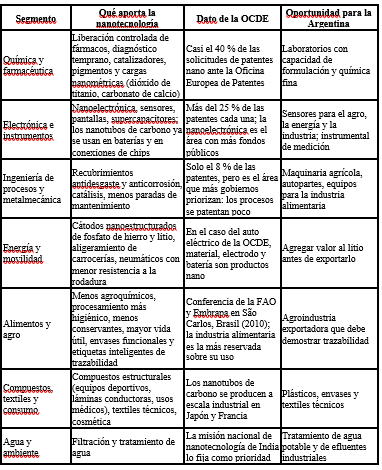
Source: OECD. Prepared by the author
The value chain matters as much as the sector. Whoever supplies the material captures one part of the value; whoever integrates it into a component or uses it in their process captures another. An Argentine company does not need to manufacture nanomaterials to benefit: it can buy them, license their application or contract the coating of its equipment.
Tools for obtaining the technology
The Argentine company seeking nanotechnology has three types of tools at hand: national promotion instruments, centers where the technology already exists and international networks that connect supply and demand.
The OECD's experience shows what works. In the 2008 inventory, covering 24 countries, programs for companies combined competence centers, clusters, incubators, technology parks, transfer networks and seed capital. Germany has funded, since 1998, competence centers that bring researchers and industrial users together, and its evaluations show that they accelerated innovation. The United Kingdom added knowledge transfer accounts at 12 universities and proof-of-concept funds that, since 2004, financed 159 projects for £15 million. Switzerland created Nano-Tera, a network of universities and technology transfer offices, and the United States funds small technology companies through the SBIR and STTR programs; the latter requires partnering with a research institution.
In Argentina, the main instruments are the following:
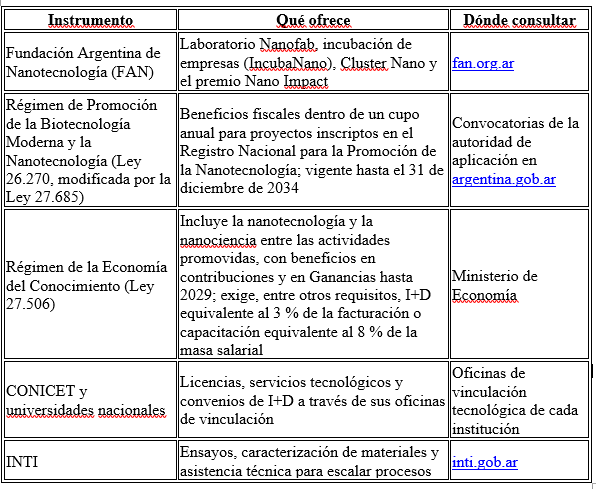
Source: OECD and prepared by the author
At the regional level, the OECD cites the Brazilian-Argentine Nanotechnology Center (CBAN) as a channel of cooperation with Brazil, which accounts for more than half of Latin American publications in nanotechnology. In Europe, the 16 technology platforms explicitly linked to nanotechnology and the large integrated projects are, according to the European Commission, the typical vehicle for transferring intellectual property from the public to the private sector.
Contract formats
Nanotechnology transfer is rarely carried out under a single contract: it usually begins with a confidentiality agreement and ends in a license accompanied by technical assistance. Because processes are rarely patented, a know-how license carries as much weight as a patent license. In Argentina, contracts with foreign suppliers can be registered with the INPI (National Institute of Industrial Property) under Law 22,426. Since February 10, 2026, a new regulation has been in force, INPI Resolution 38/2026: registration is voluntary and informative, and is based on the applicant's sworn statement. Registering remains relevant because of its tax effect. Article 104 of the Income Tax Law presumes a lower net profit on payments abroad when the contract complies with Law 22,426.
Step by step for an Argentine company
The order matters: first the industrial problem, then the technology and, at the end, the contract.
- Define the problem, not the technology. Which function needs improving (wear, barrier properties, conductivity, weight, service life) and how much is it worth to solve it.
- Conduct technology monitoring. Search for patents under class B82Y, the nanotechnology class, in Espacenet, PATENTSCOPE and the INPI database. Identify patent holders, the term of validity and whether the patent is in force in Argentina.
- Identify suppliers. National centers, industrial suppliers and international platforms. Multi-walled carbon nanotubes, for example, are already produced on an industrial scale in Japan (Nikkiso, Nano Carbon Technologies) and in France (Arkema).
- Sign a confidentiality agreement and evaluate. Request samples under an evaluation agreement and test them at the plant or in a laboratory such as INTI.
- Review safety and regulation. The OECD concluded that only 4 of its 22 physical-chemical test guidelines apply to nanomaterials without changes, and that characterizing the material is a prerequisite for any assessment. ISO has already published guidance on safe handling, safety data sheets and labeling. If you export to the European Union, you must consider the REACH regulation.
- Negotiate a term sheet. Scope, exclusivity, territory, field of use, royalties, milestones, improvements, training and warranties.
- Sign and register. Formalize the contract and file it with INPI on time to secure the tax treatment of payments abroad.
- Finance. Combine own resources with the nanotechnology promotion regime, the knowledge economy regime or an investment partner.
- Implement and scale. Train staff, use the agreed technical assistance and measure the result against the problem defined in step 1.
- Manage the relationship. Royalty reports, shared improvements, renewals and compliance with confidentiality.
The international market: where to buy and sell
An international market for nanotechnology does exist, but it is not a single exchange: it is made up of databases of offers and demands, transfer offices, intermediaries and trade fairs. At the 2010 FAO and Embrapa conference, a round table observed that innovation arises mainly in universities and small spin-off companies, which are later often acquired by larger firms, and that venture capital is already seeking partners in developing countries. Those same channels can be used to sell: an Argentine center or company can publish its offer.
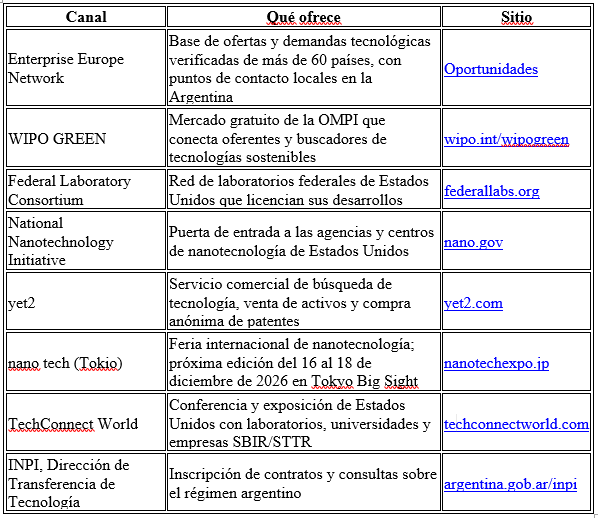
Source: OECD, own elaboration
Conclusion
For Argentina, nanotechnology is not a separate sector: it is a competitiveness tool for the sectors in which the country already competes. A company that defines its problem well, uses the national centers and negotiates sound contracts can gain access to frontier technology without manufacturing nanomaterials.
Sources
- OECD, Inventory of National Science, Technology and Innovation Policies for Nanotechnology 2008, DSTI/STP/NANO(2008)18/FINAL, 2009.
- OECD and Institute of Nanotechnology, Challenges for Governments in Evaluating Return on Investment from Nanotechnology and its broader Economic Impact, DSTI/STP/NANO(2012)12, 2012.
- OECD, Preliminary Review of OECD Test Guidelines for their Applicability to Manufactured Nanomaterials, ENV/JM/MONO(2009)21, 2009.
- OECD, Current Developments/Activities on the Safety of Manufactured Nanomaterials: Tour de Table at the 7th Meeting of the WPMN, ENV/JM/MONO(2010)42, 2010.
- OECD, Draft Dossier Development Plan: Multi-Walled Carbon Nanotubes, ENV/CHEM/NANO(2009)4/ADD3, 2009.
- INPI, Resolution 38/2026, regulation on the registration of technology transfer contracts.
- Government of Argentina, call for applications under the Promotion Regime for Modern Biotechnology and Nanotechnology.
- fan.org.ar/mapa-nano/
Director of Pulso Internacional
Lawyer specializing in international trade and productive investment, with more than 25 years of experience in international trade negotiations as an adviser to governments and to companies going international. At Pulso Internacional we analyze foreign trade, bringing clarity and international context so that your company can export and invest more.
Related analysis

Argentina Climbs to Fifth Place Among Peru's Suppliers, Overtaking Mexico
November 22, 2026 · 11 min
Indonesia Signs Trade Agreement with the EU and Competes with Mercosur in That Market in 2027
November 22, 2026 · 4 min