A Sweet Start for Exports under the Mercosur-EU Agreement
Translated from the Spanish original. Read the original

Director of Pulso Internacional
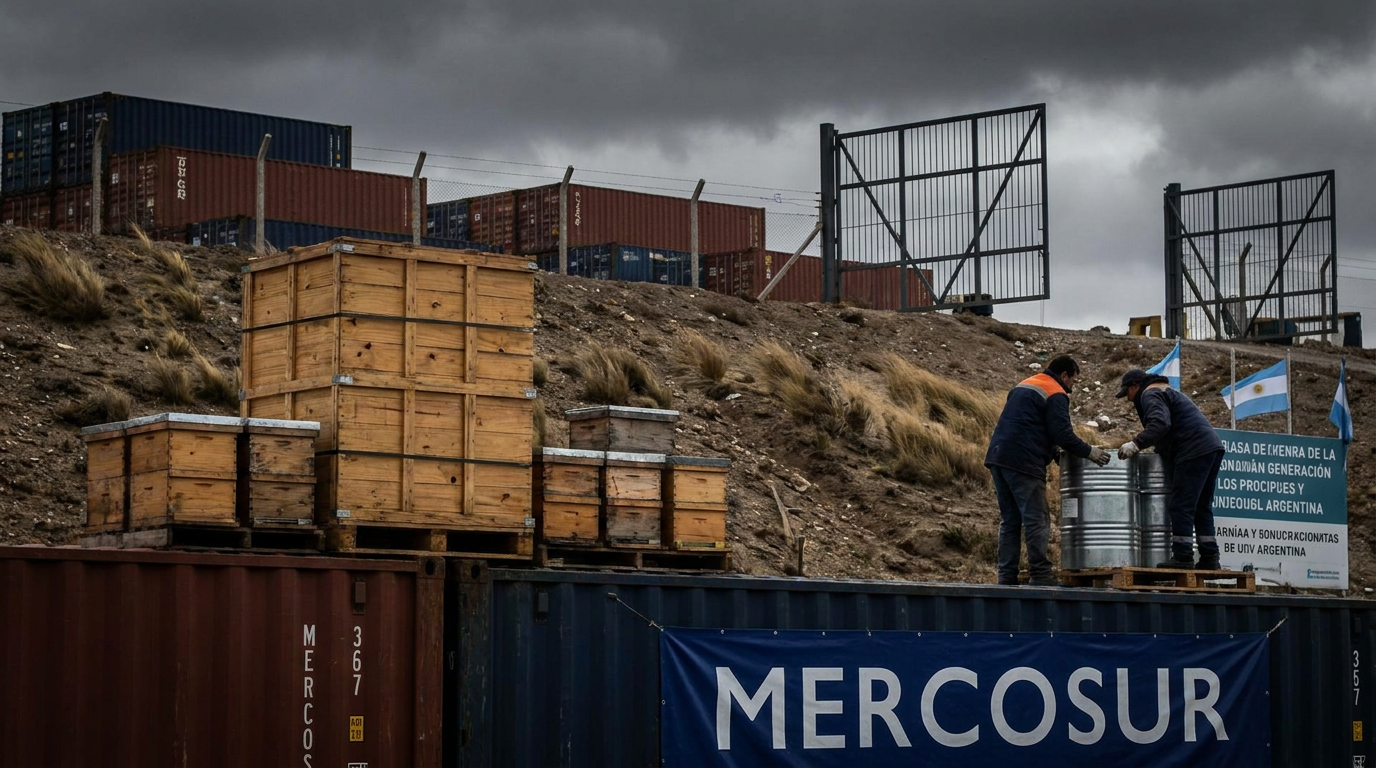
On May 3, 2026, Argentina certified the first commercial shipment under the Mercosur-European Union Interim Agreement, setting a historic precedent for regional trade. A cargo of 22,138 kilos of natural honey, produced by the family company Apícola Danangie ( D'Ambros María de los Ángeles - D'Ambros María Daniela S.R.L. ), engaged in beekeeping and forestry and operating some 14,000 hives in Concordia, Entre Ríos province, departed for Germany, taking advantage for the first time of the tariff reductions that cut the tariff on Argentine beekeeping products from 17.3% to zero. The importer is Langnese Honig GmbH & Co., one of the leading honey processors in the German market.
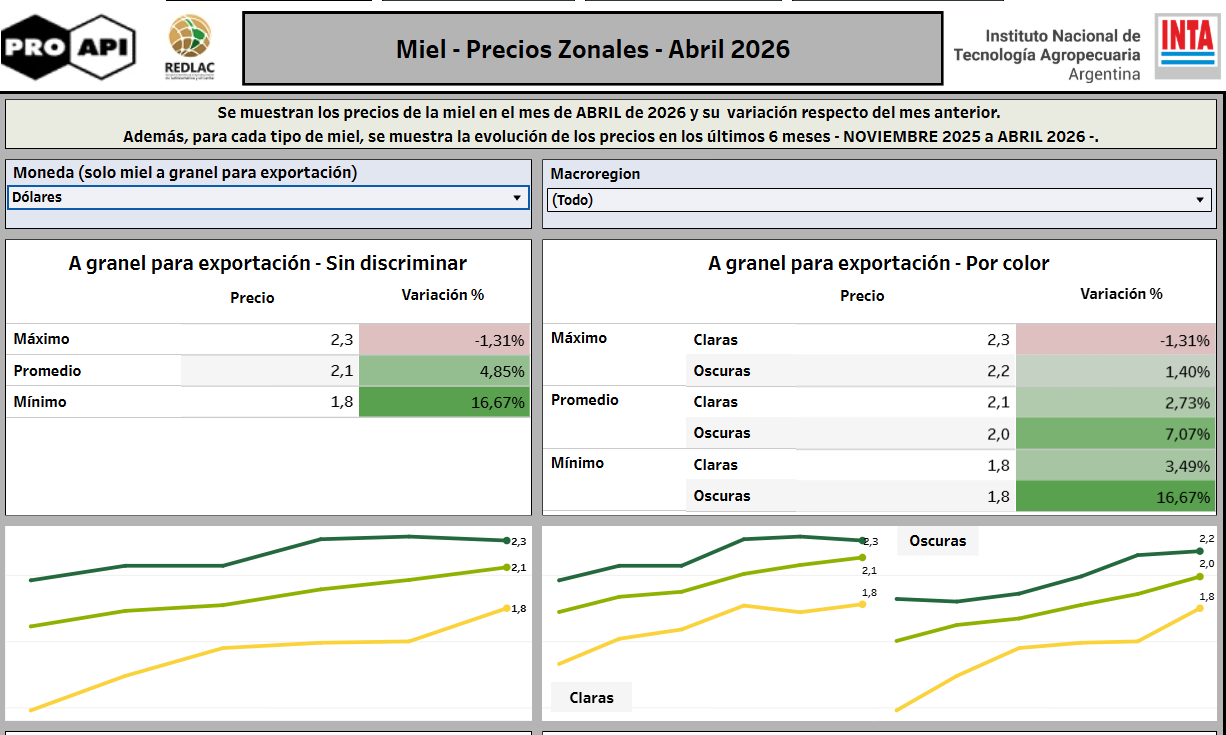
The export price per tonne can reach USD 2,300
The choice of honey as the pioneering product is strategically significant, considering that Argentina maintains a production capacity of more than 75,000 tonnes per year and has a well-established processing infrastructure.
Regulatory framework and scope of the tariff reductions
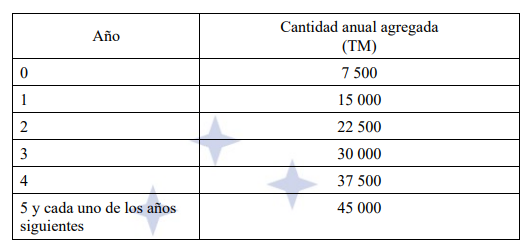
The Mercosur-EU Interim Trade Agreement, in force since May 1, 2026, establishes specific preferential conditions for beekeeping products. The European Union allocated an annual quota for honey (tariff code CN 0409 00 00), rising to 45,000 tariff-free tonnes for Mercosur as a whole within five years. This volume is less than 10% of honey consumption within the European Union.
Honey would thus stand as follows:
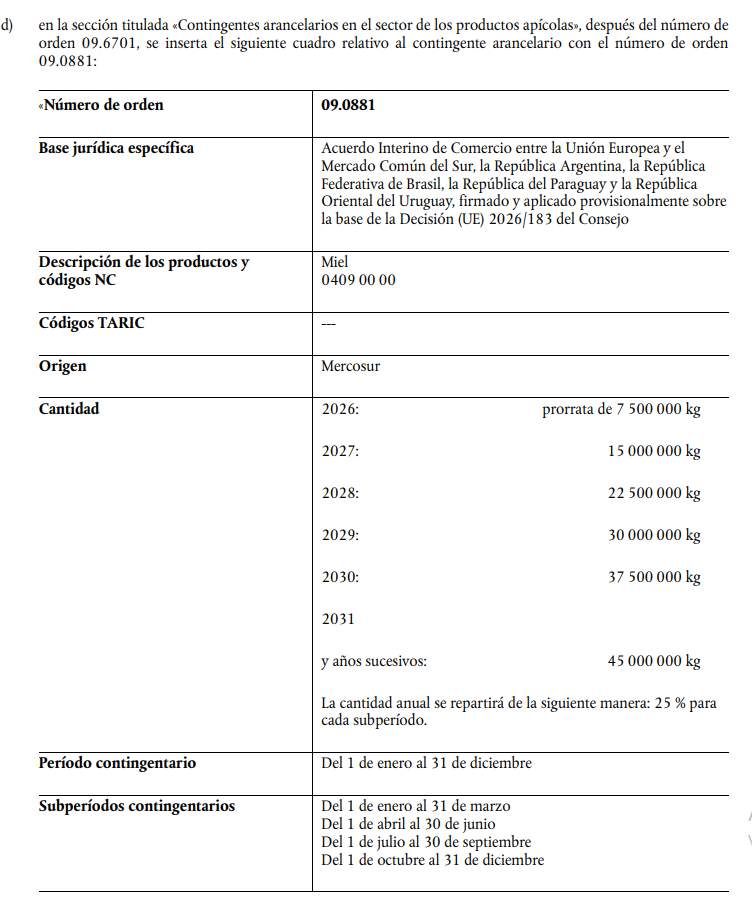
One day before the Mercosur-EU Interim Trade Agreement entered into force, the European Commission published Regulation 2026/996, the internal EU rule implementing the tariffs established in the Agreement. It reiterates the progressive tariff reduction for honey contained in the Interim Agreement but adds "quota sub-periods", whereby each annual quantity set in the quotas will be divided 25% across 4 three-month sub-periods, which may eventually work against obtaining good prices when demand is higher and lead to underuse of the annual quota.
The EU granted 21 quotas for various Mercosur agro-industrial products, which, in addition to honey, notably include:
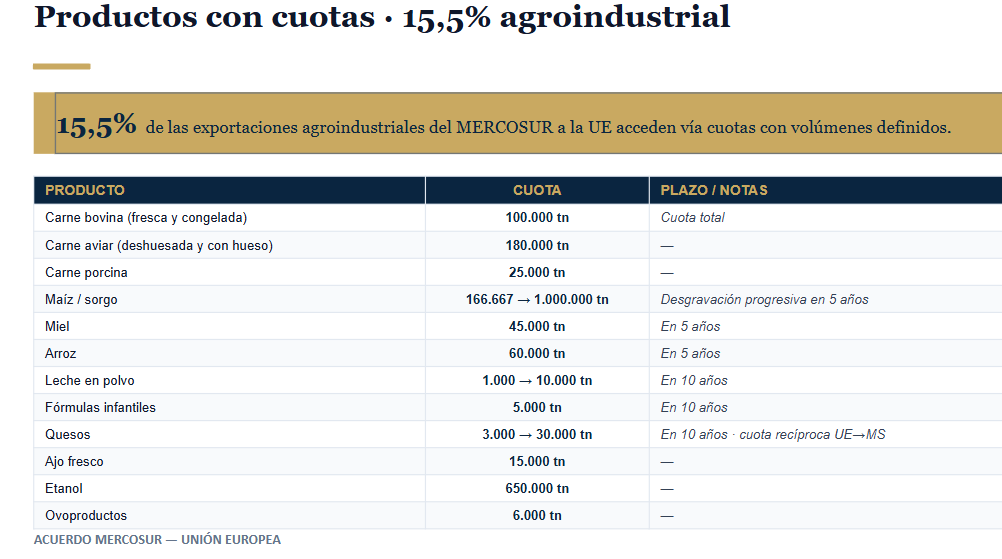
Mercosur, for its part, granted the EU 11 tariff-rate quotas, four of which will be permanent (cheeses, garlic, infant formula and powdered milk), while the other seven (chocolates and canned tomatoes) will become free trade after 10 or 14 years, as the case may be, of the Agreement's application.
Production capacity and the competitiveness of Argentina's beekeeping sector
Argentina has a solid production base that allows it to take advantage of these trade opportunities. The country has 1,200 extraction facilities approved by SENASA, and four million hives located mainly in the Pampas and Mesopotamia regions, where agro-ecological conditions favor commercial beekeeping and whose potential has no ceiling.
Strategic opportunities for producers and SMEs
The elimination of the 17.3% tariff creates an immediate competitive advantage for Argentine products over third countries that still bear that tariff burden. This differentiation is particularly relevant in a market such as Europe's, where price competition operates alongside growing requirements for quality, traceability and sustainability.
Distribution of the Mercosur Quota by Country (Projection)
The estimate, based on production capacity, of the potential use of the 45,000 tariff-free tonnes per year is: Argentina 60%, Brazil 25%, Uruguay 10%, Paraguay 5%.
Export price of honey in Argentina
Prospects for consolidation and operational challenges
The strategic challenge is to turn this first successful operation into sustained trade flows that take advantage of the tariff quotas and consolidate Argentina's presence in high value-added European markets.
Sources
- Argentina.gob.ar — First honey shipment to the European Union under the new strategic agreement certified
- Infobae — Argentine honey now reaches the European Union at a 0 tariff amid an export boom
- La Voz de Galicia — Argentine honey debuts the EU-Mercosur agreement
- Clarín — SME from Entre Ríos made the first honey export at a 0 tariff to the European Union
- Mercosur-EU Interim Trade Agreement cancilleria.gob.ar
Director of Pulso Internacional
Lawyer specializing in international trade and productive investment, with more than 25 years of experience in international trade negotiations as an adviser to governments and to companies going international. At Pulso Internacional we analyze foreign trade, bringing clarity and international context so that your company can export and invest more.
Related analysis
European Assessment of the EU-Mercosur Agreement: In 4 Months, European Exports Grow 9%
November 5, 2026 · 2 min
Why Has the US Increased Its Investment in Germany?
November 3, 2026 · 5 min