Argentina Brings 14 Beef Packers to Shanghai's CIIE as China Takes 61% of Its Beef Exports
Translated from the Spanish original. Read the original

Director of Pulso Internacional
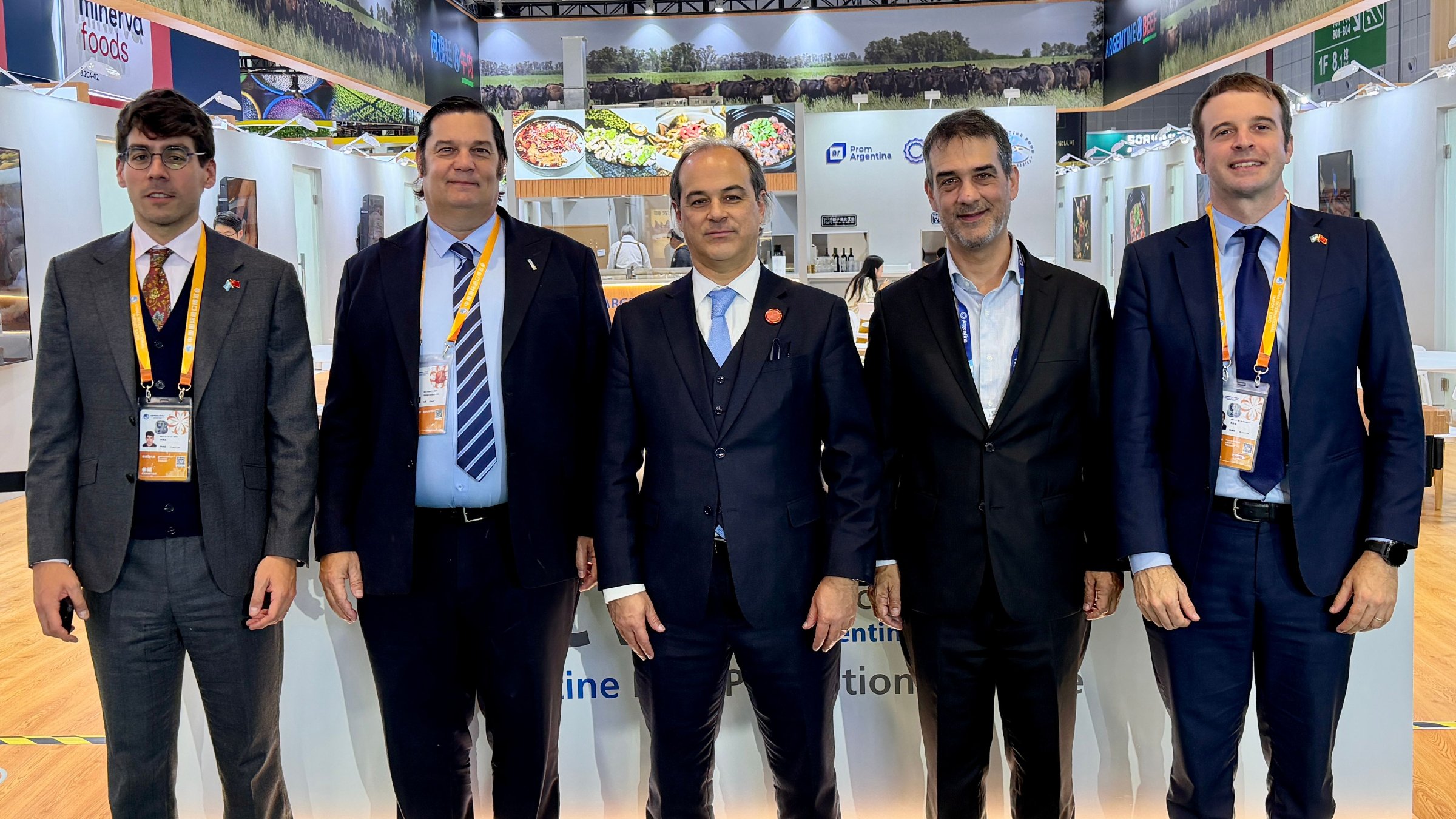
Six out of every ten tons of beef that Argentina exported between January and September 2026 went to the Chinese market. That concentration defines both the opportunity and the vulnerability of Argentina's meat sector.
A Trade Fair with Weight of Its Own: the CIIE as a Strategic Stage
The ninth edition of the China International Import Expo (CIIE) opened its doors on Thursday, November 5, in Shanghai, with the participation of more than 4,100 companies from 162 countries, regions and international organizations, spread across more than 440,000 square meters of the National Exhibition and Convention Center. The event also brought together more than 300 of the world's 500 largest corporations according to the Fortune ranking, up from 290 in the previous edition.
The CIIE was conceived in 2018, the first year of the US-China trade war, as a political signal of China's openness to global trade. Eight years later, it retains that dual nature: it is at once a business platform with concrete effects on trade flows and an instrument of geopolitical narrative that Beijing uses to project its image as a reliable partner to emerging markets. For Argentine exporters, this distinction is not semantic: it requires weighing the event's symbolic dimension against its real usefulness as a generator of contracts and relationships with Chinese importers.
In that context, the presence of the IPCVA (Argentine Beef Promotion Institute) alongside fourteen meatpacking and exporting companies is the sector's last major international promotion effort for 2026. The total Argentine delegation at the fair grew from 42 exhibitors last year to 63 in this edition, with the meat sector as one of the pillars of the national representation.
Source: IPCVA
China's Weight in Argentina's Export Equation
The growth of China's middle class has meant that, between 2020 and 2024, global beef imports showed steady growth, following the trend of previous years, rising from 2.14 million tons in 2020 to 2.92 million in 2024. IPCVA (Argentine Beef Promotion Institute) data for the first nine months of 2026 are conclusive: Argentina exported more than 331,000 tons of beef and bovine bones to China, equivalent to 61% of the total volume covered by the sector survey. In terms of value, those operations generated US$1,525.8 million, representing 40.8% of the export sector's total revenue.
Source: MRECIC
The gap between the share in volume (61%) and in value (40.8%) reflects a structural phenomenon that deserves attention: beef shipped to China is placed, on average, at lower prices than those obtained in other destinations, which suggests a different product mix, with a greater weight of secondary cuts and bovine bones, compared with higher unit-value markets. This asymmetry between volume and revenue is a variable that Argentine exporters and trade policy should monitor more systematically. However, the price trend during 2026 marks a positive turning point. In September 2026, the average export price to China reached US$4,842 per ton, 20.6% above the level recorded in the same month of 2025. That improvement explains why, despite a year-on-year drop of 7.6% in volume between January and September, cumulative revenue grew 14.2% over the same period.
Average export price of Argentine beef to China (Sept. 2025 vs. Sept. 2026)
Source: IPCVA
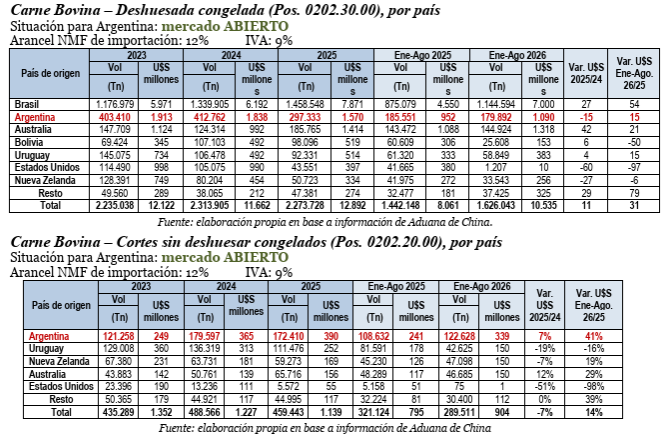
MRECIC: Agricultural Attaché's Office in China
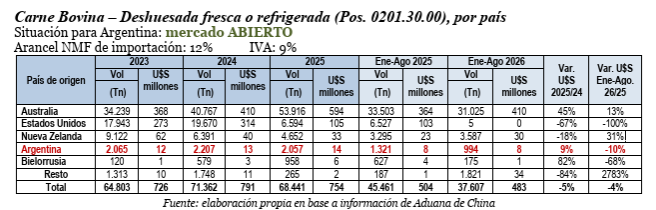
MRECIC: Agricultural Attaché's Office in China
China's quota system: the regulatory variable that reshapes competition
Behind the decline in import volumes lies the imposition of safeguards on meat imports.
Indeed, the increase in imports met in China a local industry made up of small, highly atomized producers operating at low scale, who were unable to compete with the price or the quality of imported meat. The sector therefore asked China's Ministry of Commerce (MOFCOM), through several chambers and associations, to open a safeguard investigation into imported beef, and on December 31, 2025 the final resolution of that investigation was announced, along with the decision to implement safeguard measures that include tariff quotas by supplier country from January 1, 2026 through December 31, 2028. These quotas were set on the basis of the volumes of beef imported from each country over the past 4 years; for Argentina, the 2026 quota was set at 511,000 tons, 521,000 tons for 2027 and 532,000 tons for 2028.
Since the beginning of 2026, China has applied an import management system that sets quotas by country of origin and provides for additional tariffs of 55% on volumes that exceed the assigned limits. This mechanism requires shipment planning very different from that of a market with unrestricted access: the exporter cannot expand its sales indefinitely by relying only on its price or quality competitiveness, but must operate within a tariff window whose breadth depends on regulatory decisions of the Chinese government.
Source: MRECIC
As for quota usage, between January and August 2026 imports from Brazil reached the volume of its allocated beef quota, with 1,144,654 tons entering (103.5%); Argentina used 59.4% of its quota with 303,568 tons; Australia also exceeded its quota (108.7%, 222,910 tons), while Uruguay, New Zealand and the United States recorded the lowest usage rates: 31.4%, 40.9% and 0.8%, respectively.
At this point, the statement by the president of the IPCVA, Georges Breitschmitt, takes on strategic relevance. During the opening of the CIIE, Breitschmitt noted:
"We are about to begin the last major trade fair of the year, which allows us to take stock of 2026 but also to look ahead to 2027. It is a fair with its own special features, because both Australia and Brazil have already filled their quota, and Argentina still has a balance left to fill."
Breitschmitt's statement deserves to be read carefully: if Australia and Brazil —Argentina's main competitors in the Chinese market for bovine protein— have already exhausted their allocated quota for 2026, Argentina has a temporary window of preferential access that its rivals cannot use for the rest of the year. This is, strictly speaking, a short-term opportunity that the sector should capitalize on quickly, before the quota cycle renews and competition levels out again.
China's import administration system sets the real playing field for the negotiations that will take place in Shanghai this week. Argentina's ability to maximize the available quota balance before the close of the trade year depends not only on the supply from meatpacking plants, but on coordination among the private sector, the IPCVA and the Ministry of Foreign Affairs to manage promptly the authorizations and the committed volumes.
Opportunity and dependence: two sides of the same concentration
That China accounts for 61% of the volume of Argentine beef exported is, at the same time, a commercial strength and a source of systemic risk. The strength is evident: the Chinese market absorbed more than 331,000 tons in nine months, ensuring scale and predictable demand for the meatpacking industry. The risk is just as evident: any change in the rules of access —an increase or reduction of quotas, tariff changes, sanitary restrictions, diplomatic tensions— has a direct and sizable impact on the sector's revenues.
This concentration also reflects a market structure that has not changed substantially in recent years. The dependence it creates for the sector in the face of regulatory, demand or price changes is a warning that Argentine trade policy should bear in mind when designing its market diversification strategy for the medium term.
The strategic window opened by Argentina's remaining quota balance in the Chinese market is still available, but it requires immediate executive decisions: coordinating shipments, authorizing plants and closing contracts in the coming weeks, before the tariff cycle renews in 2027 and Australian and Brazilian competitors recover their position. For the IPCVA (Argentine Beef Promotion Institute) and the fourteen meatpacking plants in Shanghai, the CIIE (China International Import Expo) is not just a showcase: it is the stage on which the next chapter of the country's main animal protein export business is being negotiated.
Sources
- Infobae / EFE — China inaugurates the ninth edition of its International Import Expo (November 5, 2026)
- Ruralnet — China concentrates 61% of beef exports and Argentina takes 14 meatpacking plants to Shanghai (November 2026)
- Agroempresario — Argentine beef strengthens its presence in China (November 2026)
Director of Pulso Internacional
Lawyer specializing in international trade and productive investment, with more than 25 years of experience in international trade negotiations as an adviser to governments and to companies going international. At Pulso Internacional we analyze foreign trade, bringing clarity and international context so that your company can export and invest more.
Related analysis

Argentine Horse Exports Are Growing and Must Be Sustained
November 6, 2026 · 5 min
European Assessment of the EU-Mercosur Agreement (ITA): European Exports Up 9% in 4 Months
November 5, 2026 · 2 min