Building Bridges: Pope Leo XIV's Visit to Argentina
Translated from the Spanish original. Read the original
Director of Pulso Internacional
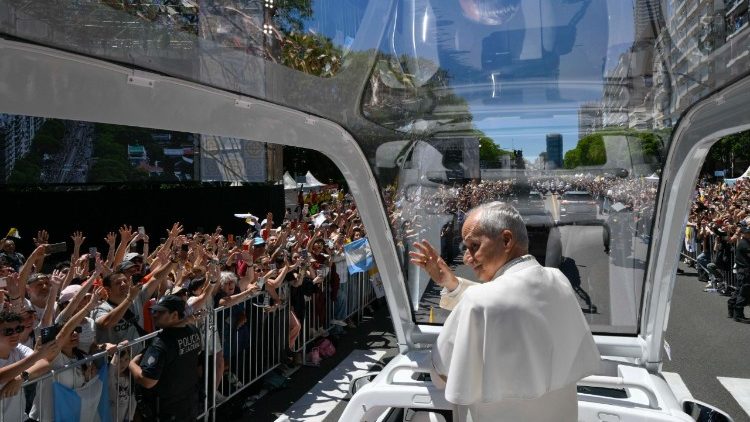
Pope Leo XIV began his visit to South America in Uruguay and on November 7, 2026 stated:
"It is not hard to imagine the benefits a bridge brings: openness, communication, exchange," he said in Paysandú, a city that is home to the General Artigas International Bridge, which crosses the Uruguay River, joining two neighboring countries, Uruguay and Argentina. For that reason, he noted:
How important it is to be a builder of bridges! That is the vocation to which we are all called: to build bridges, to strengthen ties, to unite, to communicate, to convey the joy of faith, as Blessed Jacinto did "in season and out of season."
Pope Leo XIV's visit to Argentina
On November 8, 2026, Pope Leo XIV began his pastoral tour of Argentina and offered important statements. Below, we analyze some outlines of the Catholic Church's ideas on international trade and multilateralism.
"The economy must be at the service of the person, and not the person at the service of the economy" Pope Leo XIV
The Social Doctrine of the Church as a frame of reference
The Social Doctrine of the Church works as a system of reference for hundreds of millions of consumers, workers, entrepreneurs and public officials around the world. From the encyclical Rerum Novarum of 1891 to the most recent documents of the papal magisterium, the Church has built a coherent body of thought on the legitimate conditions of trade, the distribution of wealth and the role of the State in the economy.
The weakening of multilateralism and its consequences
The Holy See holds permanent observer status at the WTO. Thus, Pope Francis, regarding the deliberations of the 10th Ministerial Conference of the World Trade Organization (WTO) held in Nairobi in 2015, stated:
"I express my hope that the deliberations of the upcoming Nairobi conference will not be a mere balancing of conflicting interests, but a true service to the care of our common home and to the integral development of people, especially the most neglected," he stressed. The pontiff lamented that "an equitable international trade system, fully at the service of the fight against poverty and exclusion," has still not been achieved.
Pope Francis was especially concerned about the agreements under discussion at the WTO Conference:
"Regional free trade agreements on the protection of intellectual property, particularly in pharmaceuticals and biotechnology (...) should be an instrument to ensure a minimum of health care and access to basic medicines for all," he emphasized.
Francis also argued that multilateral negotiations should give the poorest countries:
"the time, flexibility and exceptions necessary" to adapt to trade rules in a "non-traumatic" way.
Pope Leo XIV, for his part, has adopted in his first encyclical a position that updates and expands the thinking of his predecessor. In Magnifica Humanitas, published in May 2026, the Pontiff holds that international trade should be assessed not only by its macroeconomic results, but by its capacity to generate real dignity for the most vulnerable links in global value chains. According to Pope Leo XIV, the international order has become increasingly fragmented, partly because of the crisis of the multilateral system. In the Encyclical Letter Magnifica humanitas, he states: "The institutions created to safeguard the idea of a common destiny of peoples and of a common good at the global level appear weakened" (no. 201).
In his address to the United Nations World Food Programme (WFP) in June 2026, Leo XIV was explicit about the responsibility of international trade systems in perpetuating food poverty. Taking up a line of argument that Francis had traced in his address to the WFP, and in his intervention before the organization in 2026, he stated:
" On the other hand, access to essential goods, including food, is all too often shaped by economic or strategic considerations. As a result, those who do not generate quantifiable value risk becoming invisible. This double dynamic poses a serious ethical challenge: the human person no longer systematically occupies the center of international action. In this context, it is important to recognize that "while aid and development plans are hindered by intricate and incomprehensible political decisions, by biased ideological visions or by insurmountable customs barriers, weapons are not" (Pope Francis, Address to the Annual Session of the Executive Board of the World Food Programme, June 13, 2016). Indeed, conflicts are "fed" more easily than people are fed. This reality reflects not only operational shortcomings, but also a fundamental imbalance in political and moral priorities."
The Vatican as a global economic actor
The Vatican is not only a sacred site of Christendom or a small state; it is also a large ministry of foreign affairs with a presence in practically every country in the world, and diplomatic relations with 184 states, the European Union and the Sovereign Military Order of Malta, and it is a member or observer of numerous multilateral organizations, with highly qualified diplomats and a millennia-old tradition.
Moreover, underestimating the economic dimension of the Holy See because of its small population is a frequent analytical error, since it manages a very significant real estate, financial and artistic portfolio through the Institute for the Works of Religion (IOR) and the Administration of the Patrimony of the Apostolic See (APSA). The reforms introduced by Pope Francis through the Apostolic Letter "Motu Proprio" Una Migliore Organizzazione of December 2020 reorganized the management of these assets under criteria of greater transparency and financial traceability, aligning the Vatican State with the standards of the Financial Action Task Force (FATF).
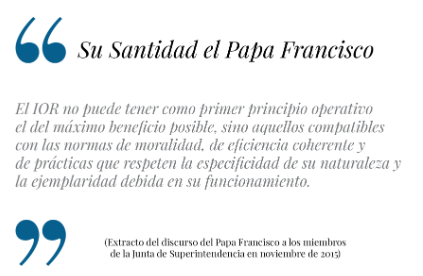
Source: IOR
But the greater importance of the Holy See's economic activity lies not in the assets or property held in the Vatican, but in the network of religious orders that operate under its guardianship. The Jesuits, the Salesians, the Dominicans, the Benedictines, the Carmelites, the Augustinians, the order of Leo XIV himself, and dozens of smaller congregations run hospitals, universities, schools, media outlets, agricultural cooperatives and microfinance networks. This institutional infrastructure constitutes a soft power network without parallel in many countries and in the system of multilateral organizations.
The Visit of Leo XIV: An Agenda with Practical Consequences
For Argentina, the visit of Pope Leo XIV is both pastoral and a diplomatic opportunity to put forward, before a global audience, policies for the country's international insertion based on the principles of sustainability, decent work and fair trade, with the dignity of the human person at the center of negotiations, which is nothing other than building bridges.
Sources
- Vatican.va — Leo XIV, Encyclical Magnifica Humanitas (May 15, 2026)
- Vatican.va — Francis, Motu Proprio Una Migliore Organizzazione (December 26, 2020)
- Vatican.va — Francis, Address to the World Food Programme (June 13, 2016)
- Vatican.va — Leo XIV, Address to the World Food Programme (June 22, 2026)
- Vatican.va — Francis, Encyclical Laudato Si (May 24, 2015)
Director of Pulso Internacional
Lawyer specializing in international trade and productive investment, with more than 25 years of experience in international trade negotiations as an adviser to governments and to companies going international. At Pulso Internacional we analyze foreign trade, bringing clarity and international context so that your company can export and invest more.
Related analysis
25 Years Since China's Accession to the WTO: The Lever of Its Dizzying Growth
November 11, 2026 · 5 min
Brazil Opens 45-Day Public Consultation on a Trade Agreement with Indonesia
November 8, 2026 · 6 min