Brazil Opens 45-Day Public Consultation to Assess a Trade Agreement with Indonesia
Translated from the Spanish original. Read the original

Director of Pulso Internacional
On Friday, November 6, 2026, Brazil's Ministry of Development, Industry, Trade and Services (MDIC) formally opened a public consultation to gather contributions from civil society, companies and representatives of productive sectors on a possible trade partnership between MERCOSUR and Indonesia. The process allows 45 days for submitting suggestions and mapping potential impacts.
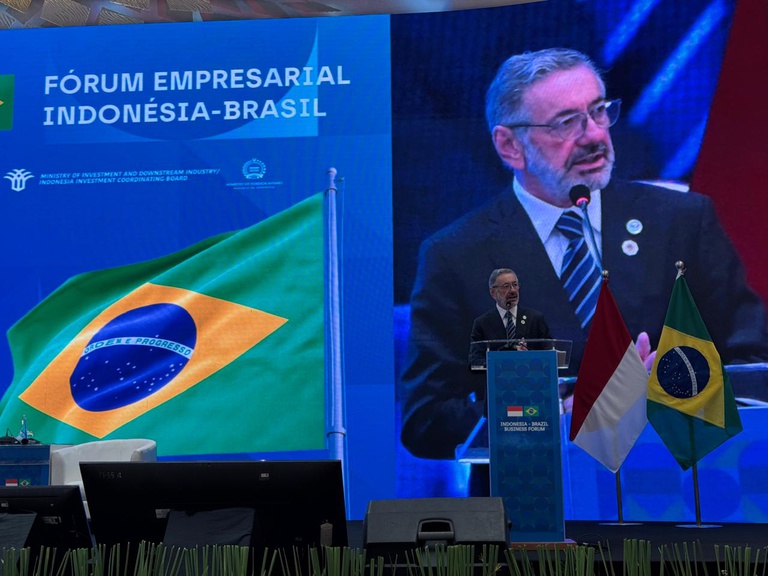
This consultation comes immediately after President Lula's visit to Indonesia on October 23, 2026. It was the first visit by a Brazilian president to that country since 2008, when the Brazil–Indonesia Strategic Partnership was created, and it also included a Brazil–Indonesia Business Forum, held in Jakarta.
A continental-scale market: the numbers behind the interest
The size of the potential agreement is, in itself, an argument. Indonesia is the largest country in Southeast Asia and has a population of more than 280 million, which makes it the fourth most populous country on the planet and the largest market in Southeast Asia. Considering the combined volume of both parties, official Brazilian government projections indicate that the economic size of this potential partnership exceeds US$4.5 trillion in combined gross domestic product.
Dimensions of the MERCOSUR-Indonesia agreement
Indonesia is, moreover, an emerging power in the Indo-Pacific and a significant player in the global value chains of textile and electronics manufacturing and agro-industrial products. It is a member of the G20 and ASEAN, which position it as a highly strategic counterpart, not only as an export destination but as a hub linking to the entire region. We should recall that the recent free trade agreement between MERCOSUR and Singapore also allows indirect access to that market, and so do the negotiations launched with Vietnam, which should also be assessed in this context.
For MDIC's Secretary of Foreign Trade, Tatiana Prazeres, the negotiation represents an opportunity to diversify trade partnerships and expand Brazil's presence in an important and dynamic market.
“Indonesia is one of the most relevant economies in Asia and represents a market with great potential for Brazilian products and services. The participation of the private sector and civil society in the public consultation is essential so that Brazil's negotiating position reflects the interests, concerns and priorities of the different sectors of society”, said Tatiana Prazeres
The formal process: what an MDIC public consultation entails
The public consultation enabled on the Brasil Participativo platform is the institutional mechanism through which the Brazilian government builds its negotiating position before eventually requesting a formal mandate from the bloc. The instrument was formalized through an interministerial circular that opens the process of sector positioning ahead of a possible negotiation between MERCOSUR and Indonesia.
In practical terms, this means that business chambers, sector federations, exporters and provincial governments have 45 days to submit their positions to the MDIC: which products they see as an opportunity, which sectors could be affected by Indonesian preferential access to the bloc, and what conditions or safeguards they consider necessary. Brazil will use that information to build its stance in MERCOSUR's internal discussions. Whoever does not participate does not exist at the negotiating table.
The run-up to negotiations in Argentina
Argentina lacks an equivalent systematized procedure. The Ministry of Foreign Affairs and the Secretariat of Foreign Trade coordinate positions ad hoc with sector chambers, but without a structured participatory process and without timeframes that allow for consensus-building. In Argentina, the national government consults business or sector chambers, which in turn ask their member companies. Some of these know little about how important their participation is for their future; others produce certain goods but are also importers and therefore have conflicting interests. As a result, responses are often incomplete and end up being of little use, especially for SMEs. The concrete consequence of this inertia carries real costs in multilateral and bilateral negotiations, since whoever arrives without a consolidated sector position negotiates from weakness, generating distrust in trade opening processes and potential damage to the productive fabric.
Agro-industrial opportunities: what Argentina can gain
From a trade policy standpoint, Argentina's export profile finds in Indonesia a destination for several of its most competitive product lines. However, to date, bilateral trade has been of little significance.
INDONESIA'S IMPORTS AND EXPORTS
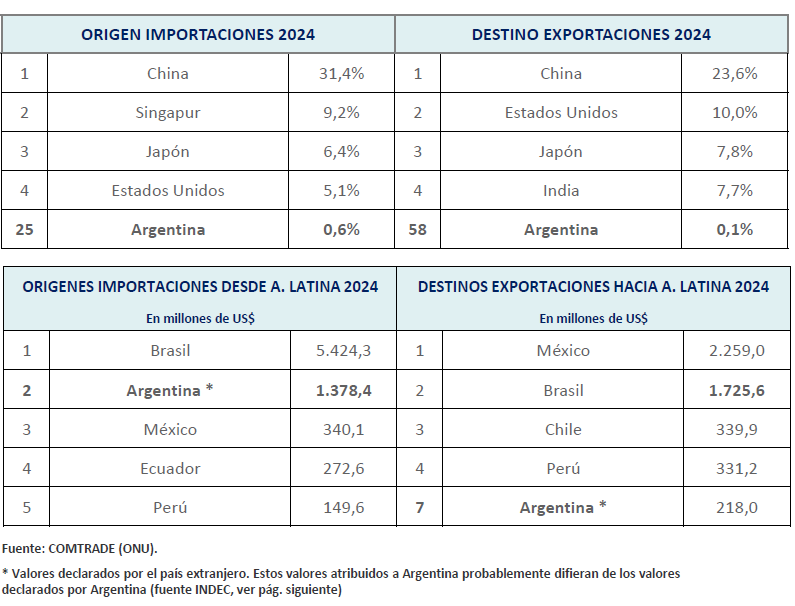
Source: Argentina Trade Net
Indonesian demand for plant- and animal-based proteins, edible oils, dairy products and cereals is structurally on the rise, driven by an expanding middle class and by the requirements of a manufacturing sector that needs agricultural inputs. Argentina's soybean complex, beef and wine sectors enjoy comparative advantages that a tariff reduction scheme could quickly translate into higher export volumes.
To this can be added cotton exports to feed Indonesia's vibrant textile sector, which requires reliable supply chains in order to enter markets such as the United States. A Mercosur-Indonesia trade agreement that included favorable tariff quotas for these products would generate a significant competitive advantage.
The risks: sensitive sectors under scrutiny
However, Indonesia is one of the world's largest producers of palm oil, footwear, textiles and low-cost manufactured goods with growing technological sophistication. An agreement without adequate safeguards could open the Mercosur market to import flows that compete directly with Argentine industrial sectors already under pressure from Asian competition; in particular, the textile industry, footwear and some segments of the processed food industry.
What Argentine stakeholders could do in the coming weeks
The 45-day period is short but sufficient for the relevant Argentine private-sector actors to act in a coordinated manner and express their positions to the Ministry of Foreign Affairs, so that it has the elements to engage in dialogue with its Brazilian counterpart and those of the other Mercosur countries. In concrete terms, this means:
- That the exporter chambers of the agro-industrial complex (oils, meats, dairy, cereals, cotton) draw up technical positions on the products with the greatest potential for tariff gains in the Indonesian market and submit them both to Brazil's MDIC and to Argentina's Ministry of Foreign Affairs.
- That potentially affected sectors, such as textiles, footwear and consumer manufactures, identify precisely the product lines with the greatest exposure and formally request that those chapters be treated with greater gradualism or with specific safeguard mechanisms in the text of the eventual agreement.
- That Argentina's Ministry of Foreign Affairs coordinate with its Mercosur peers, in particular Uruguay and Paraguay, to build a common bloc position that reflects the diversity of national interests before Brazil consolidates its unilateral stance.
- That the governments of high-profile provinces actively support the process with data on territorial impact.
The public consultation opened by Brazil's MDIC on November 6, 2026 is not the start of a negotiation, but the start of the process. Argentina must arrive at that intra-Mercosur negotiation with a position of its own, or risk speaking from a script written by others.
Sources
- Brasil 247 — Brasil e Mercosul iniciam avaliação de acordo comercial com a Indonésia (November 6, 2026)
- MDIC — MDIC abre consulta pública sobre negociação de acordo comercial entre Mercosul e Indonésia (November 6, 2026)
- Brasil Participativo — Processo: Acordo Mercosul-Indonésia
- LegisWeb — CIR: Consulta pública sobre posicionamento Mercosul-Indonésia
Director of Pulso Internacional
Lawyer specializing in international trade and productive investment, with more than 25 years of experience in international trade negotiations as an adviser to governments and to companies going international. At Pulso Internacional we analyze foreign trade, bringing clarity and international context so that your company can export and invest more.
Related analysis
Argentina Brings 14 Beef Packers to Shanghai's CIIE as China Takes 61% of Its Beef Exports
November 7, 2026 · 8 min
Argentine Horse Exports Are Growing and Must Be Sustained
November 6, 2026 · 5 min