25 Years Since China's Accession to the WTO: The Lever of Its Dizzying Growth
Translated from the Spanish original. Read the original

Director of Pulso Internacional
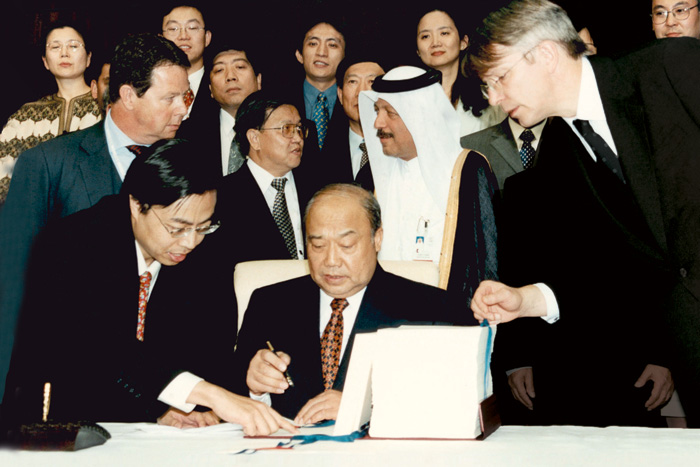
On November 10, 2026, twenty-five years passed since one of the most important events in the history of contemporary international trade: the formal approval of the accession of China to the World Trade Organization (WTO). Its accession allowed it to access world markets and become an export power, responsible for the greatest industrial and commercial transformation of the 21st century. A quarter of a century later, the countries that contributed to China's accession are living through the tensions caused by its export advance, the fragmentation of the multilateral trading system, and the tariff war with the United States. Access to a multilateral system of trade rules allowed China to become a protagonist, but the world has changed, putting strain on the regulatory framework that once facilitated its rise and generating an industrial overcapacity that developed countries are questioning. Meanwhile, Europe's exposure to Chinese products has weakened its industry.
Fifteen years of negotiations, thirteen kilograms of commitments
China's accession process to the WTO was not quick. It took fifteen years of negotiations, which began formally in 1986, when Beijing applied for readmission to the GATT, the predecessor of the WTO. The final agreement, adopted at the Doha Ministerial Conference on November 10, 2001, produced a documentary volume of thirteen kilograms, as Henry Huiyao Wang, founder of the Center for China and Globalization, recalled at a seminar held in Beijing on November 7, 2026 to mark the anniversary. Behind that physical weight lay commitments on tariff openness, trading rights, services, intellectual property and regulatory transparency that China assumed as a condition of its entry as the organization's 143rd member.
The bilateral process was arduous. Each relevant WTO member negotiated access conditions with Beijing before multilateral consensus became possible. In that context, the role of Argentina deserves to be highlighted. As early as 1988, the Argentine delegation to the GATT, headed by Marcelo Gershenfeld and Marcelo Alvarez, among others, took an active part in the bilateral negotiations on market access with China, at a time when only a few developing countries had the technical and political capacity to take part in processes of this nature. That early participation is a precedent in foreign trade policy that does not usually receive the recognition it deserves in retrospective analyses, and which should be remembered whenever it is necessary to enter into negotiations with China.
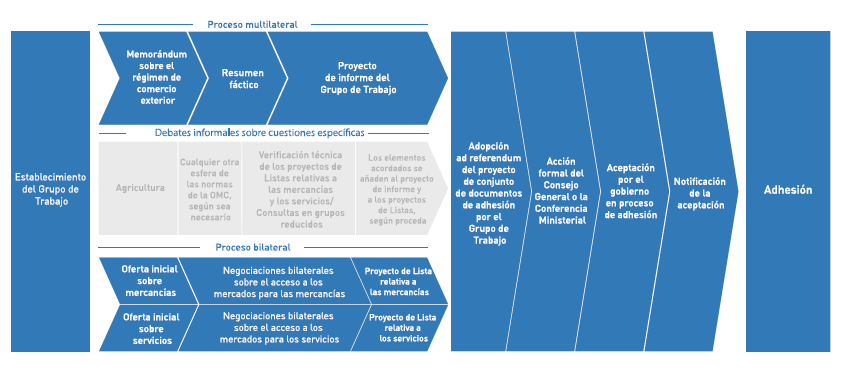
China's accession process as a WTO member
From planned economy to the world's leading exporter
The figures for the twenty-five years following accession are very significant. In 2001, world merchandise exports totaled just over six trillion dollars; by 2025 that figure had surpassed twenty-six trillion, according to data presented at the CCG seminar. China was not the only actor in that growth, but it was the most decisive. Barely eight years after its accession, in 2009, Beijing had become the planet's largest exporter of goods and its second-largest importer. Chinese merchandise exports grew more than tenfold over that period, reconfiguring global value chains in sectors ranging from electronics and steel to renewable energy and electric vehicles.
World merchandise exports 2001–2025
One of the central commitments China assumed upon accession was the opening up of foreign trading rights, until then reserved for a limited number of authorized state-owned enterprises. Within three years of its accession, China extended those rights to practically all companies, including private and foreign-owned ones. This regulatory change was the real turning point, since it enabled foreign direct investment on a massive scale and allowed foreign-owned companies to account for more than fifty percent of Chinese foreign trade by 2005. In the first nine months of 2026, those same foreign-owned companies still accounted for close to thirty percent of Chinese foreign trade, with imports and exports reaching RMB 11.69 trillion.
The anniversary debate: imbalances, WTO reform and new responsibilities
Chinese production has been fostered by the central, provincial and municipal governments with numerous subsidies that generate unfair competition. Only in 2025 did China acknowledge that it no longer needed the special and differential treatment its products received, yet it still maintains that it is a developing country.
"In September 2025, China voluntarily announced that it would not seek new special and differential treatment in current or future WTO negotiations. While retaining its developing country status, China demonstrated its willingness to contribute more to the multilateral trading system."
This gesture, which Wang noted in his opening remarks at the seminar, is politically significant, although for many it comes late. It acknowledges that the asymmetries that justified certain privileges in 2001 are no longer the same in 2026, but this had already been under question for some time.
Along the same lines, on May 1, 2026, Beijing extended its zero-tariff policy to the 53 African countries with which it maintains diplomatic relations, a signal of leadership in the construction of what the CCG calls "inclusive globalization".
Argentina and China 25 years on
On the one hand, China has become the main destination for Argentine exports (soybeans, oils, beef, lithium) and a growing source of investment in infrastructure and energy. But the current trade balance is in deficit and the trend is for it to remain so.
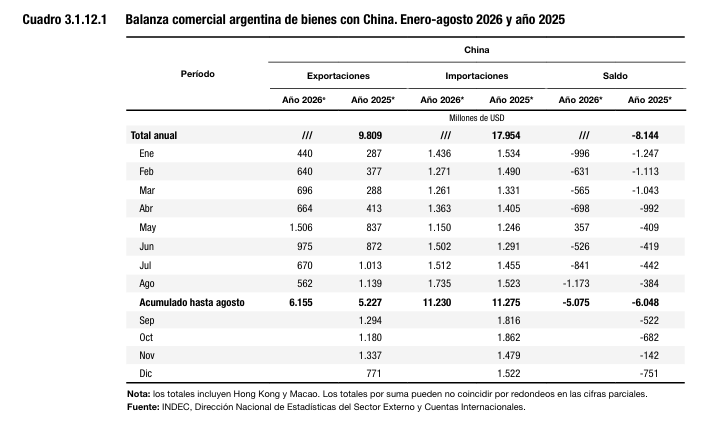
Source: INDEC Informa Year 31, No. 10, October 2026
For Argentina, the anniversary of China's entry into the WTO is not merely an occasion for historical remembrance or a short-term analysis. It is an opportunity to review the country's international integration strategy with the same ambition that Argentine trade diplomacy showed almost four decades ago.
Sources
Director of Pulso Internacional
Lawyer specializing in international trade and productive investment, with more than 25 years of experience in international trade negotiations as an adviser to governments and to companies going international. At Pulso Internacional we analyze foreign trade, bringing clarity and international context so that your company can export and invest more.
Related analysis
Building Bridges: Pope Leo XIV's Visit to Argentina
November 8, 2026 · 6 min
Brazil Opens 45-Day Public Consultation on a Trade Agreement with Indonesia
November 8, 2026 · 6 min