International Agricultural Markets and Policies in September 2026
Translated from the Spanish original. Read the original

Director of Pulso Internacional
Argentina reaches a record in grain production. According to the Rosario Board of Trade (BCR), as of the week of October 7, more than 105 Mt of grains (counting soybeans, corn, wheat, sorghum and sunflower) had already been sold, a volume that marks an all-time record so far this crop season. The magnitude can be appreciated by comparison: we are 25% above the average of the last five years and almost 6 Mt above the previous maximum. Despite this large volume already sold, according to the BCR many tons remain to be sold, even after deducting from total supply the amount earmarked for use as seed. This remainder currently stands at 41 Mt, although it is noted that, in recent weeks, the pace of sales has been advancing steadily.
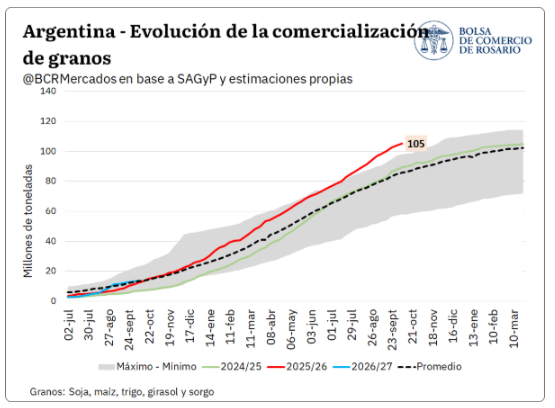
Source: BCR
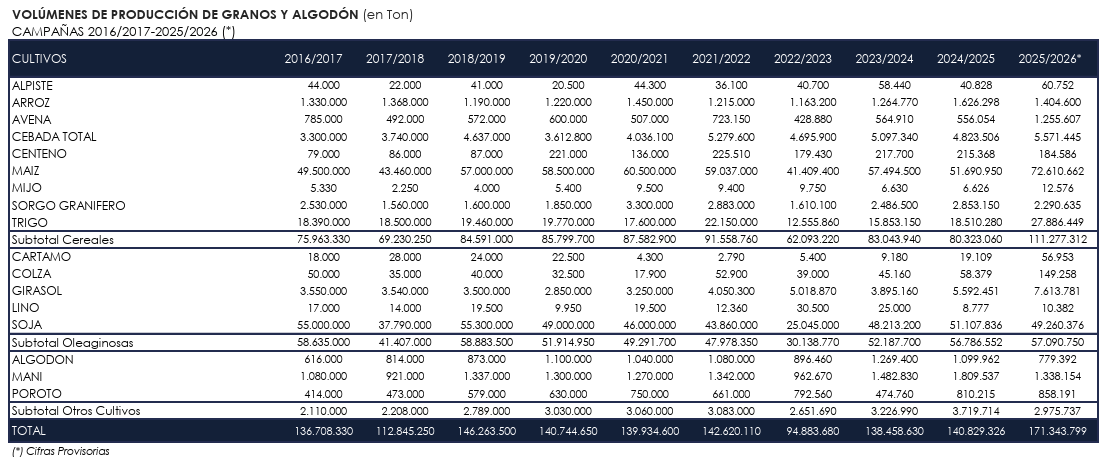
Source: MECON AGRICULTURAL ESTIMATES Weekly Report as of November 5, 2026
According to the Agricultural Market Information System (AMIS), created by the G20, international prices in September remained above the levels of the previous year. Wheat prices rose sharply at the beginning of the month due to disruptions in Black Sea exports, but fell back toward the end of the month as expectations of improved trade flows eased market concerns.
Agricultural policy measures in September 2026
AMIS reports that during September 2026, the Russian Federation suspended export tariffs on wheat and corn, and temporarily restricted exports of sulfuric acid. At the same time, Ukraine relaxed the payment deadlines for export contracts, and Lithuania tightened import controls on grain coming from Ukrainian territories occupied by Russia, while France, Italy, Nigeria and Turkey announced support measures (subsidies) for agricultural producers.
Brazil's policy measures to support fertilizer production
Brazil is in the process of approving Law No. 15.496 of 03/09/2026 (currently subject to a partial veto by the Executive), which contains measures to encourage domestic fertilizer production and establishes the Fertilizer Industry Development Program (Profert), with tax incentives and the creation of a fund to support domestic production. The objective is to reduce dependence on imports of these nutrients, which are used on a large scale in Brazilian agriculture. Among other measures, the new program provides for tax exemptions on the import of machinery and on the establishment of industrial plants to manufacture these inputs within the country. Its entry into force is expected soon.
The main ones are nitrogen, phosphate and potash fertilizers, which supply nitrogen, phosphorus and potassium, respectively, known by the acronym NPK, and are fundamental to crop productivity. According to Agência Brasil, in 2025 Brazil imported 43.3 million tons of intermediate fertilizers, according to the National Association for the Diffusion of Fertilizers (ANDA).
Global cereal stocks and food security
An issue that matters in the deployment of agricultural policies is the amount of cereal stocks existing in the world, because of food security. The forecast of the Food and Agriculture Organization of the United Nations (FAO) for world cereal stocks at the close of the 2027 crop seasons stands at 950.0 million tons, leaving global stocks practically unchanged from their opening levels. The increase in wheat stocks and, to a lesser extent, barley stocks is expected to offset the reductions in rice and sorghum stocks. Wheat carry-over stocks have been revised upward in several of the main exporters, in particular in Australia, as a result of increased supplies, and in the Russian Federation and Ukraine, following expectations of reduced exports. Forecasts for coarse grain stocks have been cut, mainly because China is expected to draw on its sorghum supplies for use in feed rations. As a result, the global cereal stocks-to-utilization ratio at the end of the 2026/27 crop seasons has been revised slightly upward, standing at 31.7%, a ratio that remains below the 32% level of the previous crop season. The FAO has raised by 1.8 million tons its forecast for world rice stocks at the close of the 2026/27 marketing seasons, setting it at 216.9 million tons, mainly because of expectations of higher stocks in India, although forecasts for several other countries, in particular Japan, have also been increased. The level of the revised forecast suggests that world rice stocks could fall by 3.2% in 2026/27, although they could remain at their second-highest level ever owing to still considerable carry-over stocks in countries such as China, India and Indonesia.
The geography of risk: Hormuz, Suez and Bab el-Mandeb as vectors of pressure
According to the new data published in September by the FAO, the FAO's benchmark indicator of world food prices rose in September, driven mainly by transport disruptions and weather concerns, which limited availability, as well as by higher quotations for crop-based product groups. The variable that most worries analysts of global value chains is not production itself, but the logistics infrastructure that sustains it. The persistent uncertainty in the Strait of Hormuz and Bab el-Mandeb not only makes maritime transport more expensive; it directly affects the price of critical inputs.
Sources
- FAO — Food Outlook: Global Food Commodity Market Trends Face Rising Geopolitical and Weather Risks (June 2026)
- Nationwide — Ag Economy Outlook (2026)
- FAO — World Food Situation / CSDB
- AgroBankHub — Greater geopolitical and climate risks are already affecting the global market for staple foods (June 18, 2026)
- Photo: ©FAO/Ismael Adnan
Director of Pulso Internacional
Lawyer specializing in international trade and productive investment, with more than 25 years of experience in international trade negotiations as an adviser to governments and to companies going international. At Pulso Internacional we analyze foreign trade, bringing clarity and international context so that your company can export and invest more.
Related analysis

European Assessment of the EU-Mercosur Agreement: In 4 Months, European Exports Grow 9%
November 5, 2026 · 2 min
Why Has the US Increased Its Investment in Germany?
November 3, 2026 · 5 min