Why the EU Signed the Interim Agreement with Mercosur
Translated from the Spanish original. Read the original

Director of Pulso Internacional
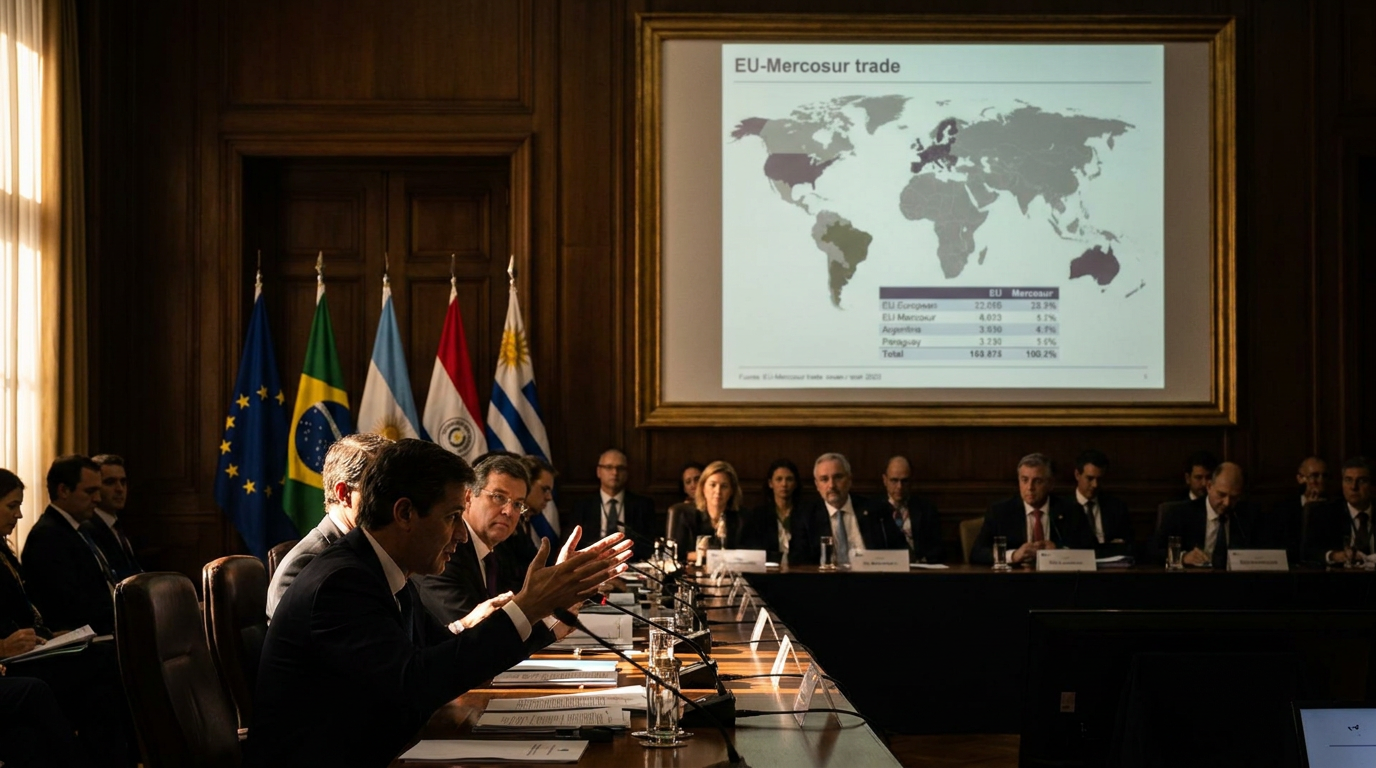
The European decision to accelerate the implementation of the Interim Agreement with Mercosur responds to a convergence of geopolitical pressures, between Chinese competition and US pressure, that together shape a significant trade opportunity for Mercosur companies. The European push toward the agreement with Mercosur underscores the growing relevance of the trilateral trade tensions that dominate the global landscape. European trade strategy seeks to diversify its partners in the face of deteriorating relations with China and US tariff pressures that reached historic levels during 2025-2026. The loss of European industrial competitiveness against Chinese exports has intensified particularly in strategic sectors such as electric vehicles, where Chinese imports into the EU grew 82% in the first quarter of 2026, despite the countervailing duties in place since October 2024. This situation forces the EU to achieve an immediate technological restructuring that requires the search for alternative markets. At the same time, trade negotiations with the United States have generated significant regulatory disparities. The so-called "Turnberry Agreement" of August 2025 established European commitments to US imports worth USD 750 billion through 2028, creating direct competition with Mercosur products in segments such as beef, soybean products and liquefied natural gas.
Decline of the European Share in Latin America
Trade data reveal the systematic decline of the European presence in the region. The EU's share of Mercosur imports fell from 35% to 16.5% over the last twenty years, while China consolidated its position as Brazil's main trading partner. The EU seeks to recover part of the market through tariff preferences under this agreement; the successful experience of previous trade agreements with Chile and Mexico demonstrated the effectiveness of these agreements in maintaining market share in Latin American markets.
Energy Security and Critical Raw Materials
European sanctions on Russia have created a growing dependence on energy imports from third countries, reinforcing the need to diversify suppliers. In this regard, the Memorandum of Understanding signed with Argentina in June 2023 on strategic raw materials sets a precedent for cooperation on lithium, cobalt and other minerals essential to the European energy transition. Global demand for electric battery components is projected to rise exponentially toward 2040, positioning Mercosur as a strategic supplier of materials that China has begun to restrict as a trade retaliation measure against both the EU and the US.
Sectoral Impact and Trade Opportunities
The tariff reductions under the interim agreement establish immediate preferential conditions for several Mercosur agro-industrial products. The elimination of the 17.3% tariff on Argentine bee products, for example, represents a direct competitive advantage, evidenced by the first certified shipment of Argentine honey to Germany on May 3, 2026, as well as by the first egg exports to the European Union, totaling 330 tonnes, 15 days after the trade agreement entered into force. The automotive sector represents the most significant opportunity for the South American bloc. According to International Trade Centre projections, Brazil has an export potential of USD 1.3 billion, while Argentina would reach USD 639 million in automotive exports to Europe, and the figures could be higher if pressure mounts to replace Chinese suppliers for European factories.
Emerging Non-Tariff Barriers
However, early experience shows that European para-tariff barriers remain complex. EU Regulation 2024/3190, which bans bisphenol A (BPA) in food packaging from July 2026, directly threatens 30% of Argentine honey shipments, equivalent to USD 70 million in 2025. This regulation requires a technological restructuring involving additional costs of 15-20% over traditional packaging, which is particularly burdensome for small and medium-sized exporters that lack the economies of scale to absorb these increases. In addition, the Interim Agreement faces pressure from Poland, which seeks its annulment, as it argued before the European Court of Justice, and from Polish ultraconservative groups that are running press campaigns against the agreement. Successful implementation of the agreement requires overcoming European requirements on sustainability, traceability and environmental certifications, which are systematically intensifying and constitute barriers to the entry of products. The establishment of a Subcommittee for bilateral consultations under the Agreement to resolve regulatory issues related to sanitary and phytosanitary measures sets a historic precedent for the management of trade disputes, which we hope will become operational. The Interim Agreement represents an opportunity to diversify markets and reduce trade dependence on China, although taking advantage of it requires support from the Argentine Ministry of Foreign Affairs and from agencies such as SENASA and INTI for domestic producers, to overcome the often unjustified barriers to the entry of goods into the European market, as well as to counter press campaigns against South American products. Monitoring the experience of the first months will be decisive in assessing whether this trade instrument effectively generates sustained trade flows or whether European non-tariff barriers will limit its real impact on the country's export competitiveness.
Director of Pulso Internacional
Lawyer specializing in international trade and productive investment, with more than 25 years of experience in international trade negotiations as an adviser to governments and to companies going international. At Pulso Internacional we analyze foreign trade, bringing clarity and international context so that your company can export and invest more.
Related analysis
European Assessment of the EU-Mercosur Agreement: In 4 Months, European Exports Grow 9%
November 5, 2026 · 2 min
Why Has the US Increased Its Investment in Germany?
November 3, 2026 · 5 min