Municipalities as Investors
Translated from the Spanish original. Read the original

Director of Pulso Internacional

Following the Republicans' defeat in the US midterm elections, we can see some clues about what may emerge in terms of investment promotion by the municipal and state governments that won those elections. Are the approaches of the Democratic and Republican parties really different? To what extent can local governments become strategic investors, rather than merely grantors of tax exemptions? The question, which might sound strange in the current Argentine context, has concrete and documented answers in three of the world's major economies.
From the municipal investment funds of China to the local public capital vehicles in New York, by way of European territorial co-investment instruments, the municipality as a direct investor has ceased to be a rarity and become a recurring model.
Why must municipalities act alongside the productive environment?
We saw how municipalities are directly affected by the upheavals in other countries' external trade policies. Such was the case of several Brazilian municipalities, directly affected by the Trump administration's foreign trade measures to the tune of almost US$ 10 billion in a single year, as we reported in our article. Preventing these harmful effects through the diversification of foreign trade and through investment can be ways of guaranteeing the political and economic stability of municipalities and regions.
Beyond tax exemptions: the municipality as shareholder
The dominant view of the role of subnational governments in local economic development tends to be reduced to two instruments: the reduction of municipal fees and the provision of industrial parks or land under loan-for-use agreements. Both are valid, but insufficient. What comparative analysis shows, and what we have pointed out in relation to the active role of municipalities as drivers of export development, is that the boundary between public policy and equity participation has become deliberately porous and non-ideological in the world's most dynamic economies.
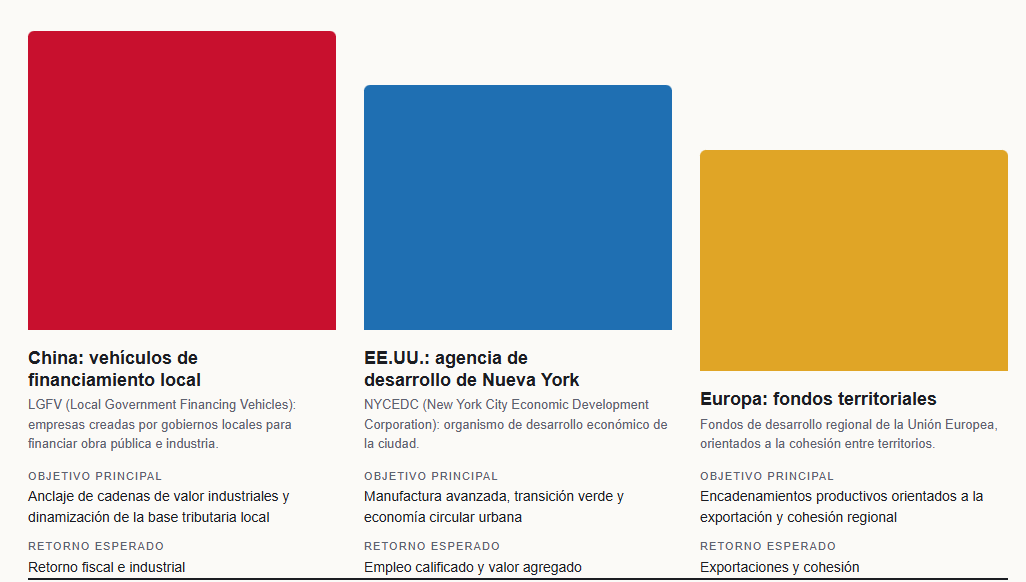
In China, the so-called Local Government Financing Vehicles (LGFVs) are the best-documented instrument of direct municipal investment in companies. They were initially created to finance infrastructure, and since Made in China 2025 these vehicles have evolved toward taking equity stakes in manufacturing and technology services companies oriented to export, with the explicit objective of anchoring value chains in the municipal territory and maximizing long-term fiscal returns. These are not disguised subsidies: this is the logic of an investment fund with a multi-year horizon and a territorial mandate.
In the European Union
In the United States, the model is different in form but analogous in function. Through the New York City Economic Development Corporation (NYCEDC), New York City operates a portfolio of co-investments in advanced manufacturing, technology and circular economy companies. The city will grant US$ 29.2 million to New York University (NYU) to establish a state-of-the-art quantum fabrication facility (QFab), which will position New York City at the forefront of the emerging field of quantum technology.
“Right now, at subatomic levels we can barely glimpse, new technologies are being developed that will transform the way we fight disease, store energy and exchange information. We want those technologies, investments and jobs to be created here in New York City, and we want New Yorkers to have a say and a stake in their success. With this new quantum lab, we are making that vision a reality,”
“This first-of-its-kind agreement will give the city board representation to shape the future of the quantum industry and a stake in the new technologies that emerge from the lab, ensuring that all New Yorkers see the benefits and progress of quantum technology, not just a privileged few. We are building a city where economic justice is not achieved at the expense of innovation.” declared New York Mayor Mamdani.
The logic is identical: the municipality does not merely facilitate the environment, but takes part in the economic growth of the companies it anchors in its territory. According to recent data compiled by Danielle Myles of FDI Intelligence, this type of subnational direct investment instrument has expanded significantly in mid-sized North American cities during 2024-2026, partly in response to the reshoring policies promoted by the federal administration.
Meanwhile, in Europe, investment is supported in order to reduce regional disparities. The ERDF has its legal basis in the Treaty on the Functioning of the European Union. For the 2021-2027 period, the Union's cohesion policy sets five policy objectives (POs) for the ERDF's "investment in jobs and growth" goal:
PO1: a smarter Europe: innovative and smart economic transformation;
PO2: a greener, low-carbon Europe;
PO3: a more connected Europe: regional mobility and connectivity through information and communication technologies;
PO4: a more social and inclusive Europe: implementation of the European Pillar of Social Rights, a set of principles agreed by the European Commission, the European Parliament and the Council of the European Union in 2017 with the aim of strengthening social rights in the Union and thereby having a positive impact on people's lives;
PO5: a Europe closer to its citizens: sustainable and integrated development of urban, rural and coastal areas through local initiatives.
Direct Municipal Investment Models
China, the United States and Europe finance the city with different instruments, each with its own return.
Source: Pulso Internacional
The return: not only social, but financial
A distinction that is imperative in this analysis is the one that separates profit-oriented municipal investment from public investment with purely redistributive aims. Chinese municipalities, for example, do not invest in companies for ideological reasons, but because equity stakes generate dividend flows that finance local services without the need to increase the tax burden on taxpayers. In technical terms, it is a diversification of the municipal revenue base.
In the North American context, the return of manufacturing companies to US soil, the phenomenon known as reshoring, has created an unprecedented demand for territorial anchor capital: returning companies need not only infrastructure, but also local co-investors willing to share the risk of relocation. The most sophisticated municipal governments have responded to that demand with temporary equity stake instruments, designed to be diluted once the company reaches operating scale.
The resulting yield finances new rounds of territorial investment. It is a revolving fund model with a local development mandate.
The regulatory framework in Argentina
In Argentina, the participation of local governments in the capital of private companies is not prohibited by the National Constitution, but neither is it systematically regulated at the subnational level.
In the province of Córdoba, Law 8102, the Regime of Municipalities and Communes, establishes in its Art. 95 that companies or corporations with private capital participation may be formed to provide municipal public services, and it makes no mention of productive or export activities.
Sources
Director of Pulso Internacional
Lawyer specializing in international trade and productive investment, with more than 25 years of experience in international trade negotiations as an adviser to governments and to companies going international. At Pulso Internacional we analyze foreign trade, bringing clarity and international context so that your company can export and invest more.
Related analysis

Argentina Climbs to Fifth Place Among Peru's Suppliers, Overtaking Mexico
November 22, 2026 · 11 min
Indonesia Signs Trade Agreement with the EU and Competes with Mercosur in That Market in 2027
November 22, 2026 · 4 min