Trump's tariffs cost Brazil's exporting municipalities nearly US$10 billion and stir political turbulence in Iowa
Translated from the Spanish original. Read the original

Director of Pulso Internacional
Damage that does not show in the totals but does in the territories
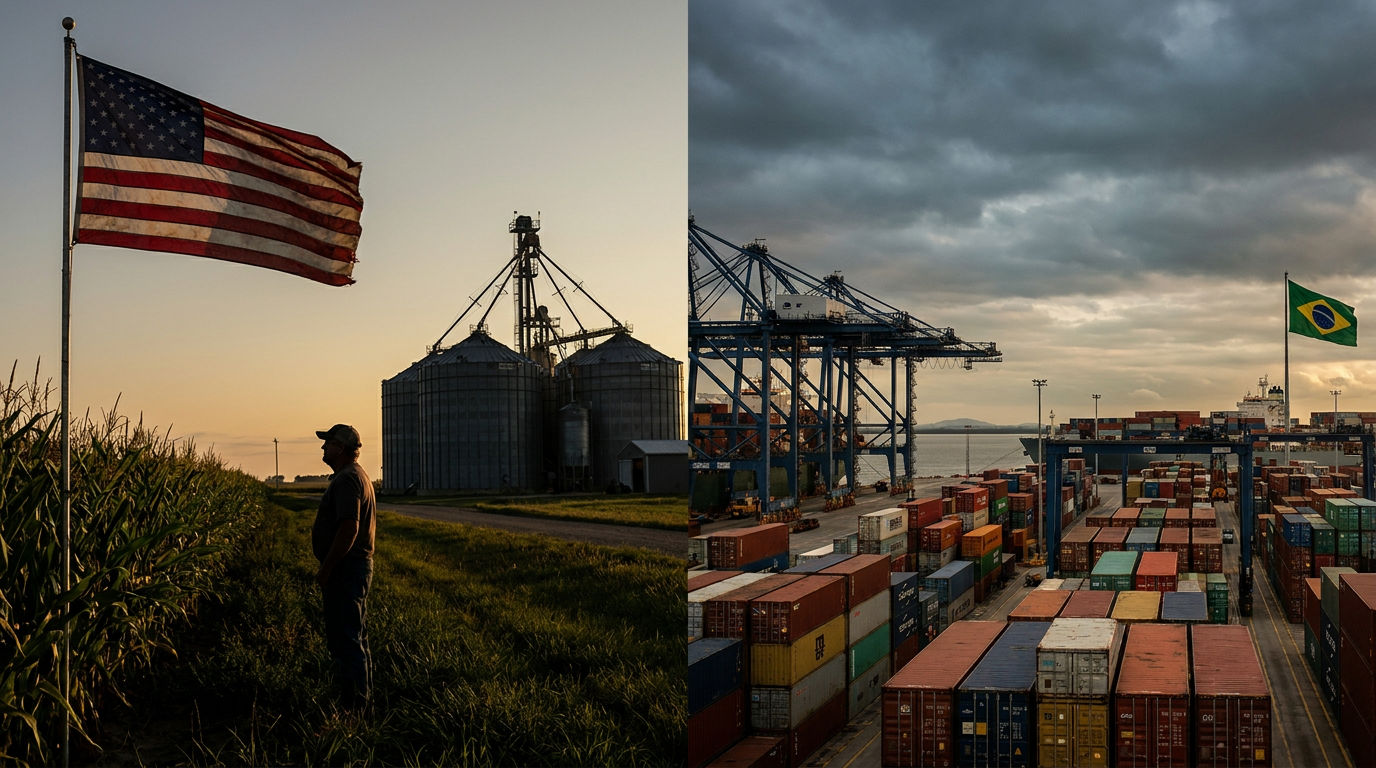
Brazil recorded growth of USD 31.8 billion in its exports during the twelve months ending in July 2026, which can be read as a sign of adaptation to the tariff policy and sanctions of the Trump administration that directly affected Brazil. However, behind the consolidated figure lies the geographic incidence of the damage that national totals do not make explicit: the producing municipalities that lost their main destination market, the sectors that took more than a year to recover their share, and a political signal that now reverberates from Iowa to Minas Gerais.
Source: CNM Brasil
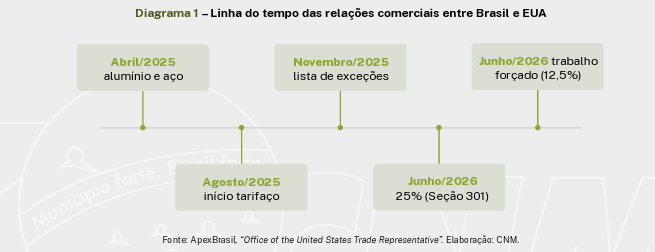
A study published on October 19, 2026 by the National Confederation of Municipalities (CNM) quantifies the problem: of the 1,643 Brazilian municipalities that maintained trade relations with the United States over the last two years, more than half, 864 localities, recorded an average drop of 30% in the value of their exports to the North American market compared with the previous period. The cumulative loss of export revenue amounts to USD 9.7 billion. In another 271 municipalities, exports to the United States fell to zero, from shipments that had previously totaled USD 104 million.
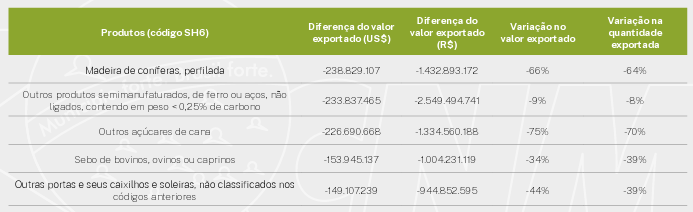
The five product categories most affected nationwide are coniferous wood, other cane sugars, semi-finished iron and steel products, beef tallow, and doors with their frames: a map that illustrates how deeply integrated the Brazilian export chain was with the US market, and how selective Washington's tariff policy was in striking it.
The top 5 products affected by higher tariffs on exports to the US
Source: CNM Brasil
The CNM identifies São João da Barra, in the state of Rio de Janeiro, as the municipality with the largest individual losses: USD 590 million in lost export revenue, concentrated in fuels, mineral oils and distillation products. In Araraquara, in the state of São Paulo, the blow was felt in horticultural exports. In Guaxupé, Minas Gerais, coffee was the main source of the damage. This small municipality of just over 50,000 inhabitants is the second-largest coffee exporter in Brazil and is home to the country's largest cooperative of coffee growers. It is precisely the State of Minas Gerais that has the most affected municipalities, with a total of 251. In the past, as we discussed in our previous article, coffee had an influence on Brazil's democratic stability; the current instability foreshadows changes in the leadership of the federal government.
Coffee: a market that does not wait
Among the hardest-hit sectors, coffee deserves particular analysis. In August 2025, the Trump administration imposed 50% tariffs on coffee and coffee products of Brazilian origin, a level that virtually wiped out the product's competitiveness in the North American market for more than a year. In November of that same year, a list of exemptions was enabled covering roasted and unroasted coffee, decaffeinated or not, husks and substitutes containing coffee; but regulatory uncertainty had already triggered a process of origin substitution by US buyers. Marcos Matos, executive director of the Brazilian Coffee Exporters Council (Cecafé), quoted by Valor Internacional, described it in precise terms:
"Although Europe and Asia hold prominent positions in the coffee trade, Brazil's trade partnership with the United States goes back decades, which makes it difficult to abandon that market. Since the United States imposed the 50% tariffs in August last year, the industry has been racing against time to reverse them."
Matos's concern pointed to a structural risk that economists call trade hysteresis: the loss of market share that persists even after the instrument that caused it (in this case, the tariff) is removed. In July 2026, US authorities revoked the additional duties on all types of coffee, but the question that becomes imperative is whether North American buyers, accustomed for more than a year to varieties from other origins, will once again give Brazilian coffee the same preference as before. In the EU, too, Brazilian coffee was questioned by Polish legislators. The market, unlike regulatory instruments, does not reverse by decree.
Iowa: when tariff damage becomes Democratic electoral capital
The phenomenon is not exclusively Brazilian. Less than three weeks before the November 3 midterm elections in the United States, the state of Iowa (the country's agricultural heartland, a leader in corn and soybean production) is showing signs of an electoral shift unprecedented in the last decade. Matt Russell, executive director of the Iowa Farmers Union, confirmed to the EFE news agency what the polls have been anticipating:
"Rural Iowans are increasingly interested in voting for Democrats, more than they have been in the last decade. Are we seeing a shift back toward a more purple state? It's clear that we are heading in that direction."
Russell attributes the situation to a combination of factors: rising fuel prices linked to the conflict in Iran and, centrally, the White House's tariff policy. His diagnosis is blunt: "I would say it's one of the worst recessions in decades, and much of it hasn't been due just to natural economic cycles or weather-related issues. It has been the result of policy decisions, above all coming from the administration." Polls suggest that the Democrats could win up to three seats in the House, one in the Senate and the governorship of Iowa, an outcome that would have been unthinkable given that the state backed Trump in the last three presidential elections.
The mechanics of the damage are clear in the testimony of Ryan Marquardt, a fifth-generation farmer: tariffs depressed the selling price of corn, soybeans and livestock, while input costs (fertilizers, diesel) remained high or kept rising. The rural producer's operating margin was squeezed from both ends at once.
The political paradox in Brazil and the Bolsonaro variable
A survey of the Brazilian agricultural electoral landscape shows that the farm sector remains predominantly loyal to Jair Bolsonaro even where tariffs have caused direct harm. In eight of the ten leading agricultural municipalities by production value, Bolsonaro prevailed over Lula; in Flores da Cunha, the country's main wine-growing region, 79% of voters chose the right-wing candidate. The reasoning of the pro-Bolsonaro farmer in the face of Trump's tariffs is revealing: Christian Rancan, a 26-year-old winegrower and local councilman, summed it up pragmatically: "Bolsonaro has a better chance of reversing the tariff because he is closer to Trump." The coffee experience shows that even the formal revocation of a tariff does not guarantee the recovery of a lost market.
The tension deepens on another front: the MERCOSUR-European Union agreement, signed in January 2026, which eliminates tariffs on European wine over a ten-year period, is causing alarm among winegrowers in Rio Grande do Sul, who feel that the trade liberalization promoted by Lula exposes them to European competition without offering equivalent compensation in the North American market, while a 40 % tax burden is eroding their export competitiveness.
Source: Author's elaboration based on CNM
The territorial damage to municipalities documented by CNM data shows that a tariff policy sustained for more than twelve months can permanently reshape regional value chains. For Argentine exporters of products with high exposure to the US market (oils, biodiesel, manufactures of industrial origin), the Brazilian experience illustrates the kind of structural damage that can occur even when overall volumes are growing. Diversifying destinations and strengthening the exportable supply toward alternative markets is key, but it requires coordinated trade policy decisions among the Ministry of Foreign Affairs, sector chambers and provincial governments before the Brazilian pattern is replicated in other partners of the bloc.
Sources
- Valor Internacional — Trump tariffs hit Brazilian cities despite export growth (October 19, 2026)
- Agencia EFE — Trump, diesel, tariffs… Iowa's rural vote begins to lean toward the Democrats (October 19, 2026)
- ABC Paraguay — Bolsonaro reaps the support of the agricultural sector despite Trump's tariffs (October 19, 2026)
Director of Pulso Internacional
Lawyer specializing in international trade and productive investment, with more than 25 years of experience in international trade negotiations as an adviser to governments and to companies going international. At Pulso Internacional we analyze foreign trade, bringing clarity and international context so that your company can export and invest more.
Related analysis

European Assessment of the EU-Mercosur Agreement: In 4 Months, European Exports Grow 9%
November 5, 2026 · 2 min
Why Has the US Increased Its Investment in Germany?
November 3, 2026 · 5 min