Argentina Can Integrate Into Secure Supply Chains
Translated from the Spanish original. Read the original

Director of Pulso Internacional
While the debate in Europe and in the United States centers on reducing dependence on concentrated Asian suppliers, Argentina's limited integration into global value chains (GVCs) or supply chains, traditionally perceived as a competitive disadvantage, becomes a geopolitical asset, since lower dependence on imported inputs means lower vulnerability to external disruptions and should be the resource used to pursue technological and productive independence. As Ambassador Marcelo Cima anticipated in 2023: "The geopolitical conflicts unfolding today have led to a reconsideration of international trade based not only on cost efficiency but on the effectiveness and sustainability of reliable supplies."
Conceptual framework of global value chains
Global value chains, emblems of globalization, represent the set of interconnected activities that companies and countries carry out to take a product from its conception to its final use, crossing multiple borders.
This system operates through two mechanisms of integration: "backward" participation, that is, the import of foreign inputs to incorporate into a country's own exports, and "forward" participation, through the supply of domestic value added that meets final demand in third countries.
The OECD defines this integration as the degree to which countries participate in internationally fragmented production networks, where value is progressively added in different jurisdictions. The fundamental metric lies in the Trade in Value Added (TiVA) indicators, which break down gross exports to identify the geographic origin of the embedded value.
Argentina's positioning in the global context
Data from the OECD TiVA 2022 index (Trade in Value Added) show that Argentina has a foreign content of exports of 9.9%, a reduction from the 11.2% recorded in 2010. This figure contrasts significantly with the G20 average (19.8%), pointing to a profile of low dependence on imported inputs for export production.
Lower dependence on imported inputs means lower vulnerability to external disruptions and is the starting point of a trade integration that can deliver greater technological and productive independence
Foreign content of exports 2022 - Backward integration: Argentina vs. G20 and OECD average
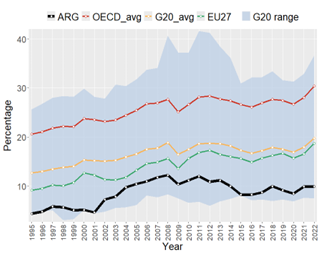

Source: OECD
In terms of "forward" participation, that is, the value added by Argentine domestic products demanded abroad, it stood at 16.6% in 2022, a decline from 18.4% in 2010. This dynamic reveals an economy with low integration, concentrated in primary inputs rather than in complex manufactures. The leading sectors in forward integration are highly concentrated in transport equipment (68.4%) and agriculture, forestry and fishing (41.2%), while ICT and electronics registers barely 5.9%. This sectoral distribution shows a specialization in natural resources and commodity-based goods, structurally different from Asian economies oriented toward manufacturing assembly.
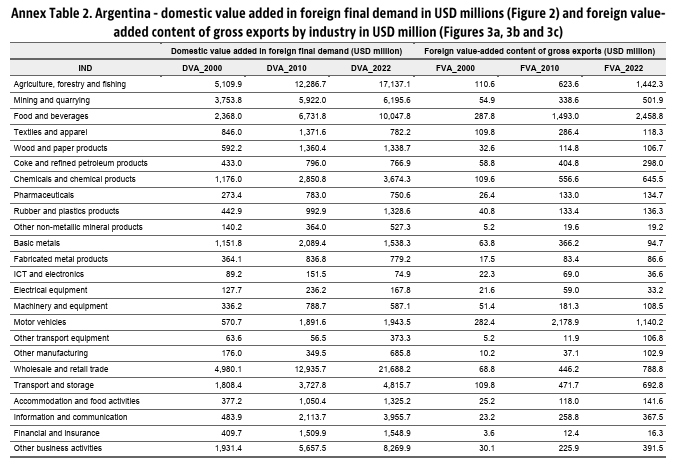
The main consumer markets for Argentine value added are the European Union (12.9%), the United States (11.1%) and Brazil (10.5%), while the suppliers of inputs are the European Union (17.5%), China (17.3%) and the United States (15.5%). This geographic diversification means lower systemic vulnerability compared with economies that are highly dependent on a single critical supplier, as is the case with China and the EU in electric vehicle batteries, or, in the case we analyze, with musical instruments in the US.
Regional comparative analysis and China's vulnerability
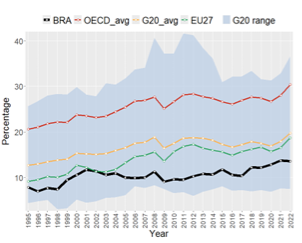
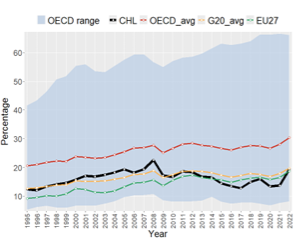
Ambassador Cima noted: "The world of reliable value chains is opening up". In light of an integration process driven by the various free trade and investment agreements being negotiated both by Mercosur (EU, EFTA, Canada, Singapore and others) and by Argentina (the trade and investment agreement with the US, the CPTPP), we believe it is necessary to understand the starting point in order to think through strategies that optimize these integration processes. From a regional standpoint, the comparison with Brazil and Chile reveals different patterns, though neither reaches the levels of integration of OECD countries. Brazil shows greater productive integration of imported inputs in the automotive and chemical sectors, maintaining deeper links with global manufacturing chains. According to the OECD, between 2010 and 2022 the foreign content of Brazil's exports rose from 9.6% to 13.6%. Chile, for its part, displays a high dependence on mining exports with limited processing, a profile similar to Argentina's but more concentrated. The sectors with the highest foreign value-added content in their exports were coke and refined petroleum products (62.9%), textiles and apparel (47.1%) and other transport equipment (42.9%).
With respect to China, Argentina's export structure shows lower exposure to direct dependence because it is oriented more toward natural resources than toward manufactures with multiple cross-border stages. This characteristic does not imply an absence of linkages but rather a different, more indirect exposure.
Foreign content of exports 2022 - Backward integration: Brazil vs. G20 and OECD average
Foreign content of exports 2022 - Backward integration: Chile vs. G20 and OECD average
Strategic advantages of low integration
Argentina's limited participation in complex GVCs also generates competitive advantages in the current context. Lower exposure to Asian, especially Chinese, bottlenecks reduces vulnerability to geopolitical disruptions that affect integrated manufacturing chains. The industries with the highest foreign content in Argentina —ICT and electronics (23.9%), coke and refined petroleum products (22.7%) and motor vehicles (20.8%)— are specific sectors where external dependence is functionally unavoidable, but their aggregate impact remains limited by the relative weight of these sectors in the total export basket. This configuration allows Argentina to maintain lower vulnerability with respect to China in certain segments because it does not depend intensively on critical intermediate imports for highly integrated export industries.
Strategic outlook and trade policy considerations
The post-pandemic global redesign of supply chains and the intensification of geopolitical tensions between the United States and China create opportunities for economies with lower prior integration. Nearshoring and friend-shoring favor suppliers in jurisdictions perceived as less exposed to sanctions or trade restrictions. Argentina can therefore immediately capitalize on the position of its industrial and primary production through agreements such as those mentioned above, without compromising the geographic diversification of trading partners that constitutes its main defensive strength, and achieve the gradual sophistication of its export offering with greater value added.
References:
Director of Pulso Internacional
Lawyer specializing in international trade and productive investment, with more than 25 years of experience in international trade negotiations as an adviser to governments and to companies going international. At Pulso Internacional we analyze foreign trade, bringing clarity and international context so that your company can export and invest more.
Related analysis

European Assessment of the EU-Mercosur Agreement: In 4 Months, European Exports Grow 9%
November 5, 2026 · 2 min
Why Has the US Increased Its Investment in Germany?
November 3, 2026 · 5 min