Argentina v. United Kingdom at the International Tribunal for the Law of the Sea over hydrocarbon exploitation in the Southwest Atlantic Ocean
Translated from the Spanish original. Read the original

Director of Pulso Internacional
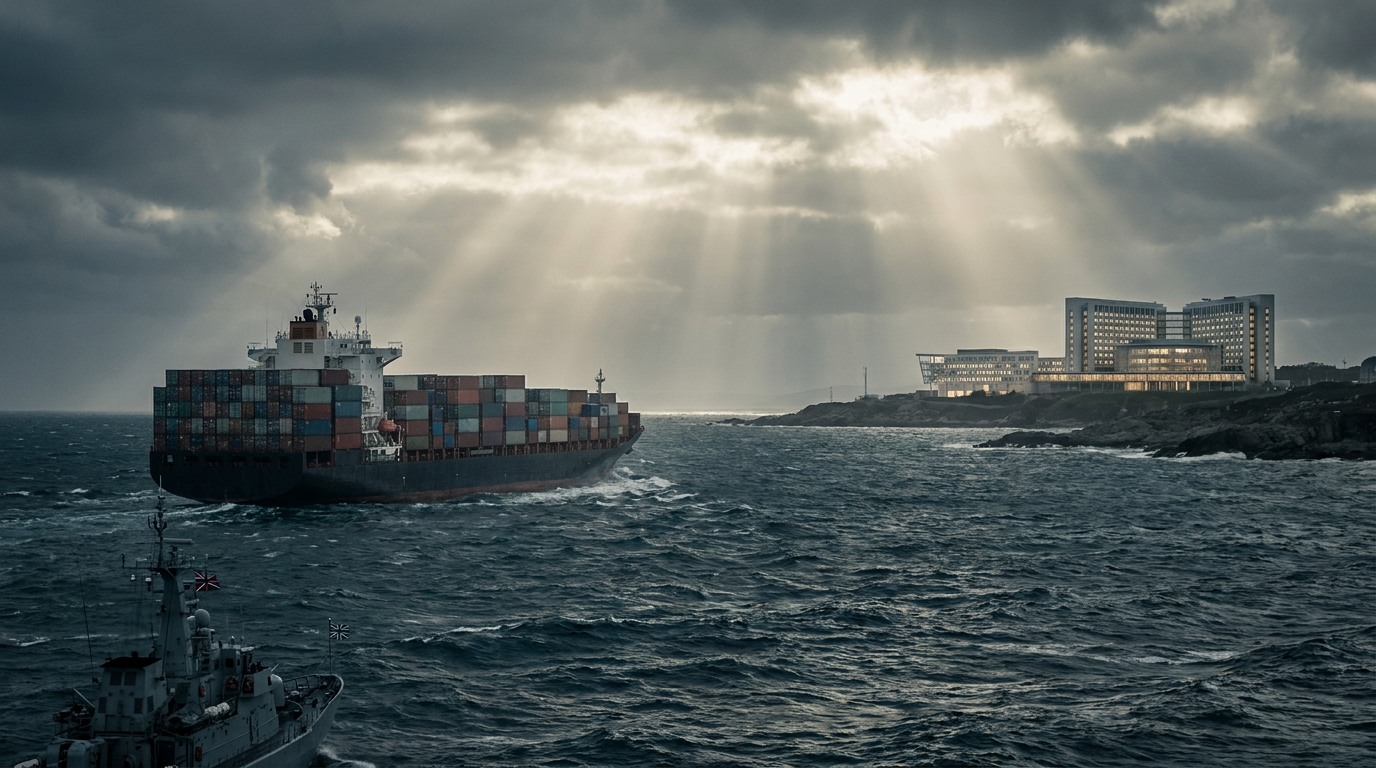
On October 20, 2026, the Hamburg-based International Tribunal for the Law of the Sea (ITLOS) agreed to hear the claim filed by Argentina against the United Kingdom over hydrocarbon exploitation in the Southwest Atlantic.
The legal framework: UNCLOS as the battleground
Argentina's claim before ITLOS is based on the United Nations Convention on the Law of the Sea (UNCLOS), the most important multilateral instrument on ocean governance, ratified by more than 160 States.
Geographical background
After more than eleven years of work, on April 21, 2009, a team led by Dr. Frida Armas Pfirter, on behalf of Argentina, submitted the outer limit of the continental shelf of the entire Argentine territory (mainland, South Atlantic islands and the Argentine Antarctic Sector) to the Commission on the Limits of the Continental Shelf (CLCS), headquartered at the United Nations in New York, in compliance with the provisions of UNCLOS and the CLCS Scientific and Technical Guidelines. In August 2009, the United Kingdom made a submission to the CLCS regarding the continental shelf around the Malvinas (Falkland) Islands and South Georgia and the South Sandwich Islands, which was rejected by Argentina, which expressly asked the CLCS not to consider or qualify it. The CLCS decided that, owing to Argentina's objection, no Subcommission would be established to examine that submission by the United Kingdom. In turn, the United Kingdom asked the Commission not to examine the part of the Argentine submission relating to the area in question, and the Commission decided that, in accordance with its rules of procedure, it was not in a position to examine or qualify the parts of the submission that were subject to dispute.
The dispute between Argentina and the United Kingdom over hydrocarbon exploitation in the Southwest Atlantic Ocean.
On October 13, 2026, Argentina filed with ITLOS a request for provisional measures aimed at suspending the hydrocarbon exploration and exploitation activities that the United Kingdom, through its delegates, unlawfully authorizes around the Malvinas Islands, in waters that Argentina considers part of its extended continental shelf. The submission alleges that these unilateral activities, carried out under the regulatory cover of the de facto administration in Port Stanley, compromise its inalienable sovereign rights and its non-renewable resources, causing it serious harm that would be difficult to repair later. Precisely this potential serious and irreparable harm is the legal threshold required for interim measures to be granted under international law. The case is titled "Hydrocarbon Exploitation in the Southwest Atlantic Ocean (Argentina v. United Kingdom)", and ITLOS's admission of the proceedings is in itself a step forward, since the Tribunal recognizes prima facie jurisdiction to intervene, which means that Argentina's claim was not dismissed in limine. This implies that the legal framework of the claim, including the invocation of the relevant UNCLOS articles on the continental shelf and the exclusive economic zone, withstood the preliminary scrutiny of the international body.
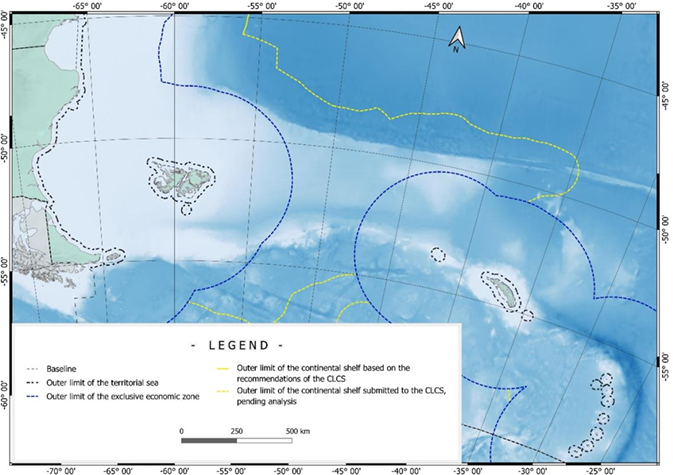
Source/ Map submitted by Argentina to ITLOS
The content of the claim. What is at stake is resources, not only territory
It is important to understand that the core of this action concerns control over the non-renewable natural resources of the seabed and subsoil on the adjacent continental shelf, which belong to Argentina and are claimed by the British Crown.
As Frida Armas Pfirter rightly points out, UNCLOS expressly provides that neither its provisions nor the actions of the CLCS shall prejudice matters relating to the delimitation of boundaries between States with adjacent or opposite coasts, while the Commission, in drafting its Rules of Procedure, went further and specified that it would not act in cases of pending territorial or maritime disputes.
The request for provisional measures filed by Argentina details that the exploration and exploitation activity the United Kingdom seeks to carry out is in the so-called «Sea Lion» field, located approximately 107 nautical miles (198 km) north of the Malvinas Islands and covering an area of some 541.40 km². The de facto British authorities unilaterally granted several production licenses, including the so-called «Sea Lion discovery area» (within PL032), PL032 and PL004b. According to the BBC, potential reserves in the disputed area could reach 1.7 billion barrels of oil, figures that, in the context of the global energy transition and current crude prices, represent a first-order strategic asset for any sovereign State.
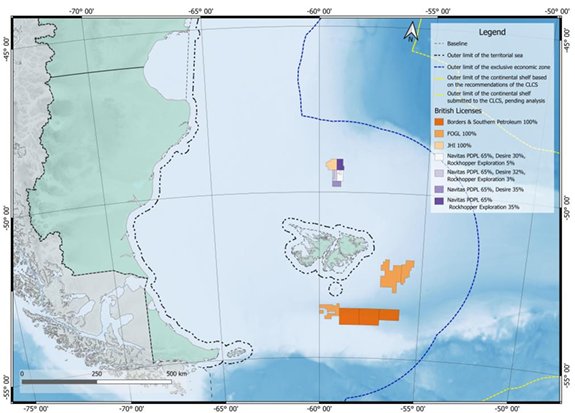
Source/ Argentine submission. Detail of the Sea Lion areas
The October 20 order: scope and interpretation
The order issued by ITLOS on October 20, 2026 establishes the procedure for handling the requested provisional measures and sets the conditions under which both parties must submit their pleadings. The Tribunal's official press release, published on the same date, confirms the formal opening of the case and the scheduling of a hearing for November 10, 2026, in line with the procedure provided for in Article 290 of UNCLOS for the adoption of interim measures.
The provisional measures Argentina is requesting from the Tribunal
In its request for provisional measures, Argentina asks the Tribunal to prescribe the following provisional measures:
(a) that the United Kingdom prevent the commencement or continuation of the exploitation of hydrocarbon resources on the continental shelf, in the North Falkland Basin, through the so-called "Sea Lion" project;
(b) that the United Kingdom refrain from using information obtained in the exploration of the natural resources of the disputed maritime areas to the detriment of the rights of the Argentine Republic;
(c) that the United Kingdom cease preventing the Argentine Republic from fulfilling its obligation, under Articles 192 and 194 of UNCLOS, to protect and preserve the marine environment in the maritime areas subject to the dispute; and
(d) that the United Kingdom refrain from adopting any other measure that may aggravate the dispute, in particular the granting of new permits.
The geopolitical context: why this moment matters
At least three variables converge in the launch of this action in 2026. First, growing international pressure over natural resources, driven by the energy security agenda that permeates both the policy of the United Kingdom and its ties with the United States, and that of Argentina. Second, the judicial activism of third States before ITLOS, including landmark cases brought by small Pacific island nations, which have expanded the case law on continental shelf rights and established a doctrine favorable to claimants. Third, the growing interest of energy companies in the South Atlantic, which increases the political pressure on both governments to establish legal certainty in the area. In this regard, the US company Halliburton, one of the leading firms supplying technology and equipment for oil extraction, confirmed that neither it nor its subsidiaries will carry out any work on the Sea Lion project and that, moreover, they do not participate in hydrocarbon exploration or production activities in or around the Malvinas (Falkland) Islands, as is also the case with Schlumberger. However, two oil companies, the British Rockhopper Exploration and the Israeli Navitas Petroleum, are pressing ahead with work related to Sea Lion.
Implications for foreign policy and the private sector
From a trade and investment policy standpoint, the Malvinas case before ITLOS introduces an element of legal uncertainty in the area that companies holding licenses granted by the Malvinas (Falkland) Islands administration cannot ignore. Should the Tribunal grant the provisional measures requested by Argentina, a scenario would arise in which ongoing operations would become subject to international review, with the contractual and financial consequences this entails for the operators involved.
The Argentine Ministry of Foreign Affairs, for its part, will have to maintain a top-tier litigation team and coordinate with its strategy before the UN Commission on the Limits of the Continental Shelf (CLCS), the technical body established by the United Nations Convention on the Law of the Sea (UNCLOS) that assesses coastal States' claims to continental shelf extensions beyond the standard 200 nautical miles, up to a maximum of 350 nautical miles. To date, the Commission has more than 90 formal submissions from various States pending, involving sovereign rights over seabed areas with natural resource potential valued in the trillions of dollars, including hydrocarbons, polymetallic minerals and rare earths. This litigation before ITLOS requires long-term institutional consistency, sustained technical and legal resources, and coordination among the Ministry of Foreign Affairs, the state energy sector and the province of Tierra del Fuego, Antarctica and South Atlantic Islands that transcends electoral cycles. The next hearing is on November 10 and 11, 2026, and can be followed online.
Sources
- ITLOS — Order in Case No. 37 (Argentina v. United Kingdom) (October 20, 2026)
- ITLOS — Press Release No. 402 (October 20, 2026)
- ITLOS — Official case page: Hydrocarbon Exploitation in the Southwest Atlantic Ocean
- ITLOS — Request for Provisional Measures submitted by Argentina
- ITLOS — Press Release No. 401
- un.org
Director of Pulso Internacional
Lawyer specializing in international trade and productive investment, with more than 25 years of experience in international trade negotiations as an adviser to governments and to companies going international. At Pulso Internacional we analyze foreign trade, bringing clarity and international context so that your company can export and invest more.
Related analysis

European Assessment of the EU-Mercosur Agreement: In 4 Months, European Exports Grow 9%
November 5, 2026 · 2 min
Why Has the US Increased Its Investment in Germany?
November 3, 2026 · 5 min