Argentine Beef Heads to SIAL Paris
Translated from the Spanish original. Read the original

Director of Pulso Internacional
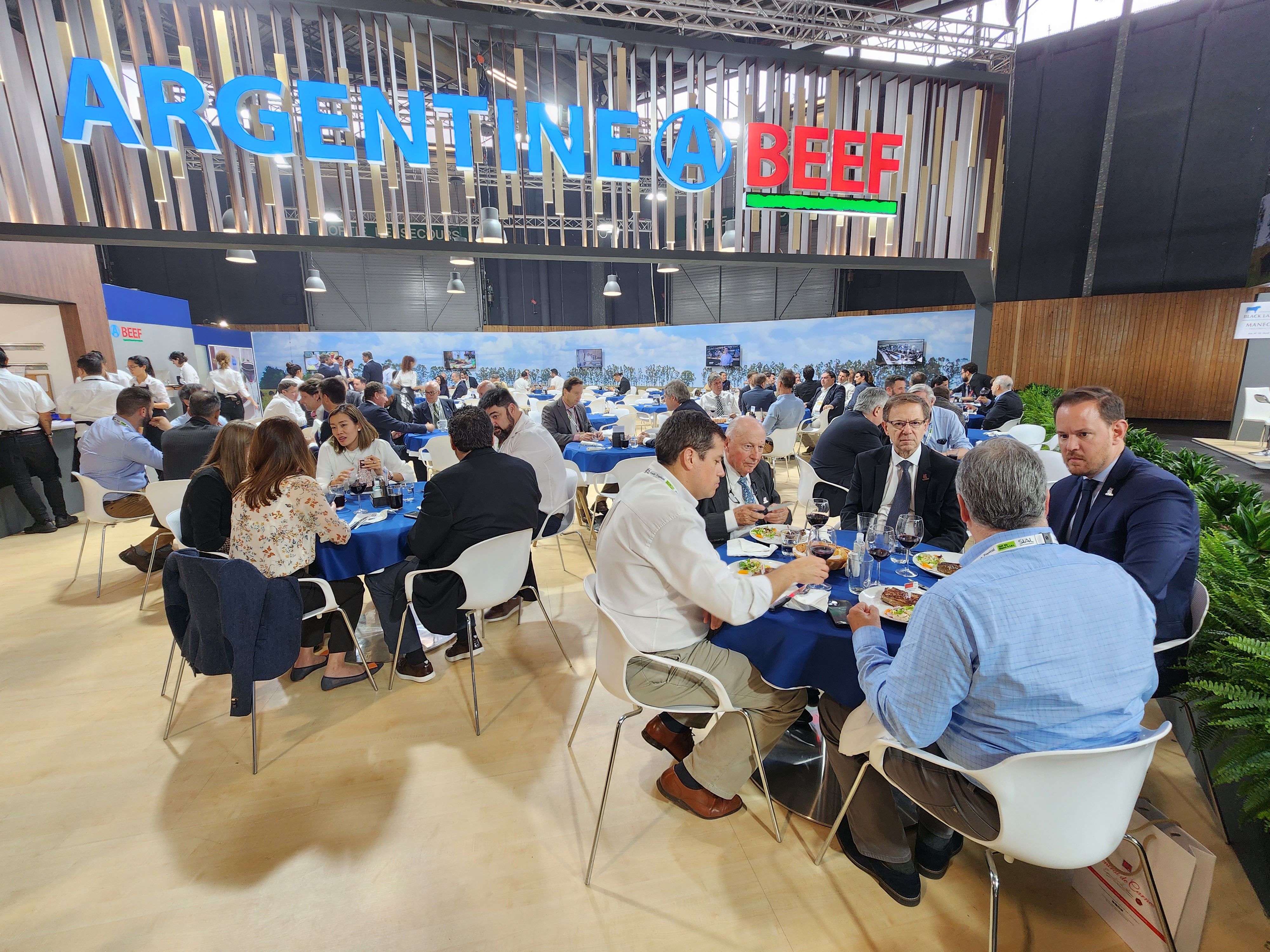
From October 17 to 21, Paris will draw the attention of Argentina's agri-export sector. For the thirty meatpackers traveling under the institutional umbrella of the IPCVA (Argentine Beef Promotion Institute), the SIAL 2026 fair is the stage on which at least three high-stakes issues will be settled simultaneously: adapting to the EU anti-deforestation regulation, the distribution of the Mercosur-EU quota, and taking advantage of the competitive vacuum left by Brazilian beef, on a negotiating calendar that no longer allows for delay.
The pavilion as a promotional instrument
Argentina's participation will be coordinated by the IPCVA, which will operate a 1,000-square-meter Argentine Beef pavilion with space for 30 exporting companies, plus an institutional restaurant for presenting high-quality cuts to international buyers.
As he told the newspaper Clarín, Mario Ravettino, president of the Argentine Beef Exporters Consortium (ABC) and vice president of the IPCVA, set the general tone for the delegation:
"This edition is especially important because the trade picture with the European Union is very interesting. The prices of the goods that Argentina sells to the bloc are significant at this moment."
Ravettino's statement sums up a reality that market data confirm: against a backdrop of good commercial prices and sustained demand, Argentine exporters arrive with high expectations, but also with many questions about the future of the European market. The balance between opportunity and regulatory uncertainty is precisely what gives this edition its strategic character.
Regulation 1115/2023: one more para-tariff barrier
The dominant regulatory issue on the agenda in Paris will be the implementation of the European Union's Regulation 1115/2023 , which establishes new traceability and due diligence requirements for supply chains linked to products potentially associated with deforestation. For the meat industry, this means demonstrating that cattle were raised on properties that did not contribute to forest cover loss, through geolocation systems and documentation verifiable by EU authorities.
What makes SIAL a critical juncture is the timing of the problem. Tomás Coelho, of Frimsa, put the warning in precise operational terms:
"We have the whole deforestation issue ahead of us, and any deal that is closed now for loading at the end of October or early November already falls within the regulation's risk zones. If the regulation takes effect in 2027, all of that has to be resolved."
Coelho's statement reveals a tension that worries the export sector as a whole: contracts signed in Paris today for shipments at the end of the year or in early 2027 must already incorporate the conditions of the new regime, or face rejection at the border or contractual penalties. Far from being a bureaucratic detail, Regulation 1115/2023 reconfigures the very architecture of supply chains: it imposes traceability down to the plot level, obliges operators to submit due diligence statements, and empowers the European Commission to classify countries of origin into risk categories that determine the intensity of controls.
For Argentina, whose cattle traceability system administered by SENASA is one of the most developed in South America, the challenge lies less in the availability of data than in standardizing it in formats compatible with the technical requirements of the European system. The IPCVA will have an intense schedule of meetings on the application and rollout of the system, which turns the pavilion into a venue for technical as well as commercial negotiation.
The Mercosur-EU quota
The second major axis of the Paris agenda is the implementation of the beef quota provided for in the Agreement between the European Union and MERCOSUR.
The share of the quota that each MERCOSUR country holds under the Agreement should be discussed and agreed within the regional bloc for each of the products subject to quotas. Some officials, such as Federico Sturzenegger, celebrated how, in the case of honey, Argentina had got ahead of its partners by quickly submitting its application to the EU without having agreed on what share corresponded to each partner.
"So, while Uruguayan, Brazilian and Paraguayan producers kept running around with their papers from one place to another with the chambers, our producers already had everything settled, filed and took the quota. Bingo!" Federico Sturzenegger, Minister of Deregulation, on X
This practice, celebrated by the minister, sets a bad precedent for negotiating the quotas on other products, such as beef, and makes it harder to reach an understanding.
In effect, the partner countries need to agree on a transparent mechanism for distributing the volumes and avoid disorderly schemes. Without clear allocation criteria, intra-Mercosur competition for the quota could lead to tensions among Argentina, Uruguay and Paraguay that would weaken the bloc's negotiating position vis-à-vis the EU.
According to the newspaper ABC Color, Paraguay's Ministry of Foreign Affairs informed production associations today that the Mercosur countries have not yet reached agreement on the "methodology for distributing the export quotas" for the European Union. Paraguayan Foreign Minister Rubén Ramírez stated that Paraguay "maintains as its position an equitable distribution of 25%," a proposal that has the backing of the private sector.
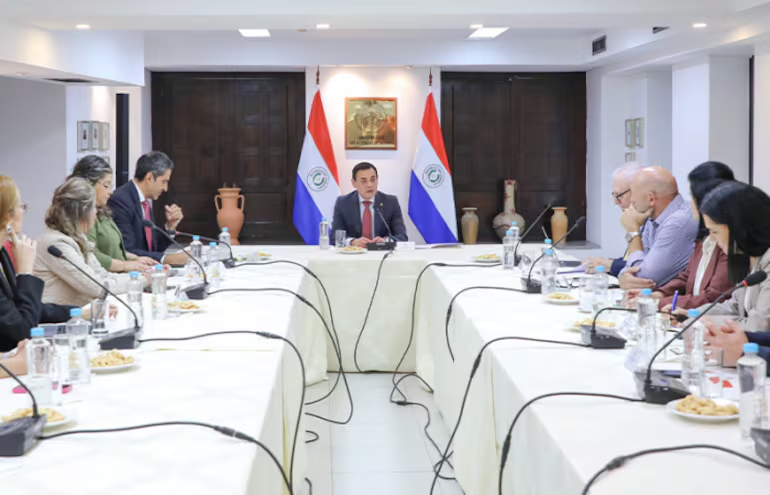
Representatives of production associations and exporters from Paraguay took part today in a meeting at the national Ministry of Foreign Affairs that addressed the question of how to distribute the export quotas to the European Union. (Photo: ABC Color).
The beef quota for the European market
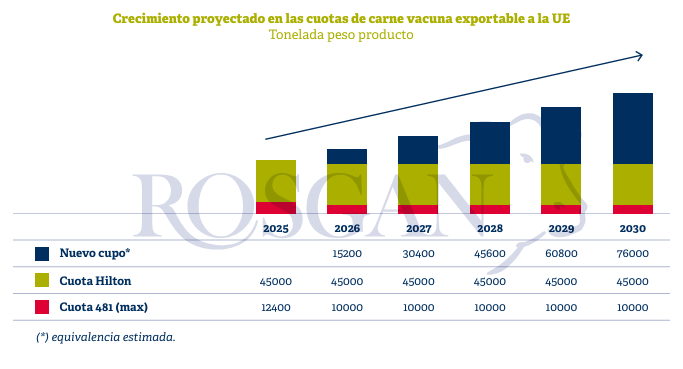
The elimination of tariffs provided for in the EU-Mercosur Agreement has an immediate impact on the Hilton quota which, prior to the agreement, falls under a regime in which European customs applies an import tariff of 20%. As a study presented by Rosgan points out, the agreement grants Mercosur an annual quota of 99,000 tons carcass weight equivalent, approximately 76,000 tons product weight, which would be implemented gradually over the next five years. This quota would be subject to an in-quota tariff of 7.5%, compared with a bound out-of-quota tariff of close to 50%. It is an additional quota that will be progressively incorporated into the quotas already in force, the Hilton Quota and Quota 481. However, unlike the requirements set under both of those tariff regimes, this new quota would not impose restrictions on the type of cattle feeding (grain or grass). It does, however, introduce requirements regarding meat preservation, setting a limit of 55% for chilled products, while the remainder must be exclusively frozen.
Ban on Brazilian beef entering the EU for two years
The third important issue to consider is the restrictions affecting the entry of beef from Brazil into the European Union, because the EU supposedly claims that Brazilian beef does not meet its standards on antibiotic use and food safety for the EU market. This limitation could last two years.
"At the moment, imports of beef from Brazil are banned in the EU, so I have no intention of devoting resources, whether human or financial, to auditing something that cannot be traded," Thévenard told lawmakers, as reported by Bordelex
This opens a window of opportunity that Argentine, Uruguayan and Paraguayan exporters will try to capitalize on. However, this non-tariff barrier must be analyzed with scientific rigor, since it is a way of dividing trading partners. In that regard, SENASA should work with ANVISA to coordinate solutions and future strategies to avoid discretionary decisions on the European side.
A new scenario for Argentine beef
This European scenario also arises at a time of broader geographic reconfiguration of Argentine exports. The agreement with the United States was decisive in the increase in shipments to that destination, while kosher beef to Israel is gaining speed and China is losing weight as the main destination. The market diversification this implies reduces dependence on a single dominant buyer and strengthens Argentina's bargaining power in each individual market. According to the newspaper MDZ On Line, citing data from the Chamber of the Beef and Byproducts Industry and Trade of the Argentine Republic (CICCRA), in the first seven months of the year beef exports totaled 335,500 tons, the second-best performance in the last 22 years for that period, surpassed only by 2024.
Source: MDZ Online, October 2026. Qualitative trend data; exact figures not available in the sources consulted.
Source: Ciccra August 2026 report
SIAL and the potential for trade promotion of the meat industry in Europe
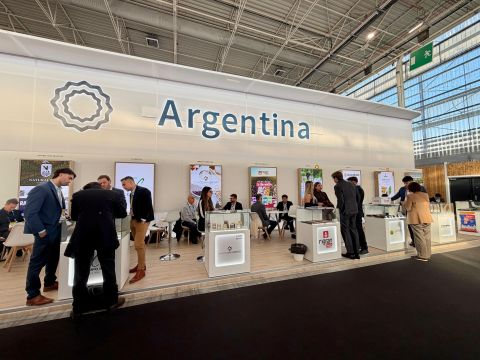
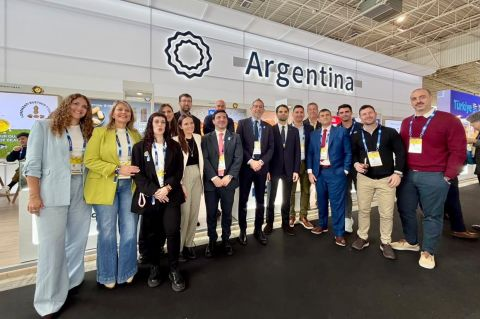
Prom-Argentina was also present at SIAL 2026 with a large pavilion
The convergence of these three vectors (regulatory pressure, the new quota and the competitive vacuum) makes SIAL 2026 a pivotal event for Argentina's export industry.
For the Ministry of Foreign Affairs and the IPCVA (Argentine Beef Promotion Institute), the immediate challenge is twofold: to ensure that the intra-Mercosur distribution mechanism is defined with transparent criteria and is not approached with supposed shortcuts, as happened with the allocation of the honey quota, which was carried out without the consensus of the other members of the regional bloc, and to ensure that Argentina's position in the technical negotiations with Brussels on Regulation 1115/2023 is coordinated at the speed the calendar demands.
Sources
- ipcva.com.ar
- Mirador Provincial — Argentine beef exports: IPCVA makes its debut in France in the face of the European Union's new requirements (October 15, 2026)
- Clarín — "It is very interesting": Argentine beef exporters arrive at SIAL Paris with high expectations over the EU market's new rules (October 15, 2026)
- MDZ Online — Historic shift in beef exports: China loses weight and the US climbs onto the podium (October 15, 2026)
Director of Pulso Internacional
Lawyer specializing in international trade and productive investment, with more than 25 years of experience in international trade negotiations as an adviser to governments and to companies going international. At Pulso Internacional we analyze foreign trade, bringing clarity and international context so that your company can export and invest more.
Related analysis
European Assessment of the EU-Mercosur Agreement: In 4 Months, European Exports Grow 9%
November 5, 2026 · 2 min
Why Has the US Increased Its Investment in Germany?
November 3, 2026 · 5 min