Global Overview of Foreign Direct Investment in 2026
Translated from the Spanish original. Read the original

Director of Pulso Internacional
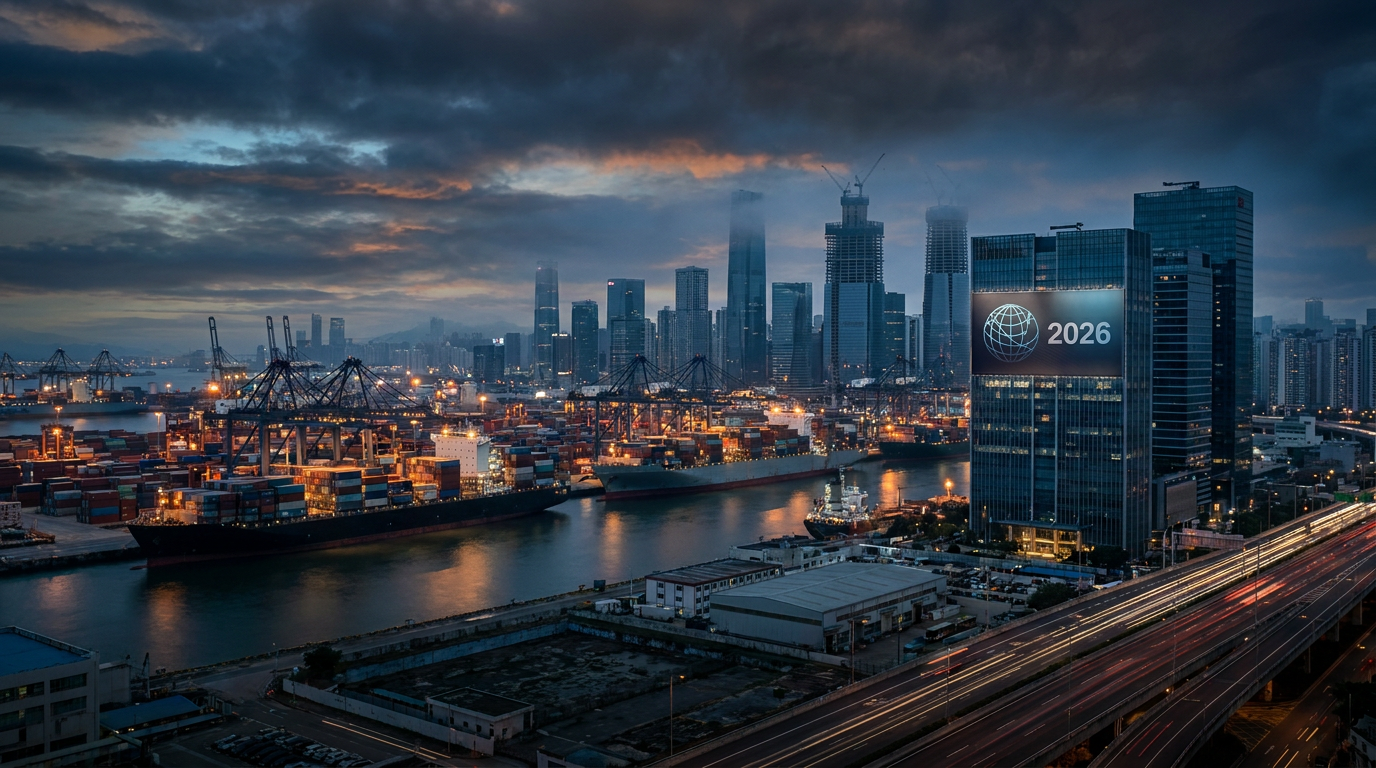
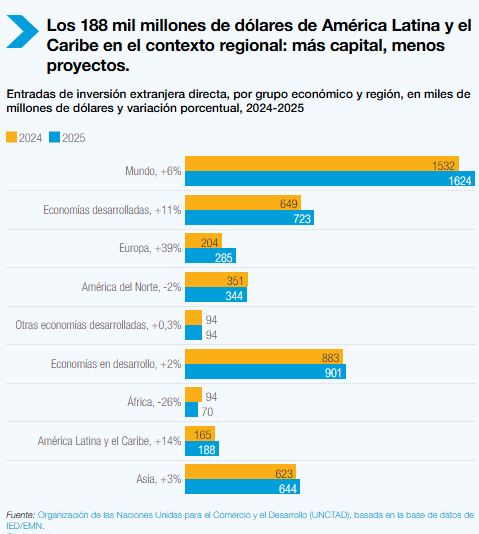
The UNCTAD World Investment Report 2026, published on July 7 this year, confirms a very significant recovery in global foreign direct investment (FDI) in terms of its numbers, though one that is highly concentrated. Global FDI rebounded by 6% in 2025, reaching US$1.6 trillion, ending two consecutive years of decline. Governments are taking a more active role in shaping investment flows. In 2025, countries adopted a record 229 investment policy measures. While most remained investor-friendly, many measures were designed to attract investment into strategic industries, support national economic priorities or respond to economic security concerns.
A recovery that does not reach everyone
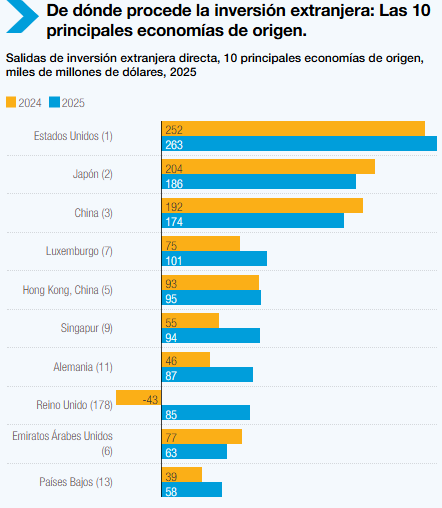
The first reading of the report reveals a structural asymmetry that is becoming increasingly pronounced. FDI flows to developed economies grew by 11%, while developing economies recorded an increase of just 2%, totaling US$901 billion. Evidently, the pressure exerted by the US government on investor home countries is paying off in consolidating the United States as the main destination for investment, as we highlighted in our article on the return of investment to the US, and these figures will be even higher by the end of this year given the investment announcements already published.
Source: UNCTAD
Source: UNCTAD
Latin America and the Caribbean posted a relatively encouraging performance: FDI inflows grew by 14%, totaling US$188 billion, comfortably exceeding the meager 2% growth recorded by developing economies as a whole. The figure is encouraging in relative terms, but it should be read with caution: the region remains marginal in attracting investment in high-technology strategic industries, and the concentration of flows in natural resources and financial services raises serious questions about the quality of the capital that actually comes in. Brazil was the top destination for FDI in the region, with inflows of US$77 billion in 2025 compared with US$63 billion in 2024, placing it among the five largest recipients of foreign investment in the world. The case of Mexico deserves particular attention. The country climbed from 11th to 10th place worldwide in FDI attraction, with US$41 billion received in 2025 compared with US$38 billion received the previous year, consolidating the benefits of the nearshoring phenomenon that positions it as a privileged manufacturing platform for the North American market under the USMCA. In 2026 the Mexican government announced a record investment of US$4.6 billion by Mercado Libre, which follows a trend of Argentine companies making investments in the Mexican market.
Argentina, with a meager US$3.918 billion in 2025, has not managed to attract investment in proportion to the size and potential of its economy.
Sectoral reconfiguration: the new map of productive investment
As relevant as the aggregate amounts is the sectoral composition of the flows. The UNCTAD report documents a strategic shift of historic magnitude: artificial intelligence infrastructure, semiconductors, critical minerals and energy transition technologies accounted for 44% of the value of greenfield investment projects in 2025, compared with barely 16% in 2020. The leap is so large that it is evident we are facing a deep reconfiguration of the map of global productive investment, driven by the combination of the industrial policy of the major powers, climate urgency and technological competition between the United States and China. For Argentina and Mercosur, this trend represents both an opportunity and a challenge. The region has reserves of lithium, copper and other essential minerals that place it in a strategic position within the new investment paradigm; however, the ability to turn that natural resource endowment into quality FDI, the kind that generates productive linkages, technology transfer and skilled employment, depends on public policy decisions that go well beyond the mere availability of resources in the subsoil.
Argentina faces the challenge of turning its regulatory framework into real investment flows
The UNCTAD report does not break out specific data on Argentina in its public communications available as of this edition, a subject we discussed in our previous article. The country is going through a moment of macroeconomic realignment that has generated favorable signals for certain segments of foreign capital, particularly in the energy and mining sectors; nevertheless, long-term FDI, the kind that finances complex manufacturing, productive infrastructure and high-value-added services, requires investment promotion and retention policies that address the country's entire productive reality. Cities, such as Río Grande, are becoming promoters of foreign direct investment, although their actions need to be coordinated in order to optimize them given the intense competition.
The UNCTAD report itself warns that the global outlook for 2026 is difficult because of trade uncertainty, geopolitical tensions, active conflicts, high financing costs and international economic fragmentation. In that scenario, countries that manage to offer access to expanded markets and productive complementarity with global value chains will hold substantive comparative advantages in the contest for international capital. Those that fail to do so will be relegated to attracting lower-quality investment or to losing relative positions to regional competitors. According to UNCTAD, investment in strategic sectors is the great challenge for developing economies: it attracts flows, but does not always manage to turn them into development. For Argentina, this means that the design of the RIGI and of other investment promotion instruments must be evaluated not only by the amounts they promise to attract, but also by the transnationality characteristics of the companies making the investments, with an assessment of strategic risks, as well as by the benefits they will generate in the host country, which can be measured, among other factors, by the quality of the linkages they create, the technology transfer they enable, the potential sales they will generate and the skilled employment they create in the medium and long term. UNCTAD's Transnationality Index is calculated as the average of the following three ratios: foreign assets to total assets, foreign sales to total sales, and foreign employment to total employment. This is how the top 14 companies in the ranking of the largest global investor companies are positioned.
Argentina's critical minerals, agro-industrial capacity and energy potential are real assets; what remains is the political and technical decision to turn them into concrete investment projects and active international negotiations with countries and multinational companies that generate benefits for the country and its people. The strategic window remains open, but not indefinitely.
Sources
- UNCTAD — World Investment Report 2026: International Investment in an Era of Transformation (July 2026)
- UNCTAD — Global investment rises 6% to US$ 1.6 trillion, but its development impact is uneven (July 2026)
- UNCTAD — Investment in strategic sectors is rising, but many developing economies are left out (July 2026)
- IPS Noticias — Investment is rising worldwide, alongside inequalities (July 2026)
- Expansión — Mexico, foreign investment, nearshoring and UNCTAD (July 7, 2026)
Director of Pulso Internacional
Lawyer specializing in international trade and productive investment, with more than 25 years of experience in international trade negotiations as an adviser to governments and to companies going international. At Pulso Internacional we analyze foreign trade, bringing clarity and international context so that your company can export and invest more.
Related analysis

European Assessment of the EU-Mercosur Agreement: In 4 Months, European Exports Grow 9%
November 5, 2026 · 2 min
Why Has the US Increased Its Investment in Germany?
November 3, 2026 · 5 min