How to Prevent Foreign Direct Divestment in Argentina
Translated from the Spanish original. Read the original

Director of Pulso Internacional
Foreign direct investment (FDI) plays an important role in productive development, both in the home economy and in the host economy, and it is just as important to attract new productive investments as to prevent those already established in the country from leaving. The current state of foreign direct investment (FDI) in Argentina is worrying, runs counter to the trend in Latin America and calls for measures that go beyond the Incentive Regime for Large Investments (RIGI).
Understanding how much FDI a country holds (stock), as well as the investment flows entering and leaving each country in the region, is important for designing strategies that increase productive investments and avoid, or at least mitigate, divestments. That is why we will briefly analyze below the FDI trend in the region, the amount and sectors of FDI in Argentina, and the flows that reveal a significant drop in direct investment in the country.
The FDI trend in Latin America
Foreign direct investment (FDI) into Latin America reached US$ 224,000 million in 2025, an increase of 18% over the previous year, according to preliminary ECLAC data. Brazil and Mexico accounted for 65% of these flows. According to the OECD, FDI flows were US$ 76,877 million in Brazil, US$ 40,871 million in Mexico, US$ 13,152 million in Chile and US$ 11,462 million in Colombia, while Argentina received US$ 3,134 million.
ARGENTINA FDI 2022-2025
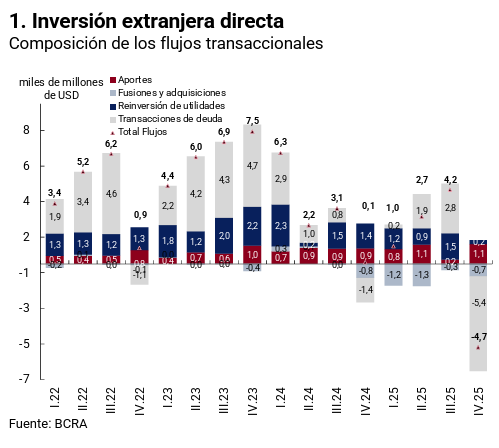
The following charts show the main outflows of investment (productive capital leaving the country) and inflows. The analyses are based on assessments by the Organisation for Economic Co-operation and Development (OECD) and the Economic Commission for Latin America and the Caribbean (ECLAC).
FDI OUTFLOWS AND INFLOWS - (selected countries)





Source: OECD
INWARD FDI FLOWS IN LATIN AMERICA AND THE CARIBBEAN
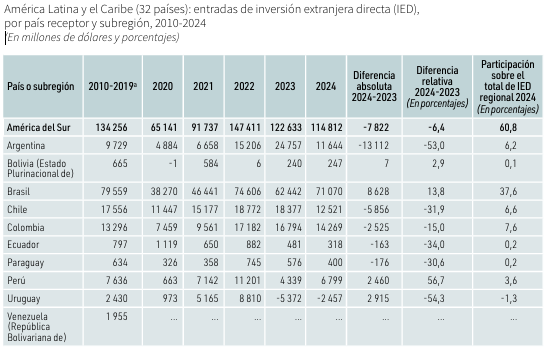
Source: ECLAC
OUTWARD FDI FLOWS FROM LATIN AMERICAN AND CARIBBEAN COUNTRIES
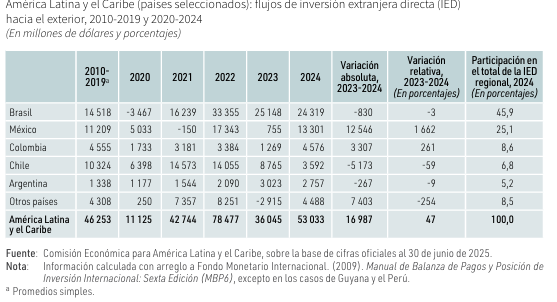
Source: ECLAC
The stock of foreign direct investment in Argentina
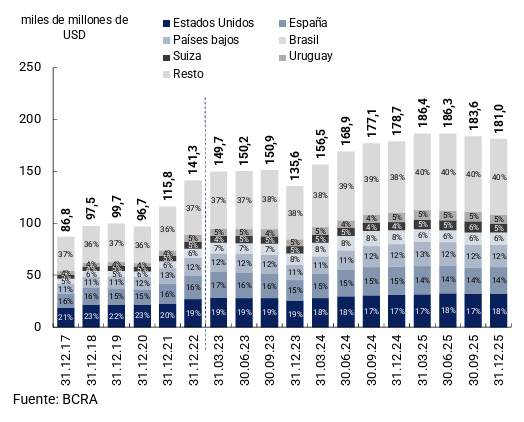
According to the Central Bank of Argentina (BCRA), as of December 2025 total foreign direct investment in Argentina amounts to US$ 181,037 million. The United States was the main source of FDI in Argentina, with a stock of US$ 32,060 million, or 18% of total holdings. Spain came second, with a stock of US$ 25,715 million (14% of the total), and the Netherlands third, with US$ 21,580 million (12% of the total). These three countries accounted for 44% of the FDI stock in Argentina. They are followed by Brazil with US$ 11,626 million, the United Kingdom with US$ 8,070 million, France with US$ 7,157 million and, far behind, Chile with US$ 6,426 million (it once held close to US$ 12,000 million), Mexico with US$ 6,174 million, China with US$ 5,642 million, Germany with US$ 5,097 million, Japan with US$ 2,405 million and Italy with US$ 1,926 million.
FDI STOCK IN ARGENTINA
The sectors where FDI is located in Argentina
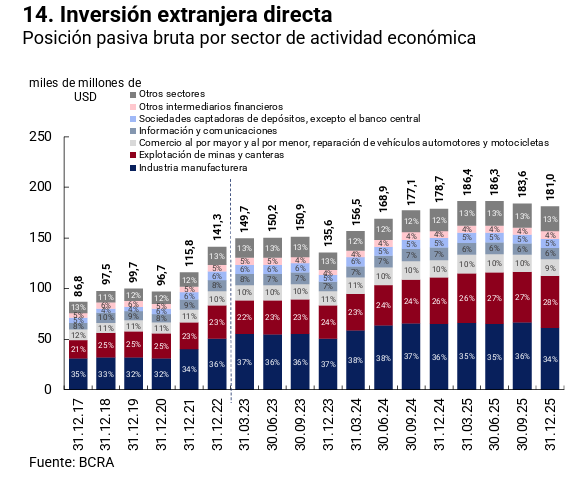
The leading sector in total FDI as of December 31, 2025 is "Manufacturing industry," with US$ 61,235 million, followed by "Mining and quarrying," with US$ 50,921 million, and "Wholesale and retail trade, repair of motor vehicles and motorcycles," with a stock of US$ 16,981 million. Together, these three sectors accounted for 71% of the FDI stock.
Foreign direct investment flows in Argentina
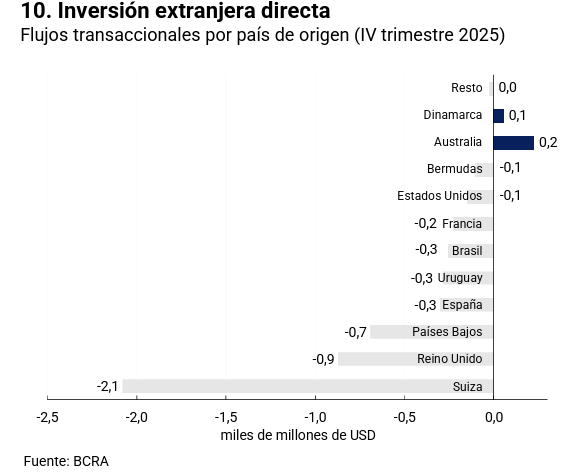
As for investment flows, that is, inflows and outflows, the picture is worrying not only because of the scarcity of new FDI but above all because of the divestments, which were significant in the fourth quarter of 2025. Net outflows of FDI stood out from Switzerland (US$ –2,077 million), the United Kingdom (US$ –871 million), the Netherlands (US$ –690 million), Spain (US$ –299 million) and Uruguay (US$ –286 million). Among net inflows in the fourth quarter of 2025, Australia stood out (US$ 229 million).
FDI FLOWS IN ARGENTINA
How to avoid foreign direct divestment in Argentina
In 1932 the United Kingdom was the country from which the largest foreign direct investments in Argentina originated, at £600,000,000 in 1932 pounds sterling, equivalent to approximately £54,360,000,000 in today's pounds sterling or USD 71,825,324,400, and today that figure has fallen to USD 8,070 million. We can therefore conclude that, historically, the United Kingdom has been the country that has invested the most and also divested the most in Argentina.
Evidently there is no single reason that pushes foreign companies to divest from Argentina or to stop doing so, nor do we claim to list them all. Some try to justify this situation by pointing to the lack of legal certainty. However, that is not the case: Argentina has an independent judiciary and bilateral agreements on the reciprocal promotion and protection of investments which, although we criticize them as anachronistic and of little use, give foreign investors the option of bringing their claims before tribunals abroad such as ICSID (International Centre for Settlement of Investment Disputes). Others point to the macroeconomy as the key factor, because of inflation and the tax burden. However, many countries that receive investment have a tax burden equal to or higher than Argentina's, and they do not stop receiving direct investment because of it. Argentina has skilled human resources and exceptional, abundant natural resources. Nevertheless, it has a limited local market and has not specialized in trying to optimize or expand it. Mercosur is a clear example of the underuse of an integrated economic area, since intra-Mercosur trade, except in the automotive sector, is very limited and does not take advantage of the full potential, as is also the case with investment among its member countries, and what is required are political agreements free of pettiness and mistrust, as well as financial support that encourages integration. The new agreements with economic areas outside the bloc can be useful, but it is necessary to optimize what already exists and to act jointly without trying to gain exclusive advantages that may harm a neighbor. The lack of an industrial policy also discourages local and foreign investment, and we have seen how the world is taking note of that need. The other key issue is the risk rating that underpins the investment guarantees which the investors' home countries grant to their companies; it will be the subject of future commentary, but it is essential for Argentina to unblock it in order to be competitive. There are many policy actions that can optimize Argentina's performance in attracting and retaining investment, as we set out earlier with regard to the RIGI; what remains is the decision to make them effective.
Sources:
- Central Bank of the Argentine Republic (BCRA) - Foreign Direct Investment Report, Fourth Quarter 2025 - Published May 7, 2026 - bcra.gob.ar
- FDI IN FIGURES April 2026- oecd.org
- ECLAC repositorio.cepal.orgR
- UNITED KINGDOM - Debate in the House of Lords in 1932 - (Sir Arnold)
Director of Pulso Internacional
Lawyer specializing in international trade and productive investment, with more than 25 years of experience in international trade negotiations as an adviser to governments and to companies going international. At Pulso Internacional we analyze foreign trade, bringing clarity and international context so that your company can export and invest more.
Related analysis

European Assessment of the EU-Mercosur Agreement: In 4 Months, European Exports Grow 9%
November 5, 2026 · 2 min
Why Has the US Increased Its Investment in Germany?
November 3, 2026 · 5 min