Global System of Trade Preferences among Developing Countries (GSTP) about to enter into force
Translated from the Spanish original. Read the original

Director of Pulso Internacional
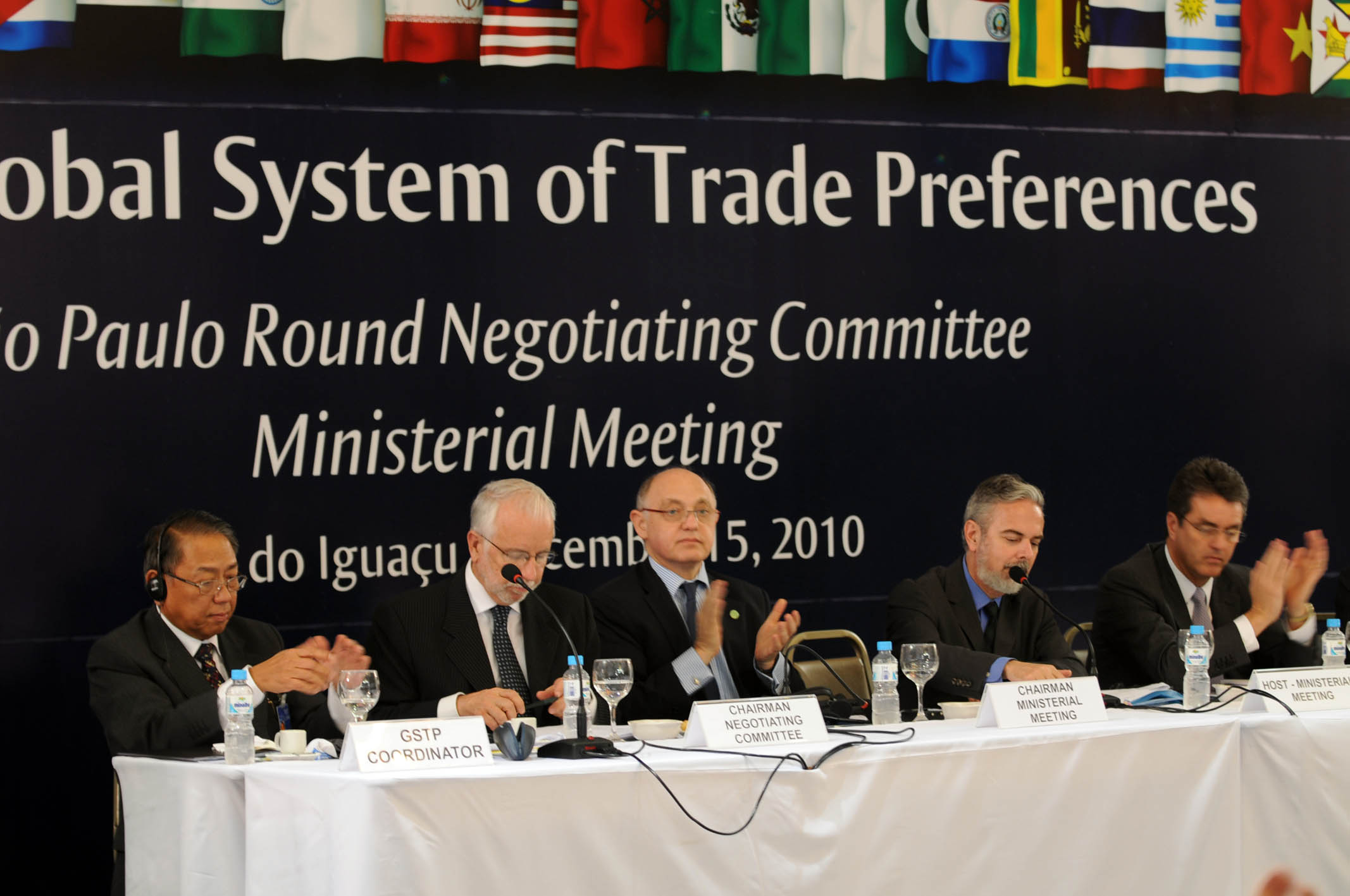
The Global System of Trade Preferences among Developing Countries (GSTP) is an interregional agreement for the preferential liberalization of South-South trade, legally grounded in the WTO's 1979 Enabling Clause. The GSTP currently has 42 member countries. After nearly three decades of intermittent negotiations, the GSTP, known in Spanish as SGPCD, is just one ratification away from entering fully into force. According to UNCTAD, the São Paulo Round Protocol—whose approval determines whether the agreement becomes operational—requires only the deposit of one more instrument of ratification to consolidate what is the only interregional trade mechanism negotiated and administered exclusively by emerging economies. In a global context where tariff protectionism is steadily advancing and the fragmentation of trade flows is deepening, this milestone is not abstract: it represents a good opportunity for Argentina, Mercosur and Latin America as a whole.
An agreement conceived in the Global South, for the Global South
The GSTP was conceived within UNCTAD as an instrument of economic complementarity among developing countries, with the aim of reducing dependence on unilateral preference schemes granted by industrialized powers. Unlike the Generalised Scheme of Preferences (GSP) of the European Union—which, as described on the European Commission's official trade portal, operates unilaterally and non-reciprocally, granting preferential access without requiring tariff concessions in return from beneficiaries—the GSTP is, by contrast, a reciprocal agreement: all members benefit from mutual tariff reductions and all assume symmetrical commitments.
This distinction is fundamental from a trade policy standpoint. GSP schemes, as gratuitous concessions by developed economies, can be modified, suspended or made conditional unilaterally—as demonstrated by the successive adjustments to the European generalised scheme of preferences implemented under the new sustainability standards for 2026. The GSTP, by virtue of its treaty-based and multilateral nature among peers, offers greater legal certainty and regulatory stability for exporters in the participating economies.
The concrete scope: 6,000 products and eleven participating economies
Once fully operational, the agreement will grant tariff reductions of at least 20% on approximately 6,000 products for the eleven countries participating in the current protocol. The size of the tariff universe covered positions the GSTP as a trade policy instrument with real reach, not merely a declaratory one.
The high complementarity among GSTP participants, on both the supply and the demand side, is the main source of gains from trade.
Source: UNCTAD - Christophe Bellmann
Which countries take part in the GSTP negotiations?
This agreement involves the following economies, most of which have yet to sign and ratify. The parties to the GSTP Agreement are: Algeria, Argentina, Bangladesh, Benin, Bolivia, Brazil, Cameroon, Chile, Cuba, the Democratic People's Republic of Korea, Ecuador, Egypt, Ghana, Guinea, Guyana, India, Indonesia, the Islamic Republic of Iran, Iraq, Libya, Malaysia, Mexico, Morocco, Mozambique, Myanmar, Nicaragua, Nigeria, Pakistan, Paraguay, Peru, the Philippines, the Republic of Korea, Singapore, Sri Lanka, Sudan, Thailand, Trinidad and Tobago, Tunisia, the United Republic of Tanzania, Uruguay, Venezuela, Vietnam, Zimbabwe and Mercosur. It should be noted that, even before the formal entry into force of the São Paulo Protocol, merchandise trade among GSTP members already accounted for 23% of their total exports in 2025, which shows that the architecture of South-South trade has a substantive dynamic of its own. The protocol's full entry into force does not create this trade from scratch; it formalizes it, deepens it and gives it the legal backing that enables medium- and long-term export planning.
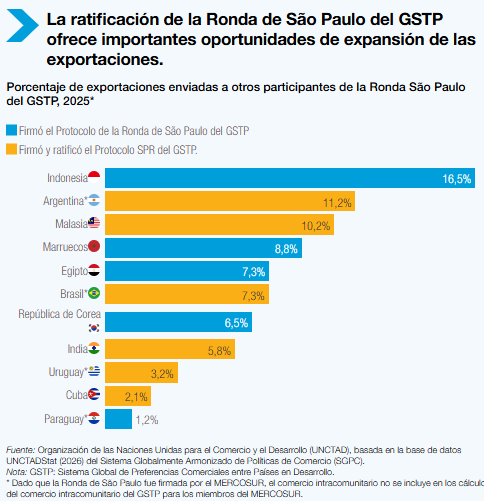
Source: UNCTAD — Global System of Trade Preferences among Developing Countries
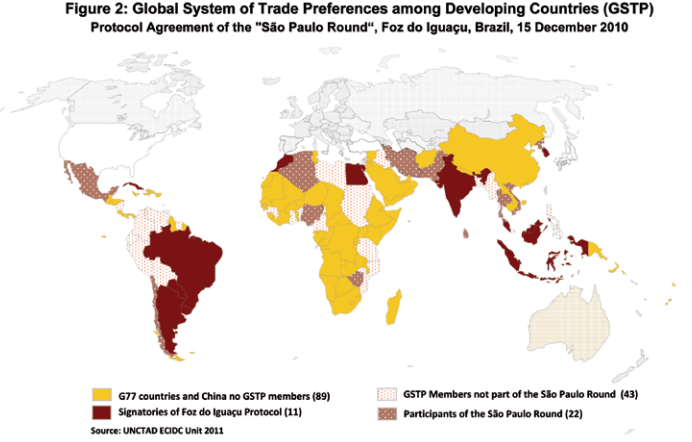
The geopolitical context: why 2026 is not 1988
The GSTP was originally conceived in 1988, in a radically different trading world. Today, the multilateral trading system is going through an unprecedented crisis of legitimacy: negotiations within the WTO remain blocked on multiple fronts, the dispute settlement mechanisms operate with reduced capacity, and the major powers—the United States, the European Union and China—have reoriented their trade policy toward the logic of friend-shoring and economic security, erecting non-tariff barriers that in practice function as disguised restrictions on developing countries' market access. Against that backdrop, the activation of the GSTP takes on a geopolitical relevance that goes beyond the merely technical and tariff-related. The agreement represents the only interregional mechanism negotiated and led exclusively by emerging economies, without tutelage or conditionalities from the countries of the North. In tune with the momentum of South-South blocs—from the expansion of BRICS to the economic partnership agreements between Africa and Asian blocs—the GSTP operates as an instrument of collective trade autonomy.
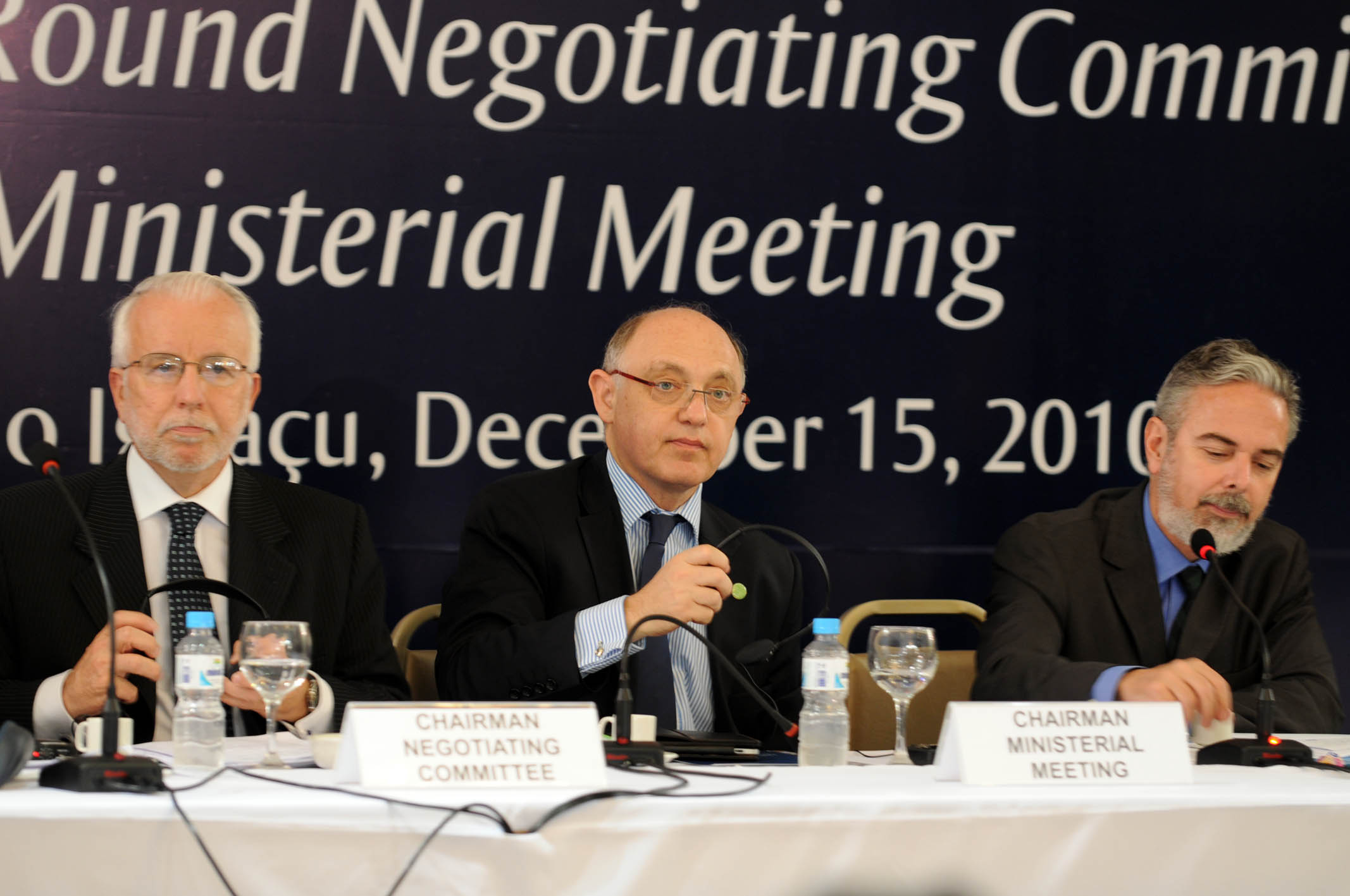
Foz do Iguaçu, December 15, 2010. Foreign Minister Héctor Timerman and Brazilian Deputy Foreign Minister Antonio Patriota presided over the signing of the São Paulo Round Protocol of the GSTP.
Argentina's participation in the GSTP Negotiating Committee. The São Paulo Round
Argentina played a very important role in the negotiations led by Foreign Minister Héctor Timerman, since the São Paulo Protocol was concluded in 2010 under the Argentine chairmanship of the Negotiating Committee of the GSTP. The full entry into force of the GSTP would allow companies in the signatory countries to reduce or eliminate tariffs on exports to other emerging markets—among them India and African economies that are members of the agreement—diversifying the range of destinations for their exports and mitigating structural dependence on the European, US and Chinese markets. The coordination of export promotion enabled by the GSTP is, moreover, a vector of industrial policy with direct implications for economies with diversified productive structures: it allows the development of interregional value chains, the substitution of imports from developed countries with lower-cost goods of South-South origin, and the generation of productive complementarity between economies that, given their relative level of development, do not compete head-on but rather complement each other. Mercosur companies will need to assess urgently which tariff lines are opening up in member markets and how to reconfigure their international integration strategy accordingly. The country is currently a beneficiary of the European Union's tariff preference schemes under the GSP and of other unilateral preference frameworks, which demonstrates its operational capacity to take advantage of differentiated access regimes.
The distinction that foreign trade operators cannot ignore
In trade compliance practice, the GSTP administered by UNCTAD is frequently confused with GSP systems such as those granted by the European Union, the US, Japan or the United Kingdom. The difference is not bureaucratic: whereas the GSP of developed countries is a unilateral regime that does not require reciprocity and can be withdrawn unilaterally and at the discretion of the granting country, the GSTP is a multilateral treaty among peers with reciprocal rights and obligations. For the foreign trade departments of Argentine exporting companies, this distinction defines the degree of legal certainty with which they can plan investments in new destination markets. The GSTP is not just one more mechanism in the universe of preferential agreements: it is the most complete expression of the trade autonomy of the Global South. Its full entry into force in 2026 sets a precedent in the architecture of twenty-first-century international trade, in which developing countries cease to be mere recipients of preferences and become the architects of their own rules of exchange. The Ministry of Foreign Affairs and the export chambers have a concrete agenda before them: survey the tariff lines that have been opened, identify the sectors with the greatest productive complementarity with the eleven members of the protocol, and translate that map of opportunities into trade missions, cumulation of origin agreements and value-added strategies geared toward South-South trade. This trade agreement demonstrates the negotiating capacity of the Argentine Ministry of Foreign Affairs, which, together with Brazil, Paraguay and Uruguay, successfully coordinated the text of this initiative despite the international pressures that delayed its entry into force. It was the first time that Mercosur negotiated in a multilateral forum, a precedent that should be deepened.
Sources
Director of Pulso Internacional
Lawyer specializing in international trade and productive investment, with more than 25 years of experience in international trade negotiations as an adviser to governments and to companies going international. At Pulso Internacional we analyze foreign trade, bringing clarity and international context so that your company can export and invest more.
Related analysis
European Assessment of the EU-Mercosur Agreement: In 4 Months, European Exports Grow 9%
November 5, 2026 · 2 min
Why Has the US Increased Its Investment in Germany?
November 3, 2026 · 5 min