International Trade and Democratic Stability
Translated from the Spanish original. Read the original

Director of Pulso Internacional
In 1930 there were two almost simultaneous revolutions in Argentina and Brazil whose consequences extend to the present day and explain, in part, the asymmetries in the development paths of our two countries. Both revolutions disrupted the prevailing status quo ; however, their victors represented opposing political orientations, even though both were fueled by the realities of world trade.
Argentina and Brazil in 1930: two responses to the same external shock
In Argentina, on September 6, 1930, General José Félix Uriburu led the military coup. He represented the conservative sectors that preferred to keep the country under an agro-export model, which had yielded such good results at the end of the previous century thanks to British imports. This situation had been shaken after the 1929 crisis in the United States by the fall in the price of the commodities (wheat, corn, beef) exported by Argentina, which led to the signing of the Roca-Runciman Pact in 1933.
Since the late 19th century, Brazil's main export base had been coffee production, whose international price had doubled between 1885-1890. But later, faced with the drop in international prices in 1906, the state governors (presidents) of São Paulo, Minas Gerais and Rio de Janeiro, representing the interests of coffee producers, signed the Taubaté Agreement, which laid the foundations for sustaining the price of coffee through the purchase of surpluses by the national state, obliging it to take on international debt.
With the First World War, European countries stopped buying coffee. In 1929 production reached 28,941 million bags of coffee, but only 14,281 million were exported; this at a time when there was a large amount of accumulated stock. This demonstrated the vulnerability of an economic policy based on the export of agricultural products and led the new regime to begin outlining the principles of Brazil's industrialization. On October 3, 1930, Getulio Vargas, civilian governor of the State of Rio Grande do Sul (a non-coffee-producing state), led the coup that broke the hegemony of the conservatives in power, and assumed the presidency of Brazil, which he held uninterruptedly for 15 years; a presidency to which he returned between 1951 and 1954.
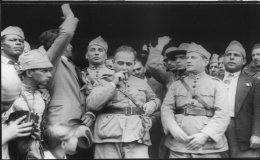
Getulio Vargas - 1930 Revolution
Getulio Vargas did not abandon agriculture, since coffee remained the main source of income, but despite the global 1929 crisis, during the decade from that year to 1939, the growth of Brazilian industry was 125 %, while agriculture did not exceed 20 %. This development was due to import substitution and State support through protectionist measures, which made it easier for the capital of the large coffee producers to shift gradually from agriculture to industry.
This phenomenon of capital transfer from the countryside to industry never happened in Argentina. The modest developments in the agricultural machinery and oilseed industries failed to expand to the rest of the industrial fabric. The persistent tension between the industrial sectors, which took refuge in State support, and the agricultural sector, which championed the free market, repeatedly hindered Argentina's attempts at industrialization and development (Savio/Perón/Frondizi) during much of the 20th century.
Today, the international prices of the commodities exported by our country are at exceptional levels, and Argentina is seeing oil and mining position themselves as new sectors with high export potential.
History shows us the link between the privileges granted to a particular sector and political instability; hence it is important to foster the equitable development of all export sectors and not to leave any of them unprotected, as a way of guaranteeing democratic stability.
Director of Pulso Internacional
Lawyer specializing in international trade and productive investment, with more than 25 years of experience in international trade negotiations as an adviser to governments and to companies going international. At Pulso Internacional we analyze foreign trade, bringing clarity and international context so that your company can export and invest more.
Related analysis

European Assessment of the EU-Mercosur Agreement: In 4 Months, European Exports Grow 9%
November 5, 2026 · 2 min
Why Has the US Increased Its Investment in Germany?
November 3, 2026 · 5 min