The Perfect Storm: As the EU and China Agree Limits on Car Trade, Argentina Raises the FOB Cap on Its 2027 Electrified Vehicle Quota
Translated from the Spanish original. Read the original

Director of Pulso Internacional
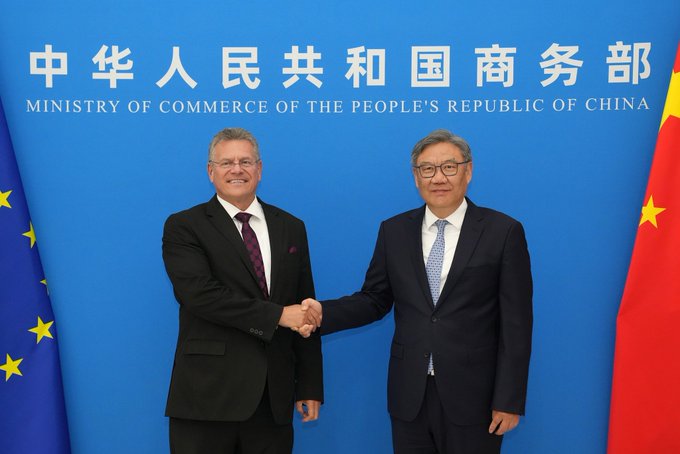
In the same week that Beijing and Brussels reached an agreement in principle to reorder flows of electrified vehicles, Argentina decided to raise the FOB cap of the 2027 electrified vehicle quota, formally broadening access to the domestic market. The timing amounts to a perfect storm that could directly affect car manufacturing in the region.
The Sefcovic–Wang Wentao agreement
European Trade Commissioner Maros Sefcovic confirmed the agreement in principle last Friday following two days of meetings in Beijing with Chinese Commerce Minister Wang Wentao. The text of the understanding was not released, but its core commitments were summarized in a post by Sefcovic himself:
"EU-China trade needs a genuine rebalancing. With Minister Wang Wentao we have reached a shared understanding to: halve exports of HEVs and PHEVs; improve market access in China; further facilitate export licenses for rare earths. A first step. I welcome the genuine engagement. We will meet again by January."
The agreement rests on three pillars: a drastic reduction in Chinese exports of conventional hybrids (HEV) and plug-in hybrids (PHEV) to Europe; improved market access in China for European products; and faster export licenses for rare earths, critical inputs for manufacturing electric mobility technology. The agreement would reportedly run for four years.
The logic of trade diversion: Mercosur as an alternative destination
When a market the size of the European Union restricts imports in a specific category, the result is not reduced production at the source but a search for alternative markets. If Beijing agrees to halve its HEV and PHEV exports to Europe, Chinese manufacturers such as BYD, SAIC, Chery and their subsidiaries producing Western brands in China, will need to place that production capacity elsewhere. Mercosur, and Argentina in particular, emerge as ideal destinations, especially at a time when domestic exchange rate policy and the opening of the 2027 quota amplify the demand signal.
Argentina opens its market further
Argentina's decision to raise the FOB cap of the 2027 electrified vehicle quota, made through Decree 1128/2026, comes at a time when the country has no local production of electric or hybrid vehicles at commercial scale. This means that every unit entering under the quota is an imported vehicle that generates no local value added beyond the distribution and after-sales chain, except for those brought in to be assembled in the country.
The new scheme raises the permitted FOB value to US$ 35,000 for battery electric vehicles and to US$ 18,000 for conventional and plug-in hybrids. The cap for mild hybrids remains at US$ 16,000. All of them may enter as completely built units (CBU), semi-knocked-down kits (SKD) or completely knocked-down kits (CKD).
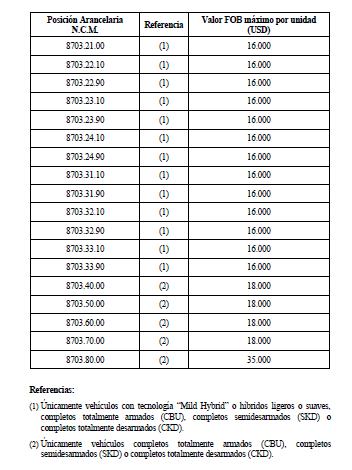
ADEFA and the manufacturers with plants in the country will need to closely monitor how the quotas are distributed among technologies and brands in 2027, particularly if pressure from the European agreement drives Chinese manufacturers to compete on lower prices in the Argentine market.
The possibility of using the quotas to assemble such vehicles in Argentina may also lead to a reconfiguration of the production model. Indeed, Volkswagen announced that it will bring most of the parts from China to be assembled in our country. This has raised concern among the local auto parts makers in its value chain and has even led some of them to close. As reported by Natalia Donato of Infobae, of the 60 local suppliers the German automaker once had, 16 will remain for the new project.
Mexico has set the example of how to attract investment by lowering tariffs on the auto parts needed for vehicle assembly, and this appears to be a regional trend for the sector's survival.
The perfect storm on the horizon is made up of the trade diversion caused by the European limits, US barriers to Chinese cars, the manufacturing of Chinese cars in Brazil and the broader opening to car imports in Argentina. The next Sefcovic–Wang meeting, scheduled for January 2027, will be a new signal. It would be wise to arrive at it with positions of our own. In the meantime, many of the domestic auto parts companies that supply the automakers will need to consider industrial conversion processes.
Sources
- iProfesional — The European Union agreed to cut imports of Chinese hybrid cars by half (October 9, 2026)
- El Economista — Europe puts a temporary brake on hybrid cars arriving from China (October 9, 2026)
- EFE — The European Trade Commissioner wraps up his visit to Beijing with progress on hybrid vehicles and rare earths (October 9, 2026)
Director of Pulso Internacional
Lawyer specializing in international trade and productive investment, with more than 25 years of experience in international trade negotiations as an adviser to governments and to companies going international. At Pulso Internacional we analyze foreign trade, bringing clarity and international context so that your company can export and invest more.
Related analysis

European Assessment of the EU-Mercosur Agreement: In 4 Months, European Exports Grow 9%
November 5, 2026 · 2 min
Why Has the US Increased Its Investment in Germany?
November 3, 2026 · 5 min