Rules of Origin at the Center of Trade Negotiations
Translated from the Spanish original. Read the original

Director of Pulso Internacional
Rules of origin, are the set of laws, regulations and administrative decisions of general application used to determine the country of origin of products. Far from being a bureaucratic detail, they determine whether a product can access the tariff preferences of a trade agreement or whether, on the contrary, it must pay duties as if it came from any other country without preferential treatment. In a context of fragmented value chains and a proliferation of bilateral and regional agreements, understanding and strategically managing the origin of products is today a real competitive advantage.
What rules of origin are and why they matter now
Rules of origin are the criteria that each trade agreement establishes to determine the "economic nationality" of a good. A product is not necessarily "from" a country simply because it was exported from there. Rules of origin matter when applying import duties (tariffs) and trade policy instruments such as antidumping duties and countervailing duties, origin markings and safeguard measures. For a product to qualify as originating, and thus gain access to the agreed tariff benefits, it must meet specific requirements: a. have been wholly obtained in the exporting country, b. have undergone substantial transformation (measured by change in tariff classification, regional content value or specific processes), or c. a combination of both criteria. The relevance of this debate has intensified because of the tensions between the United States and China, which led many companies to relocate suppliers. In that process, the question of whether inputs acquired in third countries "contaminate" the origin of the final product ceased to be an occasional technical query and became a central variable in export planning.
The ALADI framework and origin cumulation
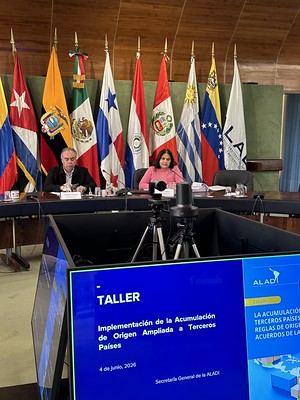
Within the framework of ALADI (Latin American Integration Association), partial scope agreements and economic complementation agreements include specific provisions on origin cumulation that open concrete opportunities for companies in the region. The principle of cumulation allows inputs, materials or production processes contributed by other countries that are party to the same agreement to be counted as if they originated in the exporting country for the purpose of meeting the rules of origin. This has highly consequential practical effects. An Argentine company that manufactures auto parts and uses components from Brazil or Uruguay, countries with which Argentina shares agreements under Mercosur and ALADI, can, under certain conditions, count those inputs as part of the regional content of its product, making it easier to meet the local value-added threshold required by the agreement with the destination country. Cumulation can be bilateral (between two countries party to the agreement), diagonal (in plurilateral agreements where several countries mutually recognize each other's inputs) or full (the broadest form, where all inputs from all party countries are considered originating in the bloc). In ALADI agreements, bilateral cumulation is the most frequent form, although some new-generation agreements are moving toward more flexible schemes.
Forms of origin cumulation in ALADI agreements
Source: author's elaboration based on the texts of partial scope and economic complementation agreements within the framework of ALADI.
Conceptual note: In all cases, cumulation operates as an exception to the general requirement of substantial transformation and is subject to the accumulated inputs holding a valid certificate of origin and meeting the conditions set out in the annex on rules of origin of the corresponding agreement.
Export planning: origin as a variable to take into account
The most frequent mistake made by exporting companies in the region, especially SMEs, is to treat the certificate of origin as an administrative formality that follows the commercial decision, rather than building it in as a variable from the design stage of the value chain. A supplier of inputs that appears cheaper may, in the end, make the operation more expensive if its inclusion causes the product to lose its originating status and, with it, the agreed tariff preference. Planning for origin involves, first, mapping precisely which trade agreements apply to the destination market and what their specific rules of origin are for the product in question. Second, identifying which input suppliers are eligible for cumulation, that is, which countries are part of the same agreement and under what conditions their materials may be counted. Third, calculating the product's effective regional content under different sourcing scenarios, in order to identify the combination that maximizes the tariff preference without compromising cost competitiveness. This type of analysis, which in large multinational corporations is carried out by specialized trade compliance teams, is increasingly within reach of mid-sized companies thanks to the development of digital tools and the availability of systematized information from bodies such as ALADI, the WTO and ECLAC.
As Lic. Andrea Ruso rightly points out in her article published in Aduana News, in some cases it is possible to use as inputs imported products from certain countries that are not party to trade agreements without losing Mercosur origin. Companies can take advantage of the trade agreements (Economic Complementation Agreements) concluded within the framework of ALADI: ACE 18, the founding agreement of MERCOSUR, ACE 36 between Mercosur and Bolivia, ACE 46 between Ecuador and Cuba, and ACE 75 between Chile and Ecuador, if they take into account 5 basic issues that allow them to be operational;
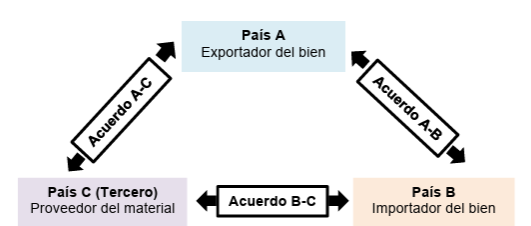
As ALADI points out, information on which third countries may participate in cumulation is essential to be able to apply it. These third countries must have agreed on tariff reductions, both with the country exporting the good that uses the third country's materials in its production and with the country importing that good, in order to take part in the value chains that ultimately make it possible to apply preferential treatment to the imported good. Thus, whenever the possibility of cumulating origin with a third country arises, we will be facing a trio of countries linked by preferential agreements: the country exporting the good, the country supplying the material that takes part in the cumulation, and the country importing the good, as shown in the following diagram.
The negotiating front: rules of origin in ongoing agreements
Rules of origin are not only a matter of applying agreements already in force; they are also one of the most sensitive and contested points in ongoing negotiations. Both in the European Union and in the US, with Mexico and Canada, measures are being discussed to increase the level of local content of products in order to guarantee access for products from "trusted partners" and to reduce the transshipment or redirection of Asian production, mainly Chinese. Amendments to the free trade agreement between the US, Mexico and Canada (USMCA) are currently being negotiated. The US seeks to raise the regional content requirement for automobiles from 75% to 80% and includes a significant number of basic parts that Mexico currently imports from China. Mexico has become the United States' leading trading partner since 2023, and this represents a challenge in negotiations that aim to extend the agreement's validity for 16 years and that would expire on July 1. If no agreement is reached, a provisional arrangement could be adopted, with partial renewals made annually. The agreements that Chile, Colombia, Peru and Mexico —members of the Pacific Alliance— have negotiated with Asian partners include diagonal cumulation provisions that allow inputs from third countries with cross agreements to be counted, generating increasingly complex value chain schemes that are, at the same time, more sophisticated in terms of planning.
Origin certification in the Mercosur-EU Agreement
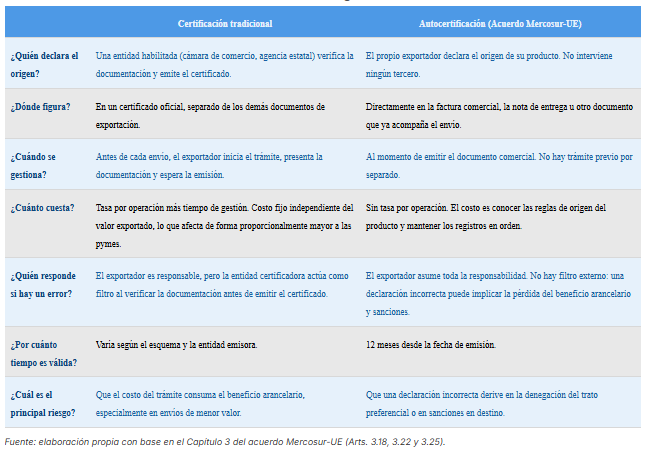
One of the novelties of the Mercosur-EU Agreement is origin self-certification, which is already used in numerous trade agreements. The agreement provides for a 3-year adaptation period and, as an interesting IDB article points out, these are the main differences between the traditional system and the new one.
What companies can do today
The current context requires Latin American exporting companies to take a proactive approach to rules of origin. Some concrete actions that foreign trade teams should incorporate into their operations include:
- Periodically auditing compliance with rules of origin for exported products, since changes in suppliers or in the composition of the product can alter its originating status.
- Taking advantage of the cumulation mechanisms available in agreements in force to expand the network of eligible suppliers without losing tariff preferences.
- Monitoring the progress of ongoing trade negotiations, since the rules of origin agreed in new treaties can open or close opportunities for certain sectors and production chains.
- Consulting with sector chambers and the competent public bodies —MRECIC, trade secretariats, export promotion institutes— on the texts of the agreements and their interpretation in specific cases.
- Considering supplier location as a decision based not only on cost and quality, but also on eligibility for origin cumulation under the agreements relevant to each destination market.
Rules of origin represent, ultimately, the hidden side of preferential trade. Those who understand them in depth and incorporate them into their export planning not only avoid costly customs contingencies, but also turn a technical requirement into a lever of real competitiveness. In a region like Latin America, where trade integration advances in a complex and fragmented manner, mastering this instrument is increasingly less optional and increasingly a condition of entry into the game of global value chains.
Sources
- aladi.org
- WTO — Rules of origin: general information and agreements
- aduananews.com
- ALADI - Report "CUMULATION WITH THIRD COUNTRIES IN THE RULES OF ORIGIN OF ALADI AGREEMENTS" - 4-28-2026
www2.aladi.org/biblioteca/Publicaciones/ALADI/Secretaria_General/SEC_Estudios/256.pdf
5. Origin self-certification: the key that unlocks the preferences of the Mercosur-EU agreement iadb.org
Director of Pulso Internacional
Lawyer specializing in international trade and productive investment, with more than 25 years of experience in international trade negotiations as an adviser to governments and to companies going international. At Pulso Internacional we analyze foreign trade, bringing clarity and international context so that your company can export and invest more.
Related analysis

European Assessment of the EU-Mercosur Agreement: In 4 Months, European Exports Grow 9%
November 5, 2026 · 2 min
Why Has the US Increased Its Investment in Germany?
November 3, 2026 · 5 min