Switzerland Votes Against Capping Its Population at 10 Million
Translated from the Spanish original. Read the original

Director of Pulso Internacional

The Swiss Referendum and the Demographic Equation in Global Trade
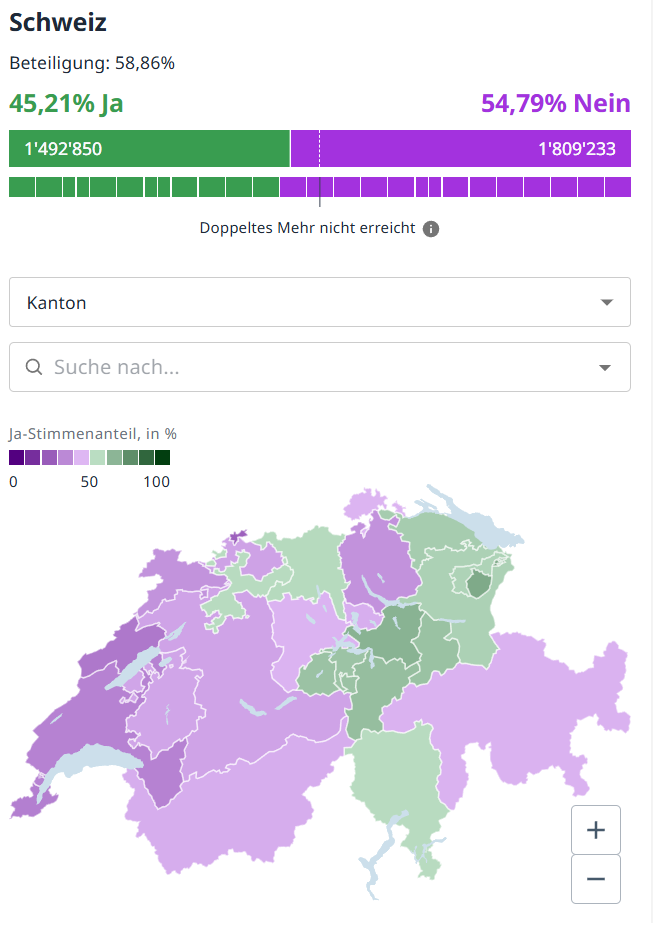
Swiss voters rejected on June 14, 2026, in a referendum, with about 55% of the vote against 45%, a popular initiative that sought to set a population cap of 10 million inhabitants by 2050. This shows that demography has definitively entered the strategic and ideological debate on economic and trade policy. The initiative, driven by far-right groups (such as the Swiss People's Party) that argue environmental sustainability concerns and a lack of infrastructure for more people, was defeated, but its mere existence shows that the discussion on population is no longer just demographic, but also geopolitical, commercial and one of sustainability. What is at stake, for Switzerland and for any country, is much more than a census figure: it is the architecture of its international integration and its survival as a nation. The supposed "sustainability" of the isolationist proposal uses environmentalist concepts such as sustainable development in order to extend them to demographic aspects that go beyond intergenerational responsibility.
Official results of the Swiss referendum
Population as a Strategic Variable: Size, Structure and Composition
The relationship between demography, birth rates and foreign trade is direct and multidimensional. The size of the population reflects in many cases the size of the domestic market, the availability of labor force, as well as the pressure on demand for imported goods (such as food or oil) and a country's capacity to sustain certain production chains. However, reducing the analysis to the absolute number of inhabitants would be a diagnostic error. Population matters in trade terms not only because of its size, but because of its composition: a young population favors durable consumption and industrial expansion, while an aging population drives health care, services, technology and specialized goods. Immigration can offset aging and labor shortages, birth rates also seek to sustain the future base of workers and consumers, and foreign trade allows small or aging countries to access global scale without depending solely on the domestic market.
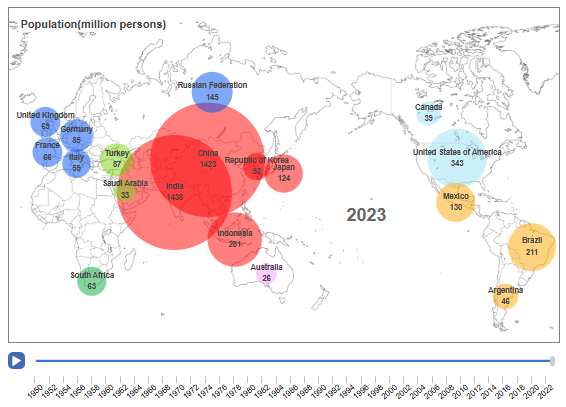
To see the evolution of the world population shown in the chart, open the link
The Swiss Model: Niche Specialization as a Response to Small Scale
The Swiss case clearly shows the logic of small and today highly developed economies. In the 19th century, many Swiss people emigrated to Argentina (mainly to the province of Santa Fe) owing to a lack of job opportunities. Today, with a population of approximately 8.9 million inhabitants, Switzerland has built its economic growth based not on the size of its domestic market, but on the sophistication of its export offering in sectors such as pharmaceuticals, precision watchmaking and financial services. Economies with small populations tend to concentrate on high-value niches, efficient logistics or sophisticated services in order to compete internationally, dispensing with the scale that economies based on mass production do require. Within this framework, the debate on a 10 million cap is not innocent. Limiting demographic growth through migration restrictions also means curbing the supply of skilled labor force that sustains, in the medium and long term, the sectors with the highest added value. The relationship between population and international trade is direct.
The Historical Precedent: From the Rome Consensus to Contemporary Pronatalist Policies
The tension between demographic growth and development is not new. In the 1970s, the so-called Rome Consensus, articulated around international organizations and governments of the developed world, promoted birth control policies in developing countries, on the argument that excess population was an obstacle to economic growth. Decades later, it was shown that this paradigm was mistaken. The demographic contraction in Europe and East Asia made clear that the scarcity of working-age population is, in itself, a systemic risk for external competitiveness and for a country's continuity as an independent nation, as demonstrated by the case of Denmark and Greenland, which is under pressure from the US. Today, countries such as Japan, South Korea, Russia and even several European countries design pronatalist incentives (subsidies, extended parental leave, priority access to housing) with the aim of sustaining their labor base and, with it, their export capacity. Immigration can sustain GDP growth, expand the labor force and strengthen export sectors that are intensive in labor or knowledge, while pronatalist policies seek slower, long-term effects on the domestic market. Both tools are complementary, not mutually exclusive, and their optimal combination depends on each country's production profile.
Demography as State Policy: Implications for Regional Trade Strategy
What the Swiss referendum places on the global agenda is a fundamental question that decision-makers in Latin America cannot ignore: what is the optimal demography for maximizing a country's international trade integration? The answer is neither universal nor static. For MERCOSUR as a bloc, the demographic discussion takes on an additional dimension, since the free movement of people within the regional space could work as a mechanism that facilitates integration and adjustment, balancing excesses and shortages of labor force among member countries, as it does within the European Union. That potential is underexploited and requires stronger regulatory frameworks that go beyond the Mercosur visa.
The Swiss parliament's rejection of the EFTA-MERCOSUR agreement
In line with the isolationist trend expressed by the 45% of voters in the referendum, Switzerland's lower house rejected the free trade agreement between the European Free Trade Association (EFTA) and Mercosur, in a vote that exposed deep political differences over the impact the agreement could have on sensitive sectors of the economy. As the newspaper Argentinishes Tageblatt reports, the agreement received 96 votes against, 86 in favor and nine abstentions. In addition, legislators rejected a series of complementary measures that sought to offset possible effects on agriculture and strengthen environmental commitments. The treaty must still be considered by the upper house of the Swiss Parliament. This delay in the negotiations may jeopardize the opening strategy implemented by the Mercosur countries, which had been driven by the interim Trade Agreement with the European Union.
The convergence of demography, migration policy and trade strategy requires Latin American governments to carefully analyze its direct implications for their capacity for growth and economic well-being. At the same time, it is essential that Argentina and the MERCOSUR member countries articulate joint policies on human capital, labor formalization and settlement in each of the countries that facilitate economic integration and encourage productive investment.
Sources
- BBC News — Swiss population cap referendum: 55% of voters reject initiative (June 2026)
- Economic Strategy Group — Population, geopolitics and trade sustainability
- "Volksinitiative «Keine 10-Millionen-Schweiz! (Nachhaltigkeitsinitiative)» Popular initiative «No to a Switzerland of 10 million inhabitants! (Sustainability initiative)» 16-3-2026 admin.ch
Director of Pulso Internacional
Lawyer specializing in international trade and productive investment, with more than 25 years of experience in international trade negotiations as an adviser to governments and to companies going international. At Pulso Internacional we analyze foreign trade, bringing clarity and international context so that your company can export and invest more.
Related analysis

European Assessment of the EU-Mercosur Agreement: In 4 Months, European Exports Grow 9%
November 5, 2026 · 2 min
Why Has the US Increased Its Investment in Germany?
November 3, 2026 · 5 min