United States threatens higher tariffs to block imports made with forced labor
Translated from the Spanish original. Read the original

Director of Pulso Internacional
The new forced labor investigation and its impact on foreign trade
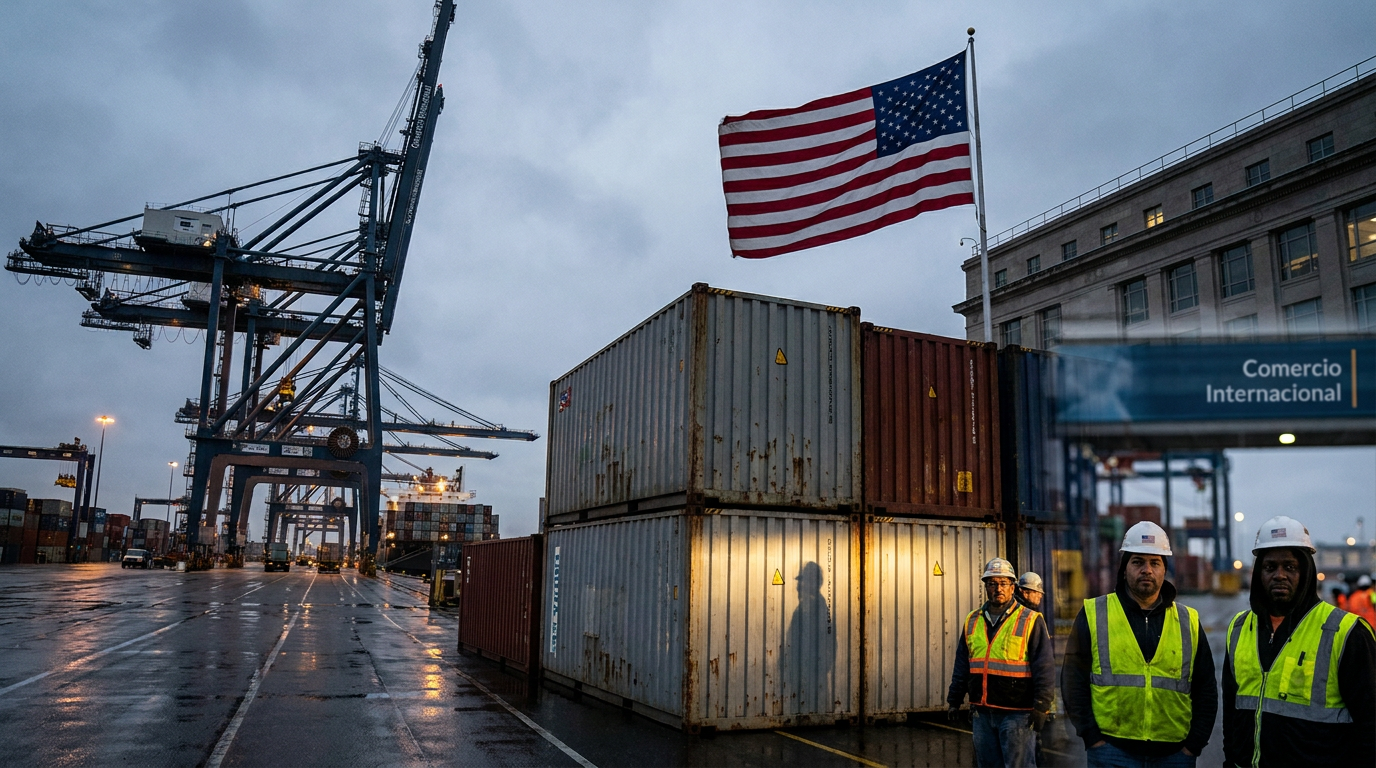
Following the US Supreme Court ruling against the reciprocal tariffs adopted by the Trump administration, on March 12, 2026 the US Trade Representative (USTR) formally launched an investigation into countries that allegedly fail to prohibit or adequately monitor the import of goods made with “forced labor”, arguing that this omission creates unfair competition that harms its workers and companies, in addition to contravening international human rights standards, and it bases this action on its domestic law, Section 301 of the Trade Act. (1)
Current international trade remedies laws, such as antidumping and countervailing duties, are insufficient because they do not directly address the role of forced labor in production, nor do they prevent the goods from entering the market. This is not a matter of prices, but of a trade distortion linked to unjustifiable production methods. This investigation affects the United States' 60 main trading partners, Argentina among them, which accounted for 99 percent of US goods imports in 2025, and the ultimate goal is to raise tariffs and establish non-tariff restrictions on imported products.
The perspective on the forced labor investigation that Argentina must take into account
Although the Americans consider their legislation to be the “model” to be followed by other countries (obviously debatable), from the Argentine perspective this investigation has three aspects to be considered:
- On the one hand, the measures adopted or that may be adopted by our country to prevent imports of goods produced with forced labor. Indeed, this same concept of forced labor appears in Article 2.9 of the Agreement between Argentina and the US signed this year, under which Argentina undertakes to prohibit the import of goods produced wholly or in part by forced labor as defined by the ILO. (3 and 4)
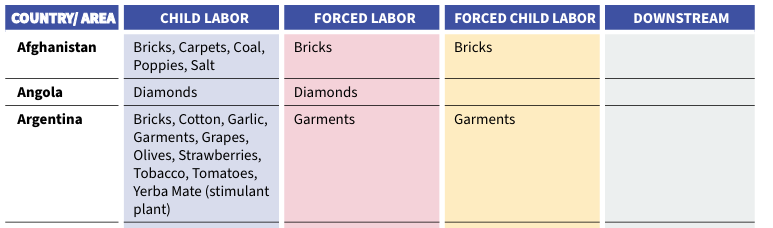
2. On the other, the forced labor that the US government alleges is practiced in other countries, Argentina among them, based on the 2024 list prepared by the US Department of Labor, which identifies 134 products and points to certain sectors in Argentina: bricks, cotton, garlic, garments, grapes, olives, strawberries, tobacco, tomatoes and yerba mate. The evidence attached to the US Department of Labor document to justify Argentina's inclusion on the list consists mostly of press articles or ILO reports, and although it acknowledges the government's efforts in the blueberry sector, which had been added in 2009, it was the only sector removed from the list. (5)
3. Finally, the impact of forced labor in third countries, which affects the competitiveness of Argentine products that are not produced with forced labor in markets such as the US, for example those of the oleochemical industry (essential oils used for personal care) or the wood industry (marquetry). (6)
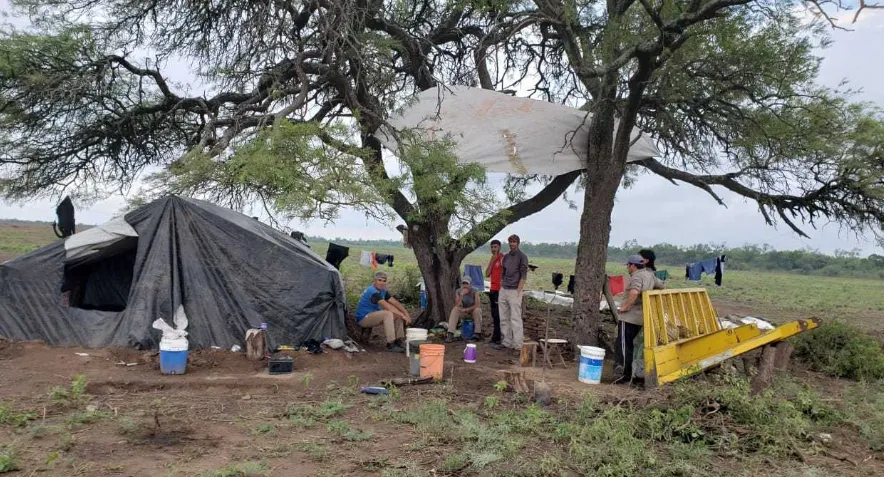
The sectors in which forced labor or child labor is alleged in Argentina are: bricks, cotton, garlic, garments, grapes, olives, strawberries, tobacco, tomatoes and yerba mate.
How to participate in the investigation before the Office of the US Trade Representative?
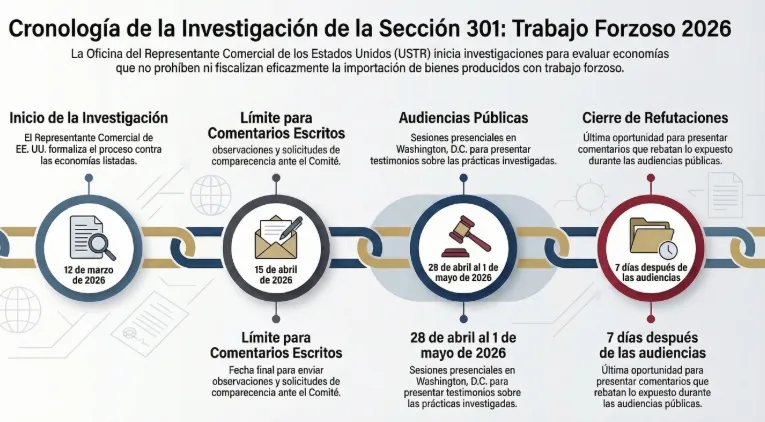
Early identification of the new policy implemented by the US, and monitoring it, is very important to prevent harmful effects. In this regard, the USTR document initiating the investigation sets out a schedule for receiving public comments and holding hearings during 2026 in order to assess possible trade sanctions or tariffs. There is a call for public consultations, whose process is as follows:
Who might have an interest in participating in the investigation?
Business chambers that consider the assertions about their sectors to be mistaken could, together with the Ministry of Foreign Affairs and US importers linked to the companies in their chambers, coordinate the corresponding submissions to avoid or mitigate tariff increases or restrictions on entry into the US market.
References:
- USTR “Initiation of Section 301 Investigations of Acts, Policies, and Practices of Various Economies Related to the Failure to Impose and Effectively Enforce a Prohibition on the Importation of Goods Produced with Forced Labor “ ustr.gov
- Section 307 of the Tariff Act of 1930 grants U.S. Customs and Border Protection ( CBP ) the authority to investigate and enforce prohibitions against any “goods, wares, articles, and merchandise mined, produced, or manufactured wholly or in part in any foreign country by convict labor, forced labor…”
- cbp.gov
- Argentina - US Agreement (2026) ustr.gov
- DOL “ List Produced with Child Labor or Forced Labor “ 2024 dol.gov
- E.g. Jojoba oil produced by the US company Vantage in Argentina vantagegrp.com
Director of Pulso Internacional
Lawyer specializing in international trade and productive investment, with more than 25 years of experience in international trade negotiations as an adviser to governments and to companies going international. At Pulso Internacional we analyze foreign trade, bringing clarity and international context so that your company can export and invest more.
Related analysis

European Assessment of the EU-Mercosur Agreement: In 4 Months, European Exports Grow 9%
November 5, 2026 · 2 min
Why Has the US Increased Its Investment in Germany?
November 3, 2026 · 5 min