India, Santa Fe's Leading Export Destination in 2026
Translated from the Spanish original. Read the original

Director of Pulso Internacional
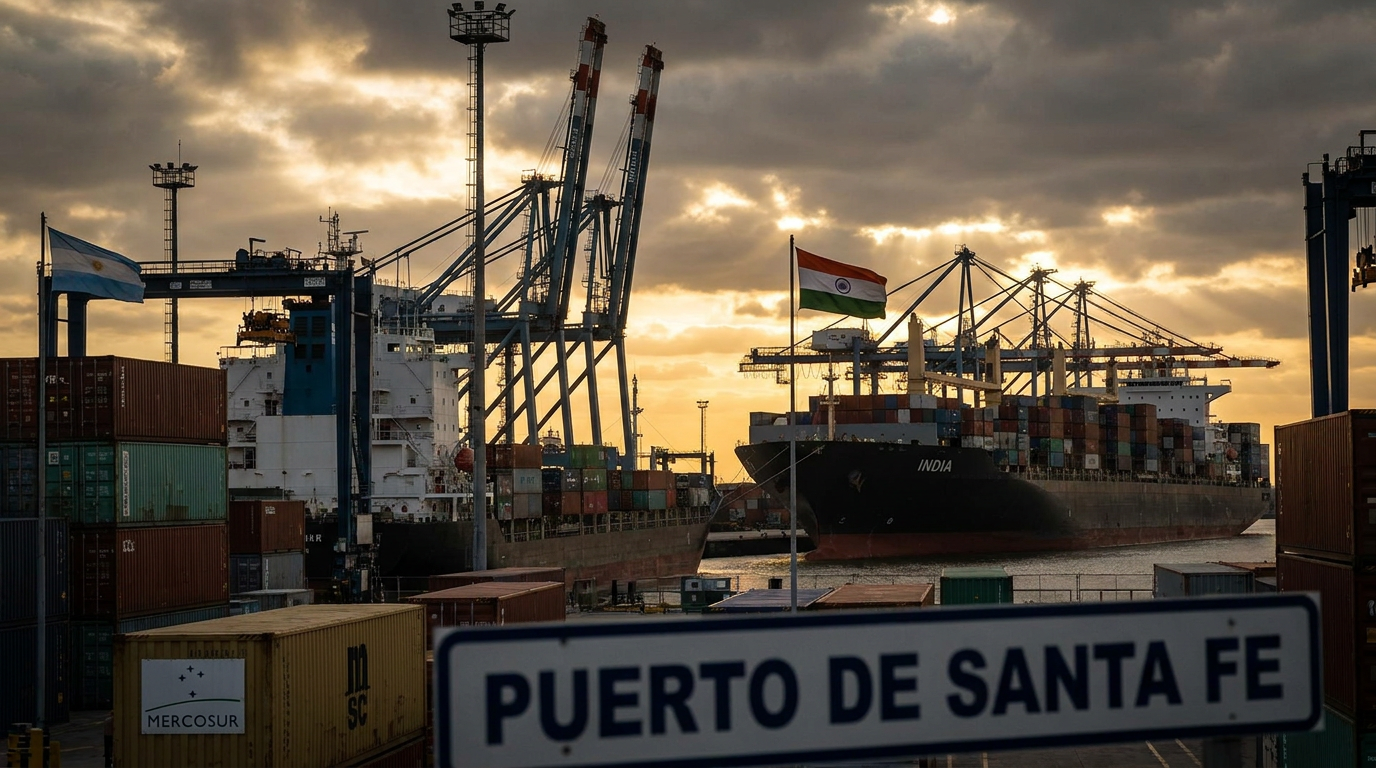
Santa Fe looks to the world's largest market: India consolidates its position as the province's main export partner
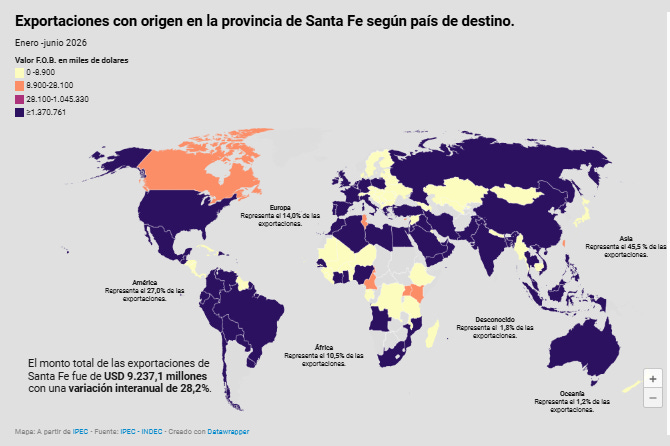
Santa Fe's total exports from January to June 2026 amounted to USD 9,237.1 million, a year-on-year change of 28.2%, according to the Provincial Institute of Statistics and Censuses (IPEC). Indian demand for agro-industrial commodities such as soybean meal and soybean oil stands out within this total. That demand is driven by a population that exceeds 1,476,625,576 million inhabitants, who are being counted in this year's census, and by a growing middle class, both of which are increasing the province's export sales. Added to this is New Delhi's policy of reducing its dependence on palm oils from Malaysia and Indonesia. This process opened a window of opportunity for Argentina, which has become India's main supplier of oils, displacing the EU, Ukraine and Russia.

The new trade negotiations
Two developments will increase the range of products that can be exported to India. The first is the new negotiations between India and Mercosur aimed at expanding the current Preferential Trade Agreement , which entered into force in 2009 under Law No. 26,409. The second is the imminent entry into force of the Global System of Trade Preferences among Developing Countries (GSTP). At the same time, the Federal Investment Council (CFI) has signed a cooperation agreement with the Confederation of Indian Industry to bring business and investment opportunities from Indian companies to the Argentine provinces. Brazil, for its part, concluded the Cooperation and Investment Facilitation Agreement (ACFI) with India. Signed in 2020, the agreement was approved by the Brazilian Congress and entered into force in October 2025. Brazil also has a trade monitoring mechanism with India, which this year is holding its eighth meeting. In 2025, trade between Brazil and India reached 15.2 billion dollars, an increase of 25.4% over the previous year. Brazilian exports totaled 6.86 billion dollars, an increase of 30.2%. In the first seven months of 2026, trade reached 10.1 billion dollars, an increase of 32.9%, while Brazilian exports reached 5.89 billion dollars, an increase of 82.1%.
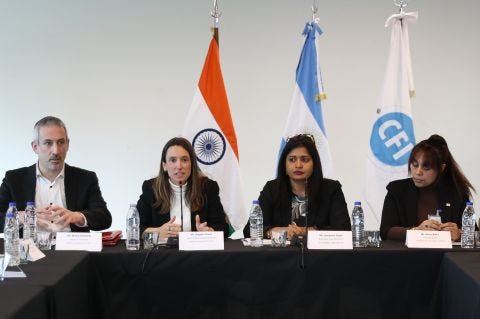
Photo: Angeles Arano of the CFI with representatives of the Confederation of Indian Industry
The weight of the soybean complex in Santa Fe's exports
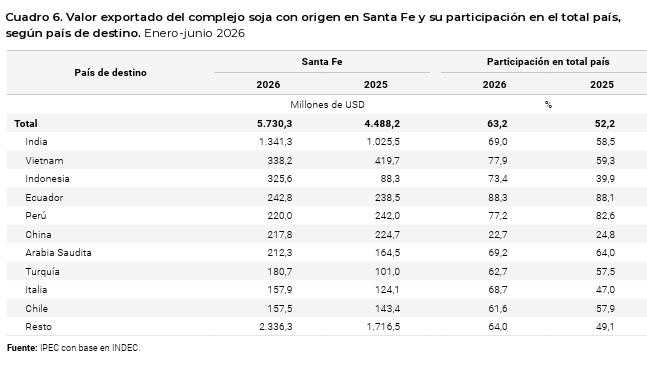
In 2025, exports of Santa Fe products reached 135 countries around the world. Of the total exported, almost half (48%) went to the Asian continent, followed by the Americas (27%), Europe (15%) and Africa (9%). India emerges as the main destination for Santa Fe's exports, receiving 15% of the value exported in the year, driven by the soybean complex, with a total of USD 2,178.82. According to IPEC, the Santa Fe province soybean complex exported USD 1,341.3 million to India in the first half of 2026, USD 315.8 million more than in the same period of the previous year. Shipments from the Santa Fe soybean complex to India are concentrated mainly in fats and oils, which account for 69.0% of the national total exported in this category to that destination in the first half of 2026, followed by chemicals and related products, with a share of 100.0%.
EXPORTS OF THE COMPLEX

Source: CIARA
Outlook for the second half
Projections for the second half of 2026 point to a consolidation of India's position as the main destination. The 2025/2026 agricultural season showed a recovery in yields in the Pampas region after the effects of the 2023/2024 weather event, which translates into greater availability of raw material for export processing. At the same time, the government of Narendra Modi maintains its commitment to food security as a strategic priority, which implies sustained imports of protein inputs. The importance of flexibility in trade negotiations and agreements and of leveraging those under way with India to position products originating in Santa Fe is a task for the provincial government and the industry chambers, while for Santa Fe companies the challenge is twofold: on the one hand, for local companies to increase their share in the marketing of commodities in India, and on the other, to leverage the ongoing trade negotiations to position their products and deepen ties with Indian companies.
Sources
Director of Pulso Internacional
Lawyer specializing in international trade and productive investment, with more than 25 years of experience in international trade negotiations as an adviser to governments and to companies going international. At Pulso Internacional we analyze foreign trade, bringing clarity and international context so that your company can export and invest more.
Related analysis

European Assessment of the EU-Mercosur Agreement: In 4 Months, European Exports Grow 9%
November 5, 2026 · 2 min
Why Has the US Increased Its Investment in Germany?
November 3, 2026 · 5 min