Japan's Trade Reality and the Opportunities for Mercosur Companies
Translated from the Spanish original. Read the original

Director of Pulso Internacional
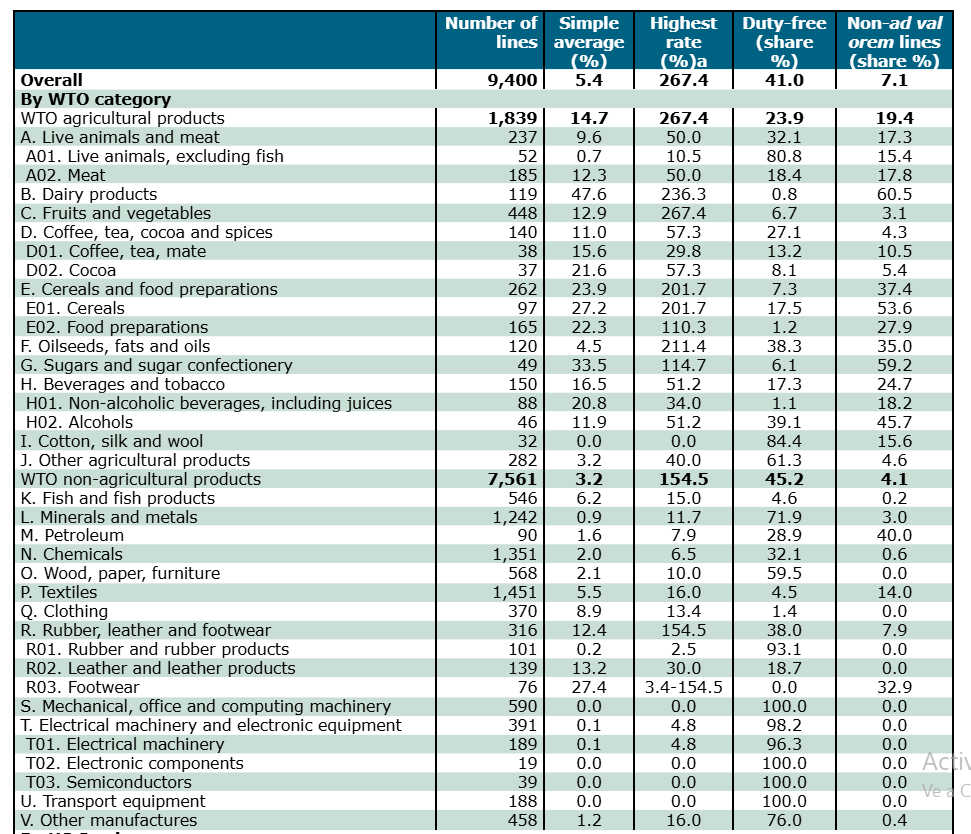
We had anticipated that trade negotiations would intensify over the course of this year, so the rapprochement between Japan and Mercosur represents a trade opportunity that requires a precise analysis of the tariff and regulatory barriers that have historically limited bilateral trade, as well as identifying trade and investment opportunities. Japan's 16th Trade Policy Review at the WTO, concluded on May 29, 2026, evidenced the persistent complexity of the Japanese protectionist system, particularly in the agricultural sector, where the average applied tariff was 14.7% during fiscal year 2025, in contrast with the 3.2% applied to non-agricultural products. In addition, Japan has a tariff structure with more than 270 different rates, with tariffs exceeding 200% in their ad valorem equivalents, setting a precedent of regulatory complexity that must be taken into account. Subsidies to its producers are very high, more than double the average of OECD countries, and represented on average 32% of gross agricultural income between 2022 and 2024.
TARIFFS APPLIED BY JAPAN
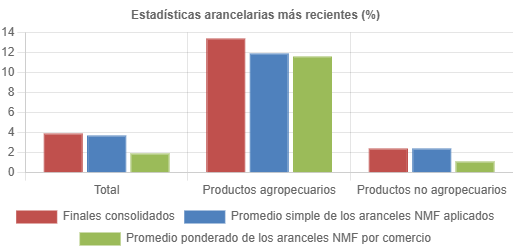
Source: WTO
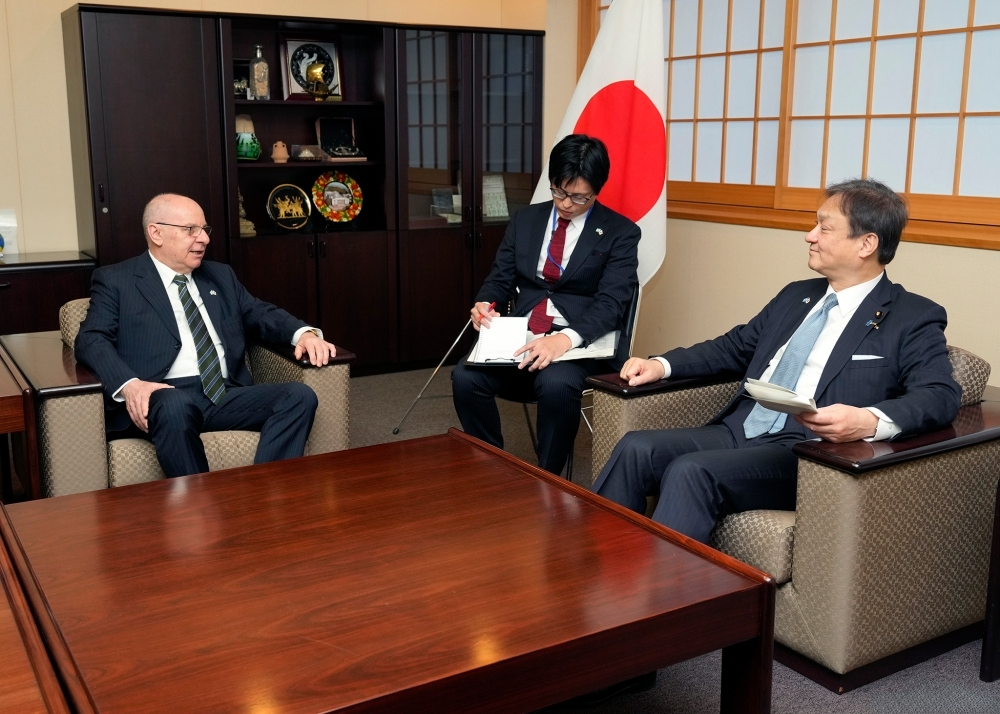
Photo: Argentine Ambassador Rubén Tempone with Mr. HORII Iwao, Japan's Minister of State for Foreign Affairs - April 8, 2026
Tariff asymmetries in strategic sectors
The meat sector shows the significance of the existing regulatory disparities. Uruguay faces a 38.5% tariff on beef, while competitors such as the United States (with which Japan signed the Implementation of the Agreement – Towards a New Golden Age of the Japan-U.S. Alliance in 2025), Australia and New Zealand operate with preferences of between 13.3% and 21.3% derived from their bilateral trade agreements with Japan. This tariff differentiation directly threatens the competitiveness of the region's meat exports and creates a system of incentives that favors third countries. The use of tariff-rate quotas and state trading systems for sensitive products such as rice, wheat and barley complements this protectionist scheme. The traceability and certification requirements that Japan, like the European Union, applies systematically represent both obstacles and opportunities for Argentine producers who manage to adapt to demanding international standards, consolidating Argentina's presence in high-value markets. Manufacturing remains a fundamental pillar of the Japanese economy, accounting for 20.5% of GDP and 15.4% of total employment in 2024, and the automotive industry is the largest export sector, representing 17.1% of all exports and supporting approximately 5.6 million jobs. However, there is a trend toward integrating value-added services (for example, software, design and after-sales solutions) into products, which is increasingly crucial for Japan's export competitiveness, a shift that requires greater investment in intangible assets. This is where the greatest opportunity for Mercosur lies, arising from the need of Japanese companies to have a local presence to deploy their export strategy. Another key issue is the need for critical minerals to mitigate its structural dependence on imports of the minerals that are essential for its ecological and digital transformations. The Economic Security Promotion Act (ESPA) establishes which critical minerals are designated as "specified critical goods" and allows the government to provide direct financial assistance for projects that enable it to establish productive investments or diversify supply sources in order to reduce excessive external dependence through targeted subsidies, which as of December 2025 accounted for 4% of a fund of 2.55 trillion yen specifically earmarked for critical minerals. It also establishes a critical mineral stockpiling system through the Japan Organization for Metals and Energy Security (JOGMEC), maintaining a domestic consumption reserve of 60 days to cushion supply disruptions from specific regions. Although China remains a main partner (supplying 23% of critical minerals in 2024), Japan is deepening its ties with South Africa (20.8%), Australia (27.8% of non-fuel minerals) and Brazil (14.1%) to diversify its partner base. Interestingly, in the processing of rare minerals Japan is adopting a strategy of internationalization through private and state investments (via JOGMEC), such as a refinery for the recycling and refining of rare earths in Carameg, France, and fluorite exploration (fluorine is fundamental to the electric vehicle battery sector and cutting-edge technologies) in Speewah, Australia, and in the US, with which it signed the Framework for Securing the Supply of Critical Minerals and Rare Earths through Mining and
Processing in October 2025. These examples can be leveraged by provinces and municipalities that wish to attract Japanese direct investment.
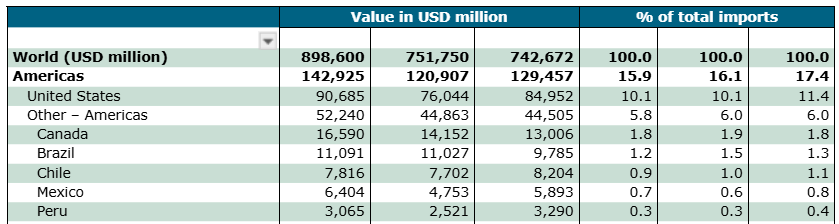
Japan's main trading partners and foreign direct investment
Brazil is among the region's main trading partners, with a significant surplus.
Imports
Japanese exports
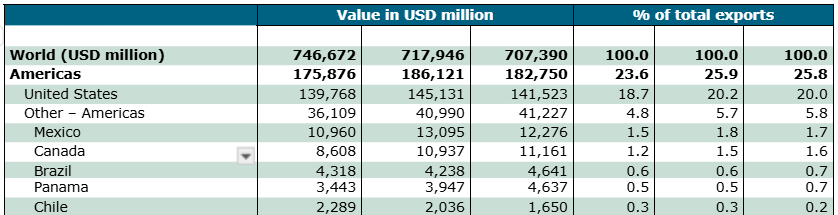
Main merchandise exports and imports by trading partner, 2022-2024
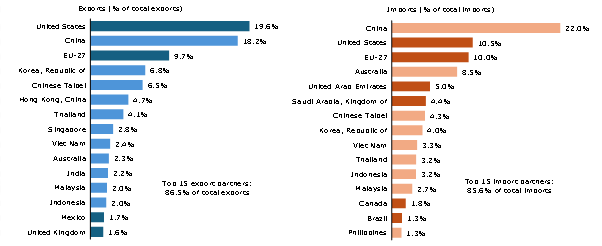
Source: WTO
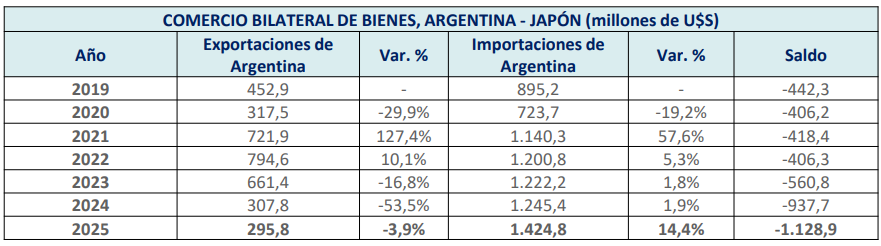
Source: Argentina Trade Net
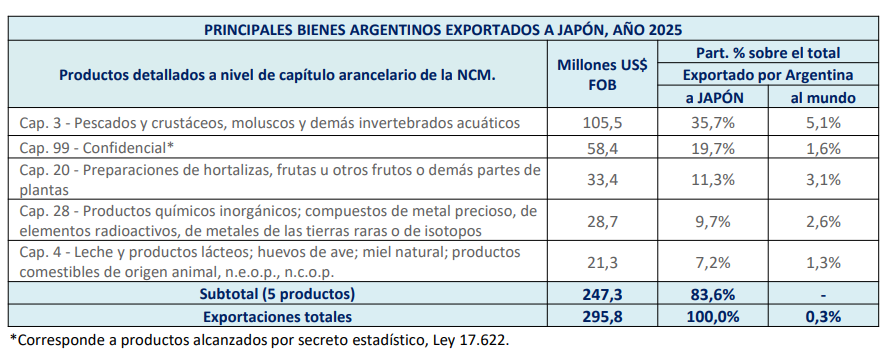
Source: Argentina Trade Net
Japan's foreign direct investment, 2018-2024
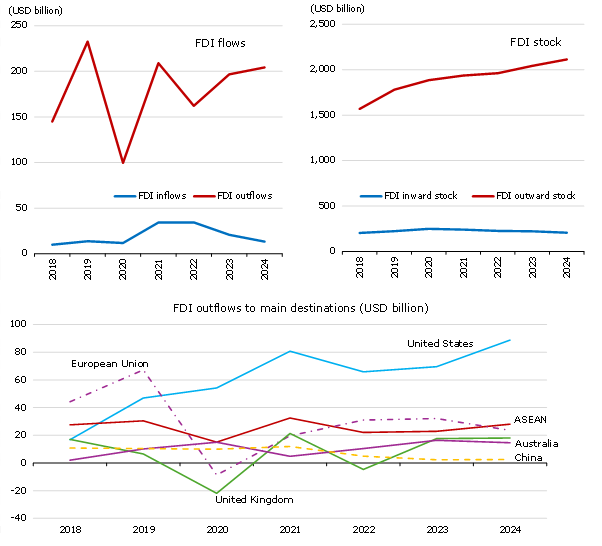
Source: WTO
STOCK OF JAPANESE DIRECT INVESTMENT ABROAD (OUTWARD) 2022/2024
STOCK OF FOREIGN DIRECT INVESTMENT IN JAPAN (INWARD)
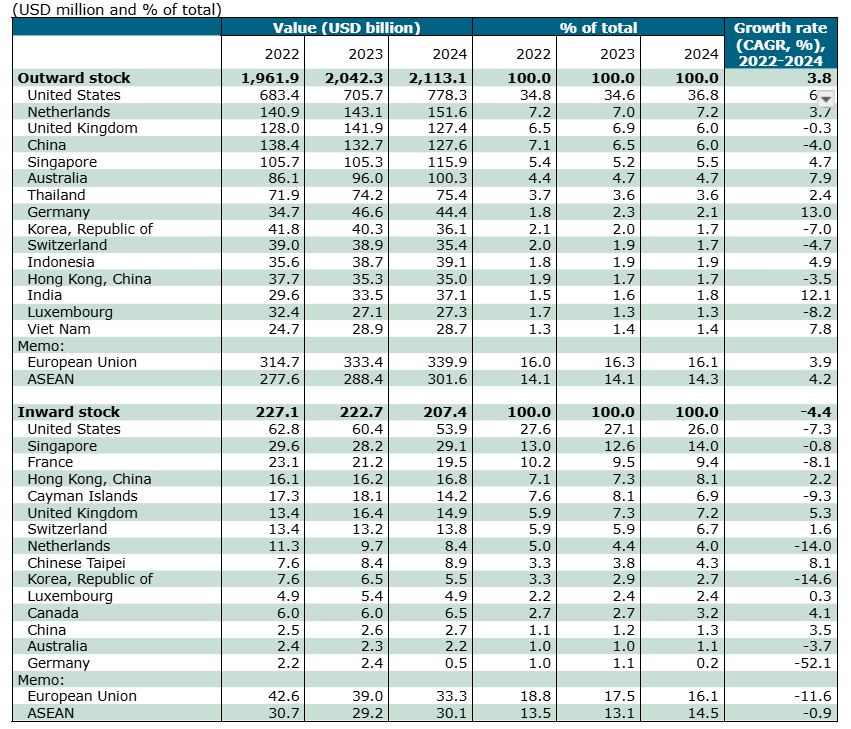
Source: WTO
We note that on July 22, 2025, Japan concluded a Memorandum of Understanding with the United States under which it commits to make investments in the United States of approximately US$ 550,000 (million). One year after the memorandum was signed, 20% of it is already underway. According to The Japan Times, three projects were selected for the first round of investments and loans, for a total of US$ 36 billion, and another three for the second round, for a total of approximately US$ 73 billion. The six projects include those related to the production of synthetic diamonds (where China holds 80% of the global market), infrastructure for US crude oil exports, gas-fired power generation to meet the growing demand for electricity from data centers linked to artificial intelligence, and the construction of next-generation nuclear reactors, such as small modular reactors.
Outlook for the Japan-Mercosur Negotiations
The Japan-Mercosur negotiations, which will accelerate in June 2026, require a strategy that goes beyond traditional tariff reduction to address the regulatory barriers that actually determine market access and investment possibilities in Mercosur. The success of these talks will depend on the ability of Mercosur negotiators to articulate specific sectoral offers that respond both to Japan's need for trade diversification and to the systemic competitiveness requirements that the international insertion of Mercosur countries into Japan demands. Meanwhile, Mercosur companies will have to comply with the sanitary and phytosanitary requirements for agro-industrial products, while automotive manufacturers and related companies will need to adapt and attract investment in order to provide support and complementary services to Japanese exports. The provinces and states of Mercosur could take advantage of the need to diversify sources of supply of critical minerals to attract Japanese investment and technology.
Director of Pulso Internacional
Lawyer specializing in international trade and productive investment, with more than 25 years of experience in international trade negotiations as an adviser to governments and to companies going international. At Pulso Internacional we analyze foreign trade, bringing clarity and international context so that your company can export and invest more.
Related analysis
European Assessment of the EU-Mercosur Agreement: In 4 Months, European Exports Grow 9%
November 5, 2026 · 2 min
Why Has the US Increased Its Investment in Germany?
November 3, 2026 · 5 min