The Largest Deal in History and Its Direct Competition with the Mercosur-EU Agreement
Translated from the Spanish original. Read the original

Director of Pulso Internacional

The Biggest Agreement in History
In a remote part of Scotland called Turnberry, home to a majestic hotel and a golf course built in 1906 and recently acquired by Donald Trump, on August 25, 2025 the US president signed what he called the biggest agreement in history, and he was not wrong. The trade agreement between the United States and the European Union was signed by Donald Trump and the president of the European Commission, Ursula von der Leyen. It came only a few months after Trump began his second term, in the midst of a string of increases in "reciprocal tariffs" that reached as high as 50% for allied countries and much more for China, and of the war between Ukraine and Russia on the European border (Finland has 1,300 km of border with Russia), which represents an existential concern and made US support necessary for reasons of security. As we warned at the time, this agreement has the US as the big winner; it was a European trade capitulation.
Approval of the Agreement and Its Expiration
It still needed ratification by the European Parliament, which after several months of doubts, criticism and lobbying approved it on March 26 with 417 votes in favor, 154 against and 71 abstentions; it is now known as the " Turnberry" agreement. The agreement expires in 2028, when negotiations will begin anew.
Features of the Trade Agreement between the US and the EU
This agreement eliminates European tariffs on US industrial and agricultural products, and the Europeans take on commitments on behalf of their companies regarding investments in the US in exchange for a tariff "ceiling" of 15% on European exports, except for steel and aluminum, which remain at 50%. The new trade framework with the US also includes political commitments by the European Union to purchase liquefied natural gas and weapons and to invest in the United States, motivated by support for Ukraine and the need to reduce energy dependence on Russia and now on the Middle East. Among other things, the agreement establishes:
- The EU's commitment to eliminate tariffs on all US industrial products and to provide preferential market access for a wide range of US fish and agricultural products, including tree nuts, dairy products, fresh and processed fruits and vegetables, processed foods, planting seeds, soybean oil and pork and bison meat.
- The EU's obligation to invest US$600 billion in strategic sectors in the United States through 2028.
- Purchases of US liquefied natural gas, oil and nuclear energy products valued at US$750 billion through 2028.
- The European Union will purchase at least US$40 billion in AI chips from the United States for its computing centers. (This explains the free acquisition of 10% of INTEL's shares by the US government, negotiated by Trump.)
- The elimination of European non-tariff barriers in the areas of automobile standards, agriculture, forestry, and telecommunications and digital services.
- The commitment to purchase US defense equipment.
With a bilateral trade volume of 1.7 trillion euros in goods and services during 2024-2025, representing 20% of the EU's global trade, this agreement consolidates the United States as Europe's main trade partner. According to the US Bureau of Economic Analysis (BEA), Europe was the second-largest source of new foreign direct investment in 2023, after having been the main source between 2019 and 2022. Although the volume committed in the Turnberry agreement seems impressive, it shows that the current investment flows of 2021 would be maintained over a two-year period.
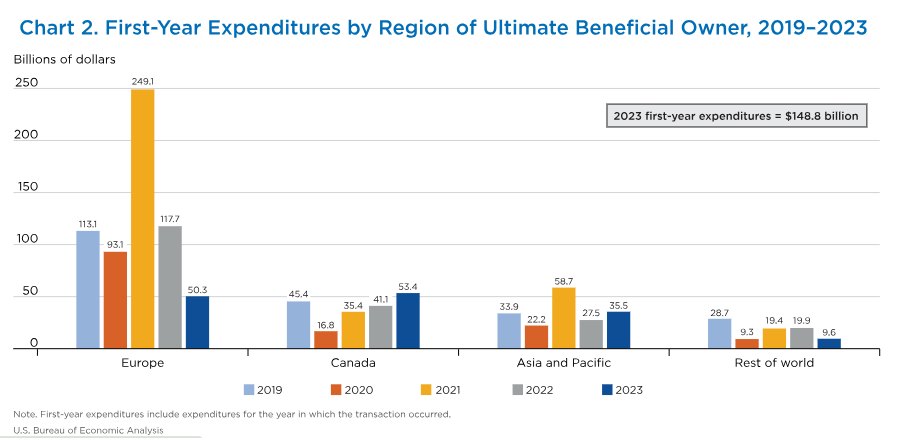
Source: BEA
European Safeguards in the Face of Uncertainty in the Trump Era
The parliamentary approval incorporates crucial safeguards to protect European interests, such as an automatic "suspension clause" in case Trump imposes new tariffs or "undermines the objectives of the agreement." It also has an expiration date in March 2028, with mandatory parliamentary review, and the condition that it will not enter into force until the United States lowers its tariffs on European products from 50% to 15%, except on steel and aluminum (the "sunrise clause"). These conditions reflect European distrust of Trump's trade policies; he has already threatened to cut off the LNG supply if the terms of the agreement are substantially modified.
Direct Competition in the Agri-Food Sector
The obligations assumed by the EU compete with the possibility of access to the European market for MERCOSUR companies, since they grant US companies the total and immediate elimination of European tariffs on US agricultural products, including beef, seafood products such as lobster, and other agri-food goods, as well as the elimination of non-tariff barriers, which represents direct competition with Mercosur's exports in the European market.
Implications for Argentine production
Agribusiness exports account for approximately 80% of Argentina's trade surplus with the European Union, concentrated in beef, wine, biodiesel and soybean derivatives. The tariff preference granted to similar US products could erode market shares. For Argentina, which sends approximately 10% of its exports to the European market, US competition in key sectors such as beef and agricultural derivatives represents an immediate challenge.
In addition, the intensification of competition for liquefied natural gas, where the European Union has committed to increasing its purchases from the United States, could limit the planned entry of LNG from Vaca Muerta into the EU.
However, the scheduled expiration of this agreement in March 2028 opens a window of opportunity.
Sources
- El Diario — European Parliament backs EU-US trade agreement and adds safeguards for Trump's breaches (March 26, 2026)
- RTVE — European Parliament approves trade agreement with US to protect the EU (March 26, 2026)
- Euronews — MEPs support EU-US trade agreement with conditions (March 26, 2026)
- BEA "New Foreign Direct Investment in the United States in 2023" August 28, 2024. apps.bea.gov
Director of Pulso Internacional
Lawyer specializing in international trade and productive investment, with more than 25 years of experience in international trade negotiations as an adviser to governments and to companies going international. At Pulso Internacional we analyze foreign trade, bringing clarity and international context so that your company can export and invest more.
Related analysis
European Assessment of the EU-Mercosur Agreement: In 4 Months, European Exports Grow 9%
November 5, 2026 · 2 min
Why Has the US Increased Its Investment in Germany?
November 3, 2026 · 5 min