Emigration, the Costliest Form of Disinvestment
Translated from the Spanish original. Read the original

Director of Pulso Internacional

Public Schooling and Free University Education as a Strategic Investment of the State
In the late nineteenth century and throughout the twentieth, faced with the question of how to attract investment, Argentina built an institutional answer. Compulsory, free public schooling, consolidated by Law 1,420 of 1884, and free university education, established by decree of President Juan Domingo Perón in 1949, created a system without precedent in the region: the State assumed the cost of investment in human capital so that this cost would not be a barrier to access. The son of the immigrant, of the factory worker, of the rural laborer, could become an engineer, a doctor, an industrial technician. It was not philanthropy but industrial and development policy. That bet produced concrete, verifiable results. The import-substitution industrialization of the 1940s through the 1970s was not made possible solely by the availability of capital or by conditions in the international market; it was achieved because there existed a critical mass of technicians, professionals and skilled workers capable of operating complex industries. Equal educational opportunity was, in that sense, the most profitable public investment the Argentine State made in its modern history. This claim is not abstract at all, since the returns were measured in industrial value added, in manufacturing exports, in the density of the national productive fabric, in higher agricultural output and in improvements in the population's health, which translated into a greater capacity for work.
To Govern Is to Populate
Between 1830 and 1950, 8.2 million European immigrants arrived in Argentina, the second-highest figure in the world, surpassed only by the United States. By 1914, immigrants accounted for almost 30 percent of Argentina's population; today they account for only 4%. President Javier Milei, contradicting Alberdi's principle that "to govern is to populate," has sought to restrict permanent residency, limit access to public health care and to university education for non-citizens, and expand the grounds for deportation, as established by Decree DNU 366/2025, on top of the defunding of the higher education system and the science and technology system. Meanwhile, the number of births in 2024 fell to 413,135. This figure represents a 47% drop from the levels recorded in 2014, when 777,000 people were born. Switzerland came close to capping its population at 10 million and preventing the entry of immigrants. Is that the idea of the current government?
The Argentines Who Emigrate
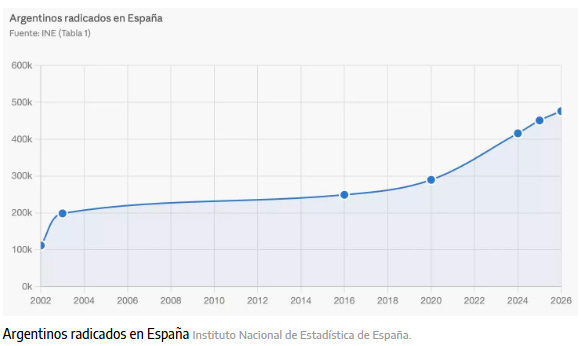
According to the Migration Policy Institute, it is estimated that in 2024 there were 1,183,000 Argentines living abroad, and many did not fare as well as they had hoped, which is a personal and family drama, and one for the country. The number of people who emigrate is very significant when compared with the 2,194,000 Brazilians living abroad. According to Alejandro Rebossio, in Spain, the main destination for Argentine emigration, 30,000 Argentines settled per year during the first two libertarian years, reaching 476,000 Argentines in 2025, including those who hold European passports. This figure is especially relevant given the decline in Argentina's birth rate.
How to Offer Opportunities to Our Young People Through New Productive Investment and Avoid Skilled Emigration
In the twenty-first century, the question of how to attract investment must be accompanied by new questions and new answers. The answer given in the last century is a necessary condition, one that must be preserved and improved, but it is not sufficient. Securing new investment that contributes to the country's productive development is as important as retaining existing investment, and the emigration of skilled human resources from Argentina is a form of disinvestment that the state finances and that the receiving countries, mainly Spain, the United States and Chile, capitalize on without any compensation. The acceleration of the phenomenon between 2023 and 2026 meant that a large number of university graduates considered or carried out relocation abroad, depriving the national productive apparatus of the critical mass needed to move up into value chains of greater complexity and technological intensity. In the face of this “Argentine brain drain,” of the absence of a policy to attract immigrants and retain young people, and without wishing to be exhaustive, some of the questions we ask ourselves are: Does the State intend to pursue a restrictive population policy? Do the national and provincial governments plan to have an industrial policy that takes advantage of the investment they make in education? Does the university recognize the need to engage with the productive reality? Or are most of its leaders comfortable in their academic and research role? Does the national State see the university only as a cost, or as a mere buffer for the labor demand of young people leaving secondary school and entering the job market? Is there a lack of an education policy that takes into account the needs of the labor market? Companies routinely complain that they cannot find skilled human resources for new positions, but do they contribute with investment in education? Are they interested in engaging with the education system?
Equal opportunity as a condition of systemic competitiveness
The discussion about equal opportunity is not, and must not be, solely an ethical debate or one about distributive justice; it is a debate about systemic competitiveness. Countries that produce talent broadly and in a diversified way, that do not concentrate access to technical and scientific knowledge in a small elite, generate more developed innovation ecosystems, more sophisticated industrial sectors and an international insertion with greater added value. Quality public schooling and accessible universities are not social concessions set apart from economic policy; they are the invisible infrastructure on which any sustainable productive development strategy rests, and a differentiating asset that Argentina can and must promote and protect. ECLAC has pointed out that the region faces difficulties in coherently articulating its trade, investment and productive development agendas, which limits the transformative impact of installed capital. That missing articulation is precisely the one that should incorporate education and the formation of human capital as a central variable, and not as a subsidiary one or a decorative touch, in the policy for attracting FDI and for preserving the investment made in human resources. The national State, the provinces, the university, companies and unions are responsible for preserving the most important asset Argentina has: its people.
References:
(1) “La única salida es el aeropuerto”: el “éxodo” de jóvenes profesionales de Argentina” - BBC bbc.com
(2) “El lado B de emigrar: historias de argentinos que se fueron a vivir afuera y no les fue como esperaban” Clarín - clarin.com
(3) Julia Albarracin - “Founded with Immigration in Mind, Argentina Has Reconsidered Its Approach” migrationpolicy.org
(4) Ricardo Beltramino - “Cómo evitar la desinversión extranjera directa en Argentina” pulsointernacional.com
(5) Alejandro Rebossio - “¿Sin lugar para la juventud? Los jóvenes no vuelven al país, pese al discurso libertario: emigración sostenida y desempleo creciente” Diarioar eldiarioar.com
(6) Ricardo Beltramino - “Switzerland voted against capping its population at 10 million” pulsointernacional.com
Director of Pulso Internacional
Lawyer specializing in international trade and productive investment, with more than 25 years of experience in international trade negotiations as an adviser to governments and to companies going international. At Pulso Internacional we analyze foreign trade, bringing clarity and international context so that your company can export and invest more.
Related analysis

European Assessment of the EU-Mercosur Agreement: In 4 Months, European Exports Grow 9%
November 5, 2026 · 2 min
Why Has the US Increased Its Investment in Germany?
November 3, 2026 · 5 min