Launch of the EU–Mercosur Textile and Apparel Dialogue (TAD)
Translated from the Spanish original. Read the original

Director of Pulso Internacional

Trade in textiles and clothing between the EU and Mercosur reached almost 700 million euros in 2025, with European exports to Mercosur worth 495 million euros and imports from the region worth 199 million euros. These figures already reveal a significant industrial and commercial relationship.
On October 15, 2026, representatives of the textile and apparel industries of Mercosur and the European Union launched the Textile and Apparel Dialogue (known as TAD), a forum for sectoral cooperation whose creation makes it possible to shape export competitiveness for the coming decades.
The TAD was created with the aim of supporting the implementation of the trade agreement, identifying regulatory and customs obstacles, promoting conditions of fair competition and exchanging best practices in sustainability, circularity and traceability. What this mechanism opens up, in practice, is an institutional channel for Argentina, Brazil and the rest of the South American bloc to negotiate in real time the standards that Europe is already codifying in its domestic legislation, and which will become, sooner rather than later, the real battleground of the bi-regional agreement. The TAD can also serve as a platform to attract European investment in ecodesign technology and in digital traceability infrastructure. And it can also be a forum for learning about the practices the blocs apply with respect to third-country suppliers.
The EU–Mercosur Agreement and the bi-regional Textile Business Dialogue
Source:
From tariffs to regulation: the shift in the competitive axis in the medium term
For decades, the debate over European market access for Mercosur textiles revolved around tariffs. That discussion, although never fully resolved, has been displaced. The EU has moved forward with two regulatory instruments that redesign the entry rules far more profoundly than any tariff reduction: on the one hand, the Corporate Sustainability Due Diligence Directive , covering human rights and the environment, known as CS3D, and on the other, the 2024 Ecodesign for Sustainable Products Regulation, which includes specific requirements for the textile sector regarding durability, reparability and recycled content. These instruments are neither optional nor negotiable within the framework of the trade agreement: they are internal EU legislation, applicable to all products entering the European market, regardless of their origin.
Corporate Sustainability Due Diligence Directive - Directive (EU) 2024/1760
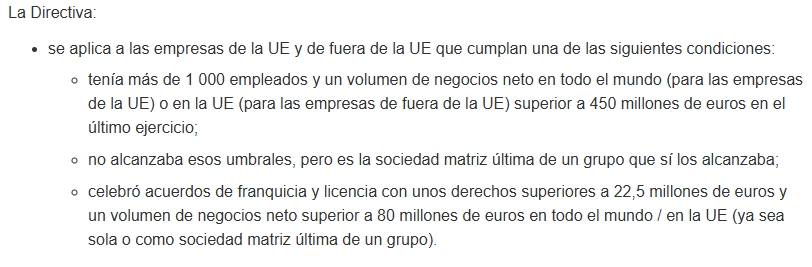
The Commission's guidelines and voluntary model contract clauses will help companies carry out due diligence. The main guidelines will be published before July 26, 2027, and the additional ones before July 26, 2028.
For Argentine and Brazilian companies, this means that export competitiveness no longer depends solely on price or the residual tariff (after the tariff reduction under the interim Mercosur-EU Agreement), but on the ability to demonstrate traceability throughout the production chain, compliance with auditable labor standards and alignment with ecodesign criteria that, in several cases, still have no regulatory equivalent in Mercosur. In this context, the TAD takes on a role that goes beyond sectoral coordination: it is the place where Mercosur industries can influence, with technical arguments and concrete data, the interpretation and practical implementation of those regulations, before they crystallize into non-tariff barriers.
The Argentine voice between opportunity and regulatory urgency
The Argentine Textile Industry Federation (FITA) and its Brazilian counterpart, ABIT, took an active part in the launch of the TAD, positioning themselves as the sector's interlocutor vis-à-vis the European counterpart. The president of FITA, Luis Tendlarz, a stance against competition from third markets with less production transparency, whose pressure on the regional market has been repeatedly documented;
"The Argentine textile industry chooses to compete, to connect with global value chains and with partners who share values and ways of producing."
Unlike a large number of countries, Argentina has local production along the entire textile-apparel value chain. In a sector that for years debated internally between tariff protection and gradual opening, the explicit adherence to a framework of shared values such as sustainability, labor standards and traceability constitutes a repositioning of Argentina's business association representation.
From a trade policy standpoint, this coordination between FITA and its European counterpart, represented by EURATEX, the European textile and fashion industry association, sets a precedent of great importance; it is the first time that both industrial sectors have a formal mechanism, framed within the bi-regional agreement, to jointly manage the challenges of implementation
Argentine textile sector exports
According to FITA's September monthly report, in June 2026, aggregate employment in the textile, apparel, leather and footwear sector stood at 92,531 formal jobs. It lost 1,284 jobs compared with May and 16,536 compared with June 2025. Since December 2023, it has accumulated a loss of 28,322 jobs. The industry is currently operating at very low installed capacity utilization, at 45.3%, and according to INDEC, the sector's exports in the first half of 2026 totaled USD 233 million, a year-on-year increase of 65.0%.
Sales classified by major category were distributed as follows: Primary Products accounted for 47.1%; Manufactures of Agricultural Origin, 29.8%; and Manufactures of Industrial Origin, 23.2%. The main destinations were China, with exports of USD 51 million, and the European Union, with USD 48 million.
The Brazil factor and the bi-regional dimension
Brazil is the largest textile producer in South America and among the ten most important worldwide in terms of production value. Adapting to European sustainability regulation represents both a threat and an opportunity: a threat for companies operating with poorly documented supplier chains, and an opportunity for those that have already made progress on international certifications and can differentiate themselves from Asian competition precisely on that basis.
DATA ON BRAZIL'S TEXTILE AND APPAREL SECTOR

Source: ABIT
For Mercosur to speak with a single voice in this dialogue, FITA, ABIT and the equivalent organizations in Uruguay and Paraguay need to coordinate common technical positions on European requirements.
Production transparency as a geopolitical response
The TAD is part of a broader trend of reconfiguration of global value chains, driven by the combination of Western geopolitical de-risking from China, the rise of corporate due diligence standards and growing pressure from European consumers for products with verifiable traceability. The launch of the TAD institutionalizes the building, on the basis of the bi-regional agreement, of a space where production transparency is the currency of integration.
The question for Argentine companies is not whether to adapt to European standards, but how quickly they can do so and with what public support. The industrial cooperation and investment tools that the TAD enables, including access to European technical assistance programs on circularity and ecodesign, represent a resource that sector chambers should actively pursue, without waiting for regulation to reach them as a barrier. The same applies to the response countries give regarding production carried out under forced labor , an area in which Argentina has made progress with the US and on which we have commented previously; these requirements must also be applied to the European production chain.
Negotiations that must be coordinated within Mercosur
For Argentina, participation in the TAD cannot be merely declaratory: it requires investment in traceability systems, domestic regulatory adaptation and sector-specific trade diplomacy that translates the bi-regional dialogue into concrete exports. The creation of regional standards to limit market access, following the European regulatory trend, is a technical path to be pursued at the bi-regional level. In addition, the coordination of common positions on issues such as condemning and preventing imports of products made with forced labor, a commitment Argentina has endorsed but neither Brazil nor the EU have within the G20 , must be discussed in order to achieve a bi-regional space with coherent sectoral policies.
Sources
- EURATEX — EU-Mercosur Textile & Apparel Dialogue (October 2026)
- El Textil — The Argentine textile industry joins an initiative to promote free trade between Europe and Mercosur
- Noticiero Textil — EU and Mercosur textile industries launch a new dialogue on the textile and apparel sector
- ABIT — Global textile trade: tariffs, regulation and competitiveness
- ABIT — The Brazilian textile industry as a focus for investment
Director of Pulso Internacional
Lawyer specializing in international trade and productive investment, with more than 25 years of experience in international trade negotiations as an adviser to governments and to companies going international. At Pulso Internacional we analyze foreign trade, bringing clarity and international context so that your company can export and invest more.
Related analysis

European Assessment of the EU-Mercosur Agreement: In 4 Months, European Exports Grow 9%
November 5, 2026 · 2 min
Why Has the US Increased Its Investment in Germany?
November 3, 2026 · 5 min