Europe's Exposure to Chinese Products
Translated from the Spanish original. Read the original

Director of Pulso Internacional
Amid Xi Jinping's visit to the US and the trade war between the two countries, we see that concern persists in developed countries over the share of Chinese products and the displacement of locally manufactured goods in most countries. To what extent has trade integration with China eroded domestic productive capacity? The deliberate deindustrialization referred to by Secretary of State Marco Rubio is a reality. In previous installments of Pulso Internacional we analyzed the exposure of Mercosur countries to global value chains and Argentina's integration into Pax Silica, as well as the concrete possibilities for integration into secure supply chains as a strategic alternative. This time, the focus shifts to the developed countries of Europe and an analysis of their degree of dependence on Chinese imports, a phenomenon that a recent report by the Berlin-based Global Public Policy Institute (GPPI) documents in an interesting study.
The CEI: measuring what is uncomfortable to quantify
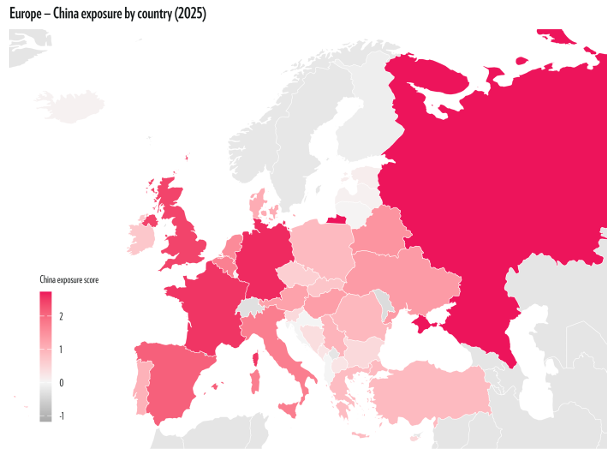
The China Exposure Index (CEI) 2026, developed by George Yin of the Global Public Policy Institute, is today a tool for assessing the economic exposure of European countries to China. The index does not merely measure import flows: it incorporates dimensions of dependence such as direct investment, supplier concentration, China's share in intermediate value chains and relative to GDP, and non-economic aspects such as military, cultural and even visa matters. The result is a map of systemic risk that European governments, still anchored in the paradigm of complementarity, but above all in the good business that selling capital goods to China entailed, have taken too long to incorporate into their industrial policy agendas. What the CEI shows is that Europe's exposure to Chinese products is not homogeneous. The continent's most industrialized economies (Germany, Italy, the Benelux countries) show significantly higher levels of dependence on intermediate goods and manufactured components, precisely the segments where the loss of local productive capacity is hardest to reverse in the medium term. This phenomenon is not recent: China's massive integration as a global supplier was consolidated in the first decade of the century, accelerated after the 2008 crisis and reached its point of most evident vulnerability during the supply chain disruptions of 2021-2022.
Silent deindustrialization: when a low price carries a high cost
The debate over Chinese imports in Europe has usually been framed between two simplifying narratives: that of free trade, which celebrates consumers' access to cheap goods, and that of protectionism, which invokes unfair competition. What the CEI analysis reaffirms is a third dimension, more uncomfortable for both positions: structural deindustrialization as the cumulative result of seemingly rational short-term decisions.
When a European manufacturer of electronic components or industrial machinery loses market share to a subsidized Chinese supplier, the loss is not limited to a production line: technical capabilities, local supplier networks and know-how accumulated over decades are eroded, and ultimately so is the very possibility of reversing the process when the geopolitical context demands it.
The European Union discovered this mechanism belatedly in the semiconductor, solar panel and lithium battery sectors; the CEI suggests that the phenomenon is broader and deeper than aggregate trade statistics reveal. It should be noted that the European response has been gradual and partially ineffective. Italy withdrew in March 2024 from the Belt and Road Initiative, which it had joined through a memorandum of understanding in 2019. The trade defense instruments available under the WTO framework (antidumping measures, countervailing duties, safeguards) operate with institutional lags that make them of little use against competition that operates in real time. The additional tariffs on Chinese electric vehicles, implemented in 2024 and reinforced in 2025, set a relevant precedent, but their sectoral scope is limited relative to the breadth of the problem.
This deindustrialization, which Argentina is also suffering today, and the lack of an industrial policy have harmful effects in the medium and long term, as they create an evident vulnerability.
European friend-shoring: declared strategy, insufficient implementation
Brussels' most articulate response to systemic exposure has been the "open strategic autonomy" agenda and the friend-shoring and reshoring policies promoted by the European Commission. The European Chips Act, the Critical Raw Materials Act and the Net-Zero Industry Act are the legislative pillars of this reorientation. However, the gap between regulatory ambition and concrete execution remains notable: implementation timelines are long, fragmentation among Member States weakens industrial coherence, and the committed levels of investment are insufficient compared with the subsidies Chinese industry receives from the State.
The GPPI report warns of this implementation gap with data that lay bare the central paradox: while European industrial policy documents proclaim the reduction of critical dependencies, trade flows with China in sensitive segments continued to grow between 2023 and 2025 in most of the categories analyzed. The rhetoric of de-risking, a term the European Commission itself adopted as a more politically palatable substitute for US-style decoupling, has not yet translated into an effective reconfiguration of supply chains.
Implications for the Southern Cone: reading the European map through our own eyes
For Argentina and the rest of Mercosur, it is necessary to follow the analysis of Europe's exposure, but in light of the regional reality and along two tracks: on the one hand, how it is possible to confront the flood of subsidized products, and on the other, how Mercosur products can integrate into the European market, based on the Mercosur-EU free trade agreement, and contribute to the diversification of origins that the bloc requires.
As we anticipated in our analysis of Argentina's integration into secure supply chains, the decisive variable is not the volume of trade but its composition and the position the country occupies in the value chain.
Sources
Director of Pulso Internacional
Lawyer specializing in international trade and productive investment, with more than 25 years of experience in international trade negotiations as an adviser to governments and to companies going international. At Pulso Internacional we analyze foreign trade, bringing clarity and international context so that your company can export and invest more.
Related analysis

European Assessment of the EU-Mercosur Agreement: In 4 Months, European Exports Grow 9%
November 5, 2026 · 2 min
Why Has the US Increased Its Investment in Germany?
November 3, 2026 · 5 min