China's industrial overcapacity: a problem facing Western companies
Translated from the Spanish original. Read the original
Director of Pulso Internacional
China's industrial overcapacity
China's industrial overcapacity, and the exports that stem from it, has become a problem for developed countries. In the past, when developing countries demanded differential treatment from them, it was granted on an exceptional basis through discretionary and temporary tariff reductions, but developed countries never refrained from producing, subsidizing or exporting, whether industrial or agricultural products.
In recent years, developed countries have been demanding that China stop its machines or invest in their countries. China replies that when some cannot compete, the term excess capacity is used as an excuse for their failure and also as a weapon to blame others.
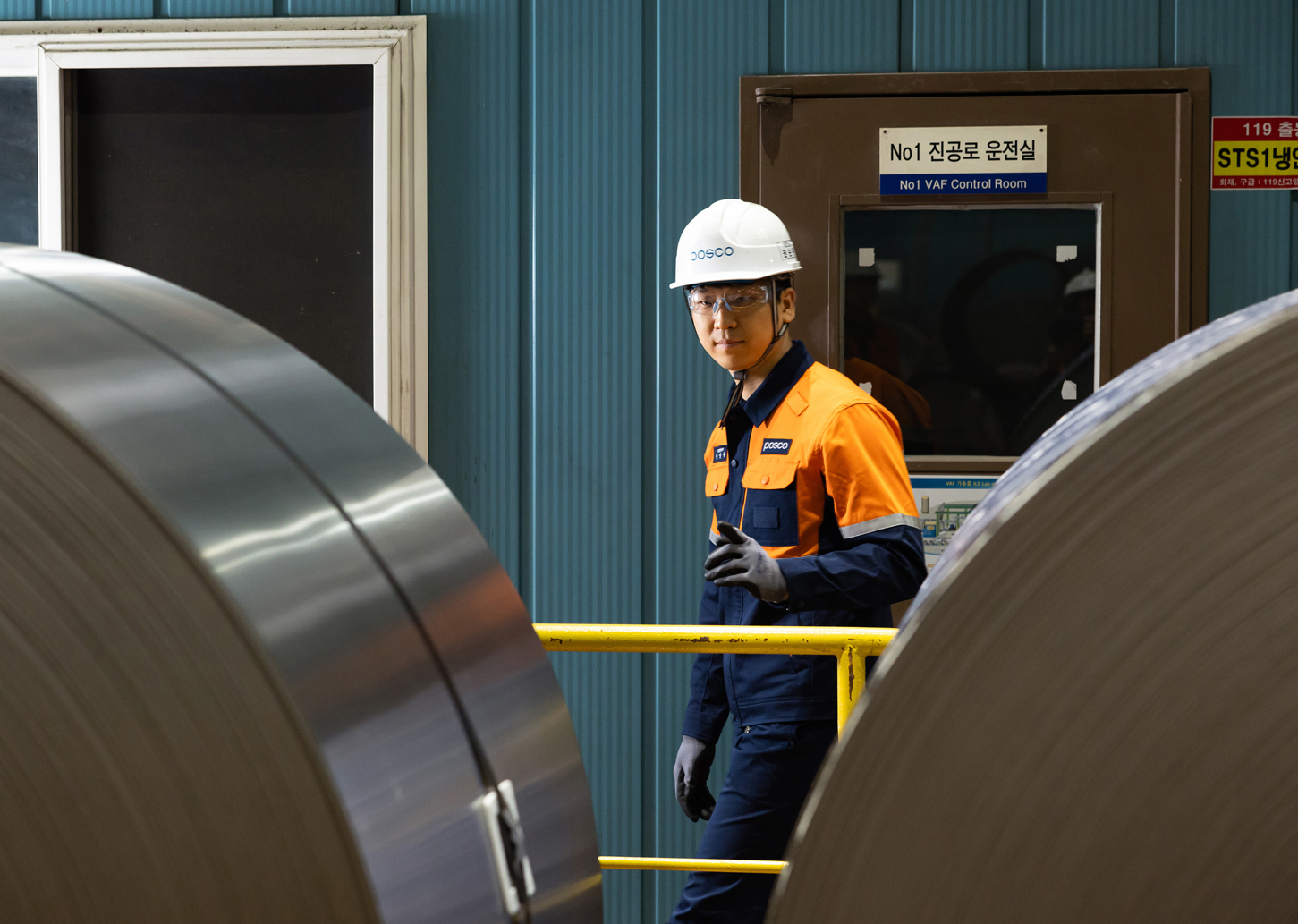
Photo: Source: Posco - China
A long-standing discussion: Starting with steel
The G20 has been addressing the issue of industrial overcapacity since the meeting of its trade ministers in Shanghai in 2016, starting with excess capacity in steel, and for that reason, within the framework of the OECD, they created the Global Forum on Steel Excess Capacity (GFSEC) as an information platform dedicated to developing and implementing solutions to resolve structural excess capacity in steel production. That same year the G20 issued a Declaration that acknowledges the problem but with a weak commitment.
"We recognize that structural problems, including excess capacity in some industries, exacerbated by a weak global economic recovery and depressed market demand, have caused a negative impact on trade and workers. We recognize that excess capacity in steel and other industries is a global issue which requires collective responses. We also recognize that subsidies and other types of support from government or government-sponsored institutions can cause market distortions and contribute to global excess capacity and therefore require attention. We commit to enhance communication and cooperation, and take effective steps to address the challenges so as to enhance market function and encourage adjustment."
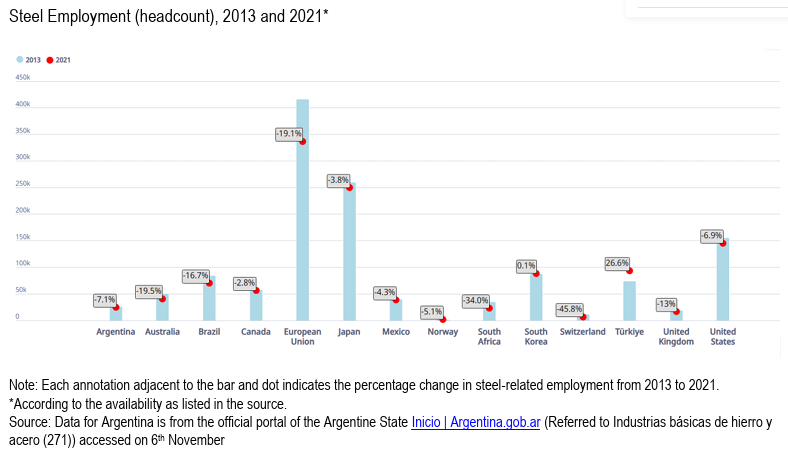
In 2025, an OECD report revealed the decline in employment in all countries between 2013 and 2021, and that the growing and persistent global excess capacity was driven largely by China, whose contribution to the global gap between capacity and demand reached 65% in 2015. Subsidized steel production in countries such as China benefits downstream sectors, such as the manufacture of electric vehicles, steel wheels, etc., giving their exports a competitive advantage in international markets.
Indeed, steel has been the subject of trade complaints by various countries, such as requests for investigations before the World Trade Organization WTO (2018 by the US and the EU, "United States — Certain Measures on Steel and Aluminium Products" (DS544, DS552, DS556 and DS564)), which have led to the adoption of safeguard measures, consisting of raising tariffs on steel and steel-derived products from China above the maximums bound by the US, as well as the imposition of antidumping measures and countervailing duties, along with technical barriers for iron ore processing that prevent or hinder imports. To these measures must be added the Trump administration's tariffs of 25% to 145% applied between 2025 and 2026 to Chinese steel. According to the American Iron and Steel Institute, during the 12-month period from September 2025 to August 2026, total and finished steel imports have decreased by 18.4% and 22.8%, respectively, compared with the previous 12-month period. Although far behind the exports of Brazil or Mexico to the US, Argentina has rebounded its share over the past year, with a positive change of 231.7%.
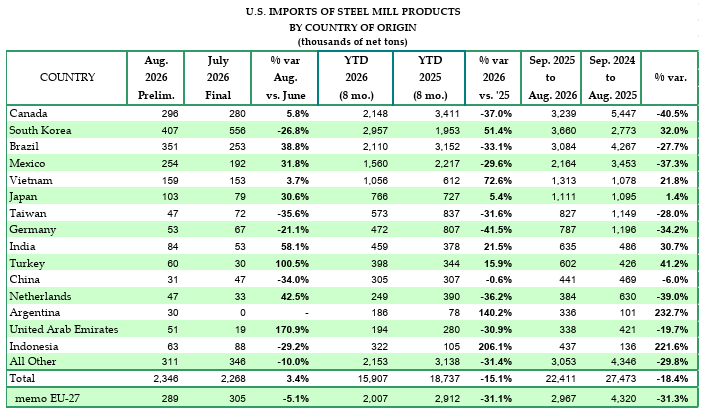
All of this has led to new investment announcements, such as that of Mesabi Metallics, a company of India's Essar Group, which will invest 18 billion dollars to build a fully integrated steel company, linking its iron ore mine in the Mesabi mining region of Minnesota with a new steel complex in Iowa, the largest in the history of the US, according to Trump.
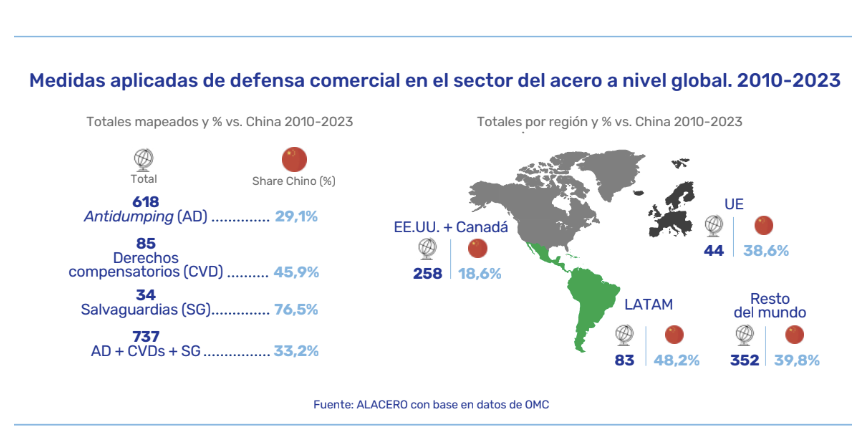
The steel industry in Latin America faces major challenges because Chinese imports have tripled over the last 15 years, and because high tariffs imposed by the United States could divert millions of tonnes toward the region, according to the OECD and Alacero. Chinese trade flows have shifted to alternative markets, hitting European and Latin American industries that absorb the steel surplus at dumping prices. Chinese steel exports reached 130 million tonnes a year in 2025, twice the consumption of all of Latin America. The volume of imports has also been a source of concern in the industrial sector in Argentina.
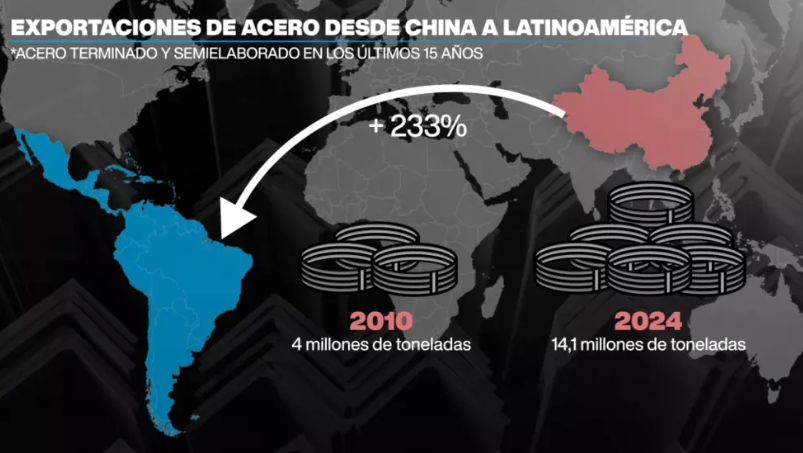
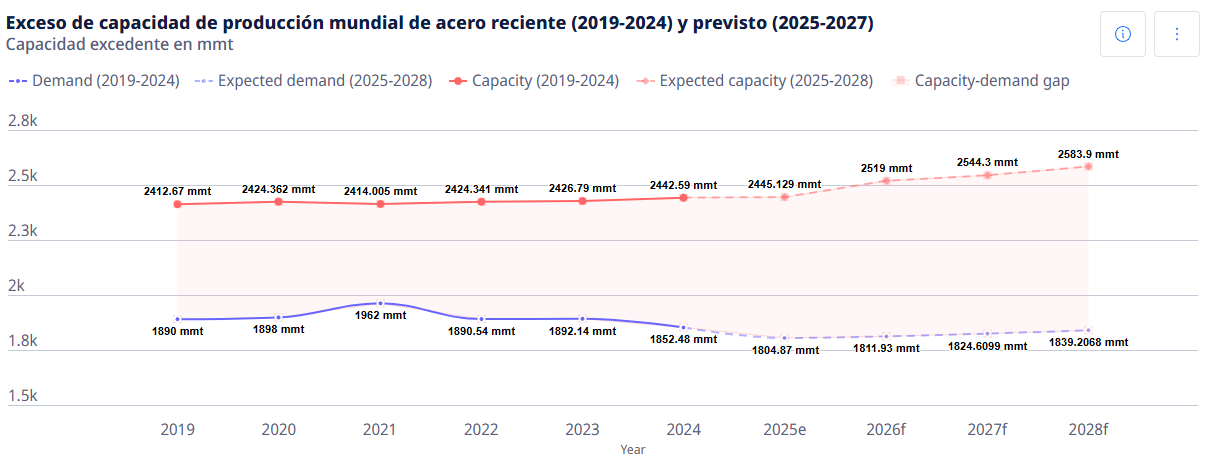
Photo source: Steel Forum
The new reality
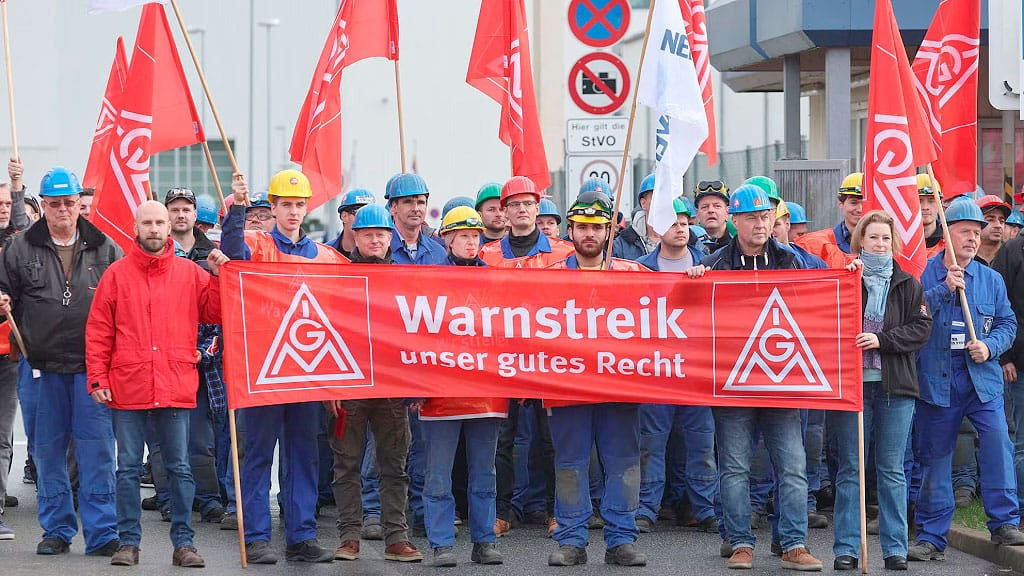
For years, European and North American companies themselves benefited from access to the world's largest market. In 2024, German carmakers were asking their government not to be so demanding with China, and they argued against protectionism for fear of losing market share. Today their sales in China have fallen to local producers, and they are closing factories in Germany. This may also have an impact in Argentina, since Volkswagen has a significant industrial presence in the country: its General Pacheco plant employs more than 4,000 people and produces the Amarok, while Córdoba manufactures transmissions, Ducati motorcycles, trucks and buses. As reported by the newspaper Argentinishe Tageblatt, in 2026 sales of cars manufactured in Argentina declined while imports of high-end vehicles increased; Mercedes-Benz and BMW grew by more than 50% year-to-date.
Europe faces growing exposure to Chinese exports in strategic sectors such as electric vehicles, solar panels and steel, with bilateral trade deficits that the EU estimates at more than 300,000 million euros a year. The imposition of import restrictions on products of that origin in the EU may be an opportunity for Mercosur, with which it has signed an Interim Free Trade and Investment Agreement, but also a threat. The International Trade Center (ITC) estimates that potential EU vehicle exports to Mercosur could reach USD 1,500 million for Germany, USD 451 million for Spain, USD 363 million for Italy and USD 330 for France. And under the agreement, Argentina is implementing an annual quota of 15,500 European cars, which will enjoy a 50% reduction in the basic tariff until the end of the eighth year the Agreement is in force.
The lack of consensus in the G20 and among the Mercosur partners
Under the US presidency of the G20, the multilateral Statement issued on October 7, 2026 by 15 of the G20 trade ministers (Argentina, Australia, Canada, the European Union, France, Germany, Italy, India, Japan, Korea, Mexico, Poland, Turkey, the United Kingdom and the United States) marks an explicit position in the global trade dispute against China's subsidized industrial policies, especially in sectors such as: (i) automobiles and electric vehicles (EVs); (ii) batteries; (iii) chemicals; (iv) foundational semiconductors; and (v) solar panels. The group of countries that signed the Statement committed to meet at the technical level, within the framework of the OECD, before December 2026 to draw up terms of reference and to share non-confidential information and data on structural excess capacity and production, its impact on these sectors, and efforts to mitigate the damage.
This partial G20 statement, which does not include Brazil (a country that likewise did not join the Statement on measures against forced labor), reveals a lack of regional alignment among the MERCOSUR partners and marks a step back from the consensus reached 10 years earlier by all G20 countries in the case of steel. Failing to coordinate positions among the MERCOSUR partners in international forums such as the G20 reveals to third countries a lack of unity that directly affects the rest of the negotiations, both the bilateral negotiations of both countries and those as a regional bloc, making them more vulnerable to potential divestment and to the diversion of subsidized trade toward our region.
Director of Pulso Internacional
Lawyer specializing in international trade and productive investment, with more than 25 years of experience in international trade negotiations as an adviser to governments and to companies going international. At Pulso Internacional we analyze foreign trade, bringing clarity and international context so that your company can export and invest more.
Related analysis
European Assessment of the EU-Mercosur Agreement: In 4 Months, European Exports Grow 9%
November 5, 2026 · 2 min
Why Has the US Increased Its Investment in Germany?
November 3, 2026 · 5 min