US accuses more than 40 countries of helping China avoid paying tariffs
Translated from the Spanish original. Read the original

Director of Pulso Internacional
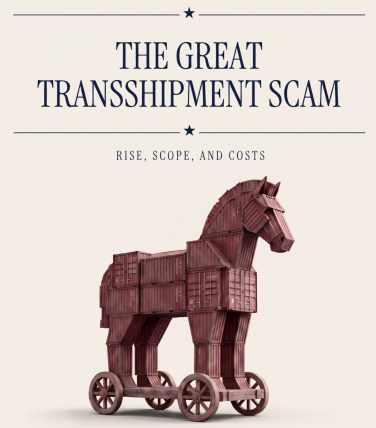
On August 13, 2026, the White House published a document that the Trump administration called the "Great Transshipment Scam" or "The Great Transshipment Scam". In it, the administration identifies the fraudulent transshipment of Chinese goods through other countries to circumvent the trade restrictions the US imposes in its trade war with China, which causes it a multibillion-dollar loss in customs duties (tariffs). According to the report, this would be a systematic practice of tariff evasion, and it therefore foreshadows a set of measures aimed at preventing it. The document is a roadmap that may have direct consequences for exporters in 38 countries, including the European Union, and the following in Latin America: Brazil, Mexico, Colombia, Chile, Peru, Panama, Costa Rica, the Dominican Republic and Argentina. This new perspective of the US administration collides with the earlier policy of the Obama government, which sought managed trade with US participation in the Trans-Pacific Partnership to contain Chinese influence, and with the earlier policy of the Biden administration of "nearshoring" or "friend-shoring", that is, the relocation of companies with production in China to "allied" countries in order to discourage China's industrial growth. The fact is that it was mainly Chinese companies that relocated to US allied countries, the archetypal cases being Mexico or Vietnam, with progressive annual increases in Chinese companies investing billions of dollars. Data from the Foreign Investment Agency of Vietnam's Ministry of Finance showed that China was the third-largest investor by capital in the first quarter of 2025, but leads in number of projects, with 251 new programs representing 29.5% of all registrations. Today the Trump administration wants investments to return and new ones to be made in the US, and one tool is to obstruct trade potentially linked to China.
The mechanics of the fraud: how customs triangulation works
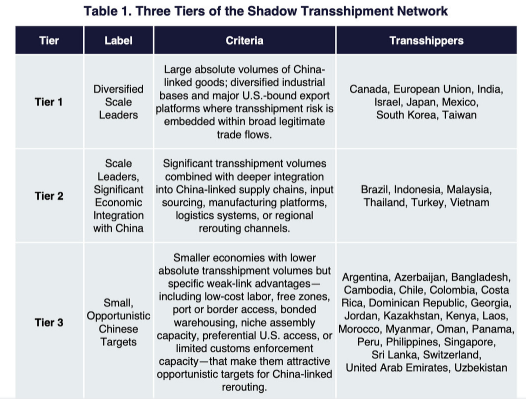
The mechanics of fraudulent transshipment are simple: goods produced in China, which are subject to the high tariffs under Section 301 of the US Trade Act of 1974, which in 2025-2026 reached ranges of 25% to 145% depending on the product category, are shipped to a third country where they undergo minimal processing or are simply relabeled, and then enter the US under the origin designation of the intermediary country, thereby benefiting from substantially lower tariff rates. The difference between the two rates is the illicit profit of the scheme. The White House document of August 13 sets out different categories of countries that facilitate this activity. The countries most frequently used as triangulation hubs include Vietnam, Malaysia, Mexico, India and the United Arab Emirates. In the case of Vietnam, exports to the United States in sensitive categories (solar panels, textiles, steel) grew in a statistically anomalous manner in exact correlation with the increase in tariffs on Chinese products, which was one of the primary red flags for CBP (Customs and Border Protection). According to the US, the same pattern repeats: when Chinese products are hit with higher tariffs and their entry into the US consequently falls, the third country's exports in the same sector rise, with Chinese components or from factories linked to Chinese interests.
The document has sorted the allegedly "offending" countries into three groups:
The increase in imports from these countries is mirrored by the drop in US imports from China (which had grown since China joined the WTO in 2001), a drop that began with the increase in tariffs imposed by Trump on Chinese products in 2018.
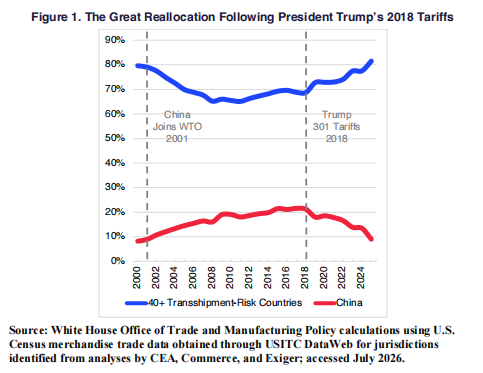
Source: White House / CBP, August 2026. The increases in these categories coincide with the escalation of tariffs on China.
The regulatory framework: Section 301, GATT and rules of origin
The regulatory framework rests on the application of the tariff scheme under Section 301 of the Trade Act of 1974, which has been extended to third countries that operate as triangulation platforms, as enabled by executive orders issued during 2025. At the multilateral level, the technical core of the problem lies in the rules of origin, the set of criteria that determine the economic nationality of goods. That is, where the goods actually come from. These rules are regulated by each country's laws, acts and administrative decisions, which must conform to the WTO Agreement on Rules of Origin . In general terms, US rules of origin, systematized in the CBP procedures manual, establish that origin is determined by the place where the product underwent its "last substantial transformation", a standard that transshipment fraud systematically violates by simulating manufacturing processes that do not alter the essence of the product. In the context of the US agreement with Mexico and Canada, the USMCA (NAFTA), origin accumulation mechanisms are especially important, since the agreement allows inputs from Mexico or Canada to be accumulated toward the regional content required to receive tariff reductions. And when Chinese components enter Mexico with minimal transformation and are declared as regional production before crossing into the United States at a zero or reduced rate, fraud clearly occurs. The August 2026 document explicitly identifies this mechanism as one of the priority vulnerabilities to be closed through reforms to CBP verification procedures.
Argentina and Brazil: risk or window of opportunity
The question Mercosur exporters must ask is twofold: are Argentina and Brazil singled out as triangulation nodes, or can they position themselves as legitimate alternative suppliers? The answer, for now, is not clear-cut. The report points to Brazil as a country with strong productive ties to China, and it stands out as the second-largest supplier of steel to the United States after Canada, which places it under scrutiny in any systemic CBP investigation. The risk is not necessarily that Brazil triangulates intentionally, but that the presence of Chinese inputs in its production chain, such as sheet, rolled coils and semi-finished products, raises doubts about compliance with substantial transformation rules. Value chain audits, which CBP can initiate on its own motion, do not distinguish between intentional fraud and poorly documented mixed origin. Both situations can lead to detentions, tariff reclassifications and, in the most serious cases, temporary exclusion from preferential access. Argentina, for its part, faces a more limited but equally real risk in sectors such as auto parts and aluminum products. The USTR has expanded the list of countries under active monitoring in its most recent Section 301 review, and although Argentina is not among the highest-priority cases, the systemic logic of the August document implies that any country with growing exports to the United States in sensitive categories (in practice, those previously supplied by Chinese products) will be subject to intensified verification.
Prepared by the author based on the White House document (August 2026) and CBP data.
In sectors where trade diversion displaces fraudulent Asian suppliers, Latin American producers with verifiable origin —in aluminum smelting, in medium-complexity textile products, in certain industrial components— can capture market share if they act swiftly and professionally on trade compliance.
What exporting companies must do now
Faced with this new reality, Latin American companies exporting to the United States must analyze their supply chains to identify the share of Chinese-origin inputs and assess whether that share is compatible with the transformation rules applicable to their product category. This audit is not a formality: CBP has strengthened its investigative capabilities with AI tools that automatically cross-check trade flows, transfer prices and origin declarations. In addition, exporting companies in the region should obtain the necessary origin documentation, such as certificates issued by recognized industrial chambers, sworn statements from suppliers backed by documentation of production processes and, for the most exposed cases, binding rulings or advance rulings from CBP certifying the origin of specific products before they become the subject of an investigation. This preventive certification can be the difference between keeping and losing market access.
Fraudulent transshipment is the new yardstick by which the United States will assess all its trading partners, including those whose good faith no one disputes. And although it is one more non-tariff barrier, it is important not to wait to be investigated, but rather to proactively demonstrate that their value chains are what they claim to be.
Sources
- White House — "The Great Transshipment Scam" (August 13, 2026)
- Pulso Internacional — Product rules of origin at the center of negotiations
- U.S. Customs and Border Protection — Informed Compliance Publication: What Every Member of the Trade Community Should Know About: U.S. Rules of Origin
- Most Favoured Nation — "Where Is It Really From?"
- Mona Paulsen (Substack) — "What Is the Great Transhipment Scam?"
Director of Pulso Internacional
Lawyer specializing in international trade and productive investment, with more than 25 years of experience in international trade negotiations as an adviser to governments and to companies going international. At Pulso Internacional we analyze foreign trade, bringing clarity and international context so that your company can export and invest more.
Related analysis

European Assessment of the EU-Mercosur Agreement: In 4 Months, European Exports Grow 9%
November 5, 2026 · 2 min
Why Has the US Increased Its Investment in Germany?
November 3, 2026 · 5 min