Argentina applies to join the Comprehensive and Progressive Agreement for Trans-Pacific Partnership (CPTPP)
Translated from the Spanish original. Read the original
Director of Pulso Internacional
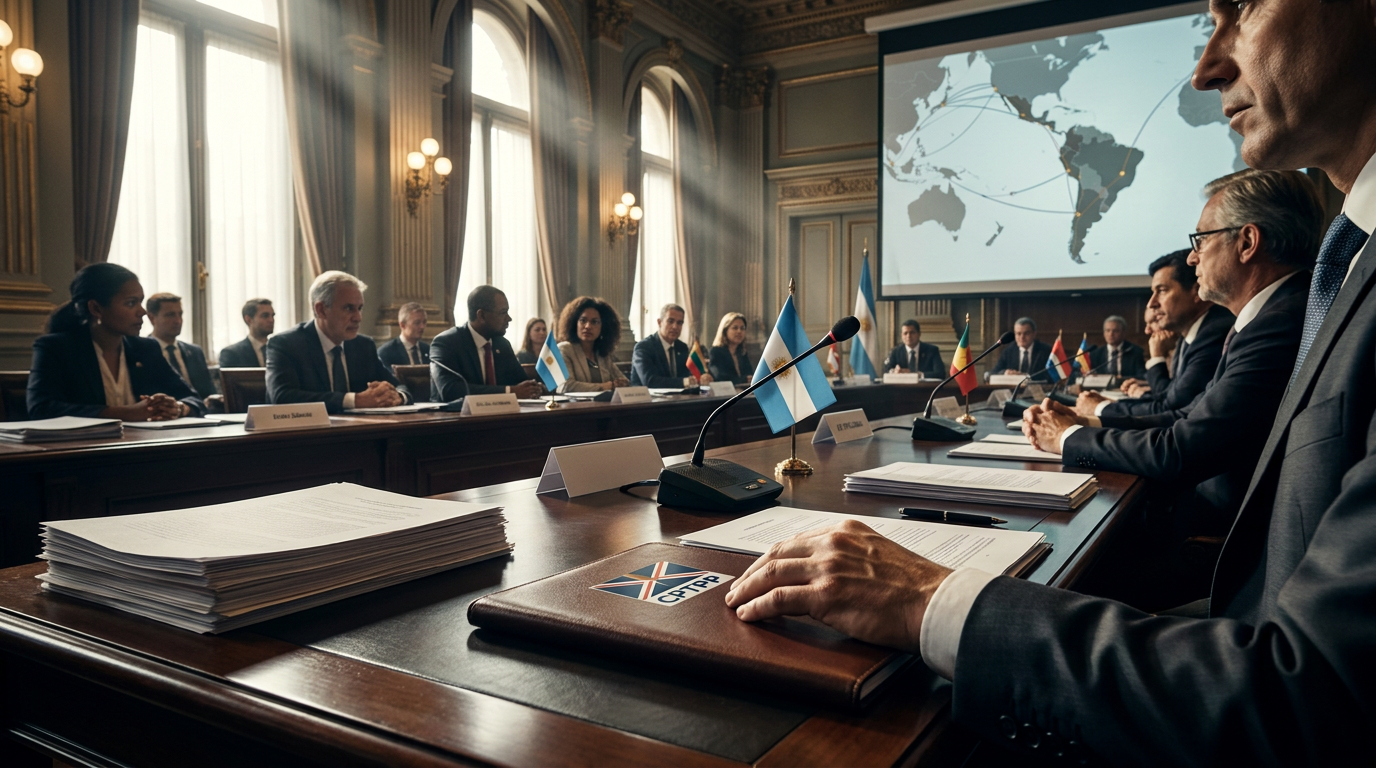
Argentina's Foreign Minister Pablo Quirno announced today, June 2, 2026, Argentina's intention to join the Comprehensive and Progressive Agreement for Trans-Pacific Partnership (CPTPP), and said he will formally submit the application to the CPTPP Secretariat on Wednesday, June 3.
The Comprehensive and Progressive Agreement for Trans-Pacific Partnership, or Comprehensive and Progressive Trans-Pacific Partnership (CPTPP), was based on another agreement originally known simply as the Trans-Pacific Partnership (TPP), which was a proposed regional free trade and investment agreement and which now involves twelve countries from the Asia-Pacific, the Americas and Europe: Australia, Brunei Darussalam, Canada, Chile, the United Kingdom, Japan, Malaysia, Mexico, New Zealand, Peru, Singapore and Vietnam which together account for nearly 595 million consumers and 13% of world GDP. It is a new-generation agreement that includes non-trade issues such as environmental, labor and technology standards. Understanding its origin and evolution will give us clues about the future negotiating scenarios Argentina will face in its accession process.
Origin and evolution: The TPP was an agreement that emerged as a result of the failure of the negotiations at the WTO. It was originally created by countries with a low level of industrialization, such as Chile, Brunei, New Zealand and Singapore, and was at one point "co-opted" by the US as a useful instrument for deploying its strategy to curb China's commercial and industrial growth. They were joined by countries such as Japan and Australia, which also have political concerns about that country, and by other Asian countries that have an interest in not being subjected to Chinese hegemony.
The negotiations began in 2002 and were consolidated in 2005 with the signing of the Trans-Pacific Strategic Economic Partnership Agreement (P4 – Chile, Brunei, New Zealand and Singapore), whose main elements were:
- A broad agreement on trade in goods, under which more than 90% of total trade among the four parties was duty-free;
- It sought greater trade facilitation in order to reduce transaction costs related to sanitary and phytosanitary measures, standards and customs procedures;
- It proposed a liberalization framework to promote trade in services among the countries;
- It sought a commitment by the parties that companies from the other TPP parties be able to compete on equal terms with local suppliers in government procurement (above certain thresholds);
- It established greater cooperation among the four parties on competition and intellectual property rights;
- It sought a framework of collaboration in strategic areas such as innovation, research and development.
Other countries then gradually joined, adding issues and seeing this forum as a space for negotiating and projecting their commercial and political interests.
Successive accessions: The incorporation of the US was a factor that contributed to the expansion.
- In January 2008, the US agreed to enter into talks on financial liberalization and, by September of that year, announced that it would begin negotiations to join the TPP at the next negotiating round, held in early 2009.
- In November 2008, Australia, Vietnam and Peru announced that they would join the bloc. Malaysia did the same in October 2010.
- Canada expressed interest in joining in 2010, but the US and New Zealand blocked its access because of Canadian agricultural policy, especially on dairy, and the protection of intellectual property rights.
- Finally, in 2012 Canada and Mexico formally became participants in the accession negotiations, although Mexico had some concerns about the customs policies of the other participants.
- Japan officially joined the negotiations in July 2013.
Relationship between the TPP and each member's free trade agreements
At the June 2010 round, the question of the relationship between this Agreement and each member's pre-existing free trade agreements was raised. Two decisions were taken. All the countries agreed to maintain coexistence between the pre-existing bilateral agreements and the TPP. The most illustrative case is Chile, which has bilateral agreements with all of the countries taking part in the negotiation. However, each of those agreements differs from the TPP itself: in the FTAs with Malaysia and Vietnam, for example, the number of tariff-free products is greater, and new chapters are incorporated, such as Trade in Services and Financial Services. It was agreed that there must be coherence between the TPP and the existing agreements. This means that countries will be able to refer in the TPP to provisions included in their prior agreements, should they wish to maintain certain rules of bilateral treatment. The underlying idea, and the best way to manage this situation, has been for the agreements to coexist and for trade operators to decide which one to use. In order to avoid lowering the level of ambition, the existing bilateral relations would be maintained and bilateral tariff-reduction schedules would be negotiated among the TPP member countries that do not have an agreement.
Broadening of objectives: On November 12, 2011, the nine countries of the Trans-Pacific Partnership announced that the TPP aims to "foster trade and investment among the TPP partner countries, to promote innovation, economic growth and development, and to support the creation and retention of jobs".
A living agreement: The TPP has a flexible structure, institutions and processes, which allow the agreement itself to evolve in response to the challenges that arise in the future. For that reason the TPP is defined as a "living agreement" that may be reopened in the future so that it can grow by incorporating the new issues that emerge from the global economy, as well as the new interests that countries may have when they join the negotiating table.
Negotiating difficulties: The negotiations were secret and there are sensitive issues that made it difficult to conclude them: agriculture, intellectual property, services and investment, and other, more novel ones, such as labor and environmental standards and state-controlled enterprises, which are not usual in traditional free trade agreements or in the WTO, as well as issues related to the digital economy: software services, telecommunications services and electronic payment services via the internet.
What is the TPP about?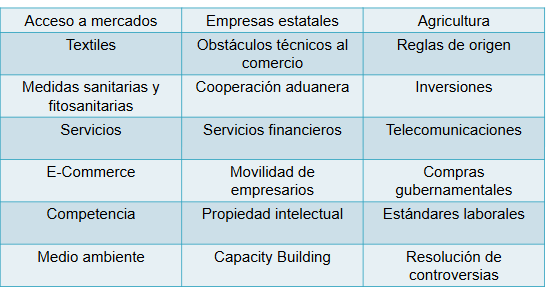
US participation in the TPP and its strategy for the region. Yes, yes... but no.
The negotiation and implementation of this agreement was one of the main objectives of the Obama administration's trade agenda. Indeed, given the failure of the Doha Round at the WTO, through the Transatlantic and Trans-Pacific negotiations the US was not trying to establish a true free trade system but rather a managed trade regime. Especially at a time when this region was undergoing change because of China's advance (in 2016 it was considered a market economy at the WTO), the TPP was used by the US as part of its rebalancing strategy toward Asia. The US jumped onto an existing negotiating process such as the TPP to project its aspirations of opening third markets and, at the same time, to compete with China for hegemony in the region, giving the negotiations a scope that their initiators had never imagined. They did something similar with the G20, a negotiating group that originally had a purely financial profile and now also has a clearly political preeminence. Evidently the TPP was a great deal for the US, which in this way advanced in countries that already buy from it but can buy more, and could set labor, environmental and technology policy standards that today only the US is fully able to meet, followed afterwards by the rest of the TPP's developed countries. But to avoid antagonizing China, the US had offered it a carrot, consisting of a proposal for tariff opening on technology products with that country within the WTO, through progress in the negotiations of the Information Technology Agreement (begun in 1996), which eliminates tariffs on high-technology products among 54 economies, including the US and China. The TPP was one of the central foreign trade issues of the government of former President Barack Obama, who spent some 7 years negotiating it.
Finally, on February 4, 2016, the TPP member countries, including the US, signed the Trans-Pacific Partnership Agreement during an official ceremony in Auckland, New Zealand. However, on his first day at work as president in his first term (2017), Donald Trump issued an Executive Order withdrawing the country from the TPP and announced in advance his intention to conduct bilateral trade negotiations, which finally gained momentum in his second term.
The US withdrawal from the Agreement was a bombshell. Nevertheless, on November 11, 2017, the ministers of Australia, Brunei Darussalam, Canada, Chile, Japan, Malaysia, Mexico, New Zealand, Peru, Singapore and Vietnam announced that they had agreed on the core elements of a new agreement, renaming the TPP the Comprehensive and Progressive Agreement for Trans-Pacific Partnership (CPTPP), which incorporates provisions of the TPP, with the exception of some provisions that will be suspended. It entered into force internationally in December 2018, with the United Kingdom the latest country to join, on December 15, 2024. Uruguay submitted its application for accession in 2022 and was approved to begin the accession process in 2025, as was Costa Rica, which applied in 2022 and was approved to begin the process in 2024; on May 5, 2026, the substantial conclusion of the negotiations for Costa Rica's accession to the agreement was announced, with its signature and legislative approval still pending.
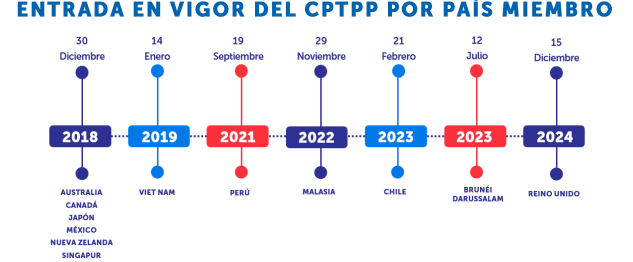
Argentina's application to join the Agreement is the start of a process that will demand negotiating efforts and new productive and investment challenges.
Sources:
Ian Ferguson "The Trans-Pacific Strategic Economic Partnership Agreement" sice.oas.org
US - Ambassador Michael Froman at the Wilson Center: "The Strategic Case for Trade" ustr.gov
Director of Pulso Internacional
Lawyer specializing in international trade and productive investment, with more than 25 years of experience in international trade negotiations as an adviser to governments and to companies going international. At Pulso Internacional we analyze foreign trade, bringing clarity and international context so that your company can export and invest more.
Related analysis
European Assessment of the EU-Mercosur Agreement: In 4 Months, European Exports Grow 9%
November 5, 2026 · 2 min
Why Has the US Increased Its Investment in Germany?
November 3, 2026 · 5 min