Divestment in Argentina's Footwear Sector
Translated from the Spanish original. Read the original

Director of Pulso Internacional
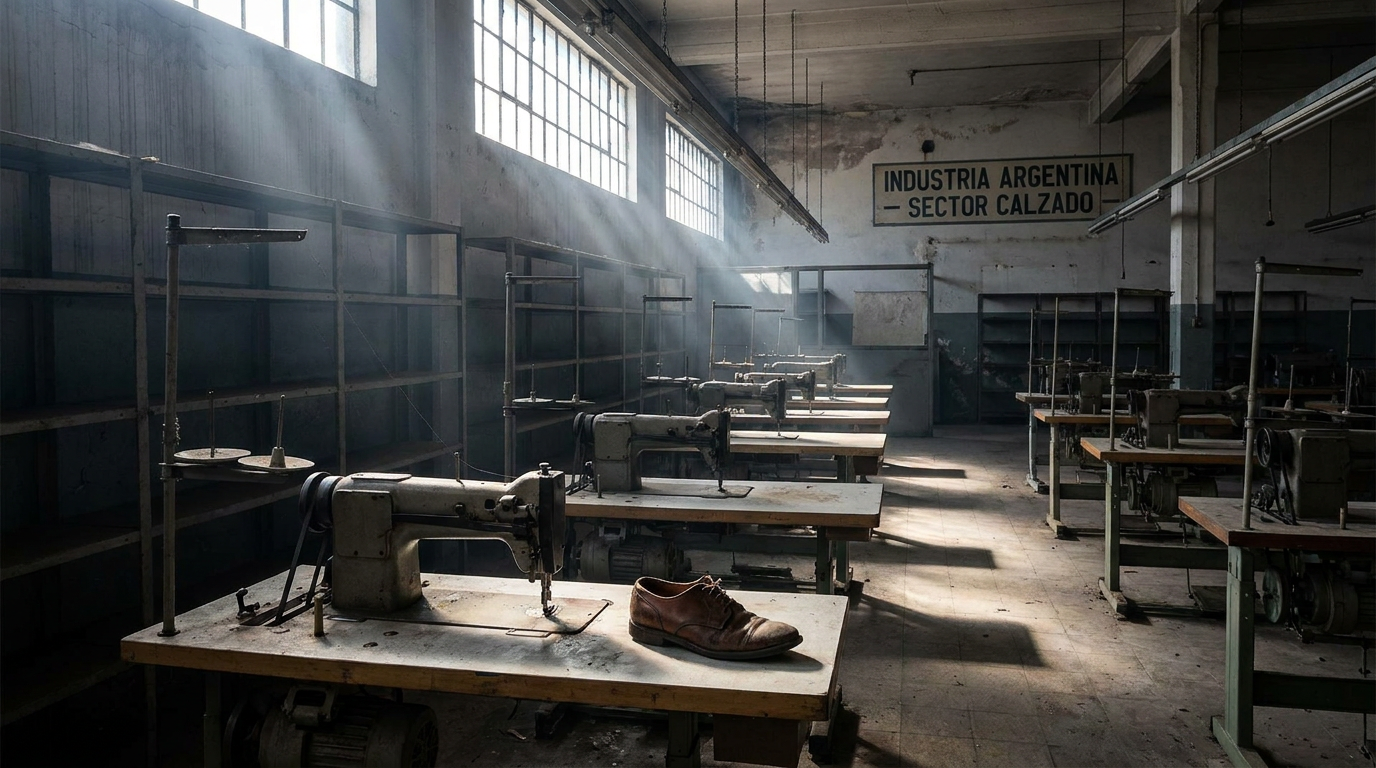
The Closure of Dass and the Symptom of an Industry Under Pressure
The definitive closure of the Dass plant in El Dorado, Misiones, a local manufacturer that produced footwear for global brands such as Adidas and Nike, with the resulting dismissal of 150 workers and the earlier closure of the company's plant in Coronel Suárez, which had led to the dismissal of 360 employees, is being repeated at other, smaller companies and shows that the import liberalization that has been implemented has far exceeded the sector's capacity for restructuring or adaptation.
The Flood of Imports: Systemic Pressure
Argentina has seen, since 2024, a significant increase in imported footwear, especially in the sports segment and in semi-finished footwear from China and Southeast Asia. The systemic pressure exerted by the growth in subsidized production and by China's industrial overcapacity, which Argentina condemned at the G20 but which meets no practical resistance in the country itself, is compounded by the closure of markets such as the United States, where tariffs on footwear divert trade toward countries like Argentina. The combined effect is devastating.
Smuggling Is Destroying the Industry
The laxity of controls that customs exhibits in many cases, especially regarding the entry of footwear, which reaches between 8 and 10 million pairs per year, is flagged by the Footwear Industry Chamber;
“When merchandise that has been brought in circulates without complying with the same rules as formal production, competition ceases to be level. The impact reaches companies that produce in Argentina, registered workers, national brands and investment decisions. It also causes fiscal damage through the evasion of duties and taxes.” Footwear Chamber.
On October 9, Horacio Moschetto, president of the Footwear Industry Chamber, took part in the International Congress on the Prevention and Investigation of Smuggling, Piracy and Trademark Fraud, where he warned of this problem. (3)

The Suspension of Antidumping Measures and Its Consequences for Sports Footwear
The segment most affected by the suspension of trade defense measures has been sports footwear, precisely the one with the largest production scale and the most exposed to Asian competition. The National Foreign Trade Commission (CNCE) had for years maintained a scheme of antidumping duties on imports of Chinese footwear that allowed for a certain competitive balance. The review and subsequent lifting of those measures, within the framework of the general trade deregulation of the economy, created a protection gap that the sector could not absorb at the speed that liberalization demanded.
The declared rationale for adopting the measure was ostensibly coherent: by lowering the cost of imported inputs and components, local industry could reduce production costs and gain competitiveness. In practice, however, that mechanism worked in reverse for many of the companies that ended up shutting down their production in the country.
Opening up inputs benefits those who produce, but the simultaneous opening of finished products, without active defense instruments, eliminates the incentive to produce. When the FOB prices of Chinese footwear enter the Argentine market below local production cost, even with imported inputs free of duties, manufacturing or assembling sneakers locally does not pay.
It should be noted that the WTO expressly provides for the possibility of applying antidumping measures when it is verified that imports are entering at prices below normal value and causing injury to the domestic industry. The WTO Antidumping Agreement (Article VI of the GATT) not only authorizes these measures but also provides the procedural framework for their application. Argentina formally has that tool at its disposal. The decision not to activate it, or to suspend those that were in force, is a policy choice, not an international legal imposition.
The Future of the Sector Requires Investment in Technology, Design and Training
The footwear sector is suffering from the measures liberalizing the economy, from smuggling, and from the lack of protection against unfair international competition. Argentina has assumed commitments in the G20 and in the trade and investment agreement with the US to prevent imports of products made with forced labor, footwear among them. It is essential to achieve coherence between external trade policy and industrial policy in order to strengthen a sector that risks disappearing. At the same time, we must understand that the sector faces an unavoidable restructuring, one that requires investment in technology and design, the development of a regional supply chain for inputs, and the training of human resources.
If you would like to learn more about strategies for developing your company and defending your market, write to us.
Sources
- Infobae — The manufacturer of Nike and Adidas closes its last plant in Argentina and lays off its 150 workers (July 7, 2026)
- Misiones Opina — The closure of Dass shows what happens when national industry is abandoned
- Footwear Industry Chamber. President Horacio Mosqueto. On smuggling in the sector. youtube.com
Director of Pulso Internacional
Lawyer specializing in international trade and productive investment, with more than 25 years of experience in international trade negotiations as an adviser to governments and to companies going international. At Pulso Internacional we analyze foreign trade, bringing clarity and international context so that your company can export and invest more.
Related analysis

European Assessment of the EU-Mercosur Agreement: In 4 Months, European Exports Grow 9%
November 5, 2026 · 2 min
Why Has the US Increased Its Investment in Germany?
November 3, 2026 · 5 min