The Mercosur-Singapore Free Trade Agreement (MCSFTA)
Translated from the Spanish original. Read the original
Director of Pulso Internacional
The Mercosur-Singapore Free Trade Agreement, known by its acronym MCSFTA, is moving forward in its process to enter into force for Argentina. On September 15, 2026, the National Executive promulgated Law No. 27,819 through Decree No. 1010/2026; the instrument of ratification, which is being processed, has not yet been deposited with the depositary (Paraguay), as it must be signed by the President or the Foreign Minister. At that point, as established in Article 19.13 of the Agreement, it will be necessary to wait until the second month following this deposit for the agreement to enter into force. Once full entry into force of the instrument has been completed for Mercosur's four founding member states, the MCSFTA ceases to be a partially implemented agreement and becomes a tool for real market access to one of Asia's main trade, logistics and financial hubs.
Singapore as a gateway to the Indo-Pacific
The relevance of the Mercosur-Singapore Free Trade Agreement (MCSFTA) is not limited to bilateral trade between Mercosur and Singapore in terms of trade volume alone. The city-state has a high GDP per capita, which reached USD 90,689 in 2024, almost double that of 2010; it operates as a redistribution node in the Indo-Pacific trading system, as it is home to more than 7,000 multinational companies with regional operations; it hosts the world's second busiest container port; and it concentrates a financial and legal infrastructure that positions it as an entry platform for products that are then re-exported or marketed in the markets of Southeast Asia, India and East Asia.
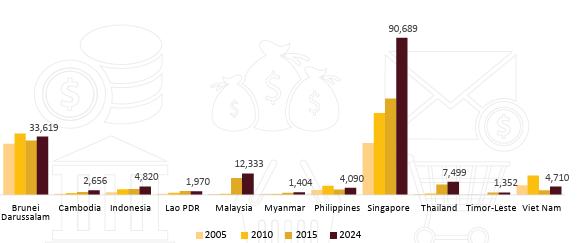
GDP per capita in ASEAN countries - Source: ASEAN - Countries linked to Singapore that can be leveraged through the Mercosur-Singapore Free Trade Agreement (MCSFTA)
For this reason, the preferential access to the Singaporean market provided by the Mercosur-Singapore Free Trade Agreement should not be read solely as a bilateral tariff reduction, but as a lever for positioning in global value chains with ramifications towards ASEAN, a bloc of eleven countries. For Argentine exporters, Singapore can serve as an entry point and showcase from which to scale up into larger markets that are more complex to access directly. Executives from various companies have expressed this view, as reported in the press release of Singapore's Ministry of Energy, Trade and Industry (METI), among them:
The logistics company of Singaporean origin Exolgan, part of the ITL Group, which is one of Argentina's leading container terminal operators. Through its integrated network of port, logistics and warehousing businesses, which includes Exolgan, Exologística and LPI, the ITL Group also welcomes the entry into force of the agreement:
"As a long-term investor in Argentina through our partnership in the ITL Group, PSA welcomes the entry into force of the Mercosur-Singapore Free Trade Agreement. Headquartered in Singapore, our longstanding investments in Argentina give us a unique perspective on the value of closer economic ties between the two countries. We believe the agreement will strengthen trade and investment flows, enhance supply chain connectivity, and support the competitiveness and long-term growth of businesses across Mercosur and Singapore. " Enno Koll, Regional CEO, Americas, PSA International
Alfa International Pte Ltd, a Singapore-based wine importer and distributor, whose director stated:
“Alfa International welcomes the MERCOSUR-Singapore Free Trade Agreement (MCSFTA), which we see as an important step towards strengthening trade and business ties between Singapore and Argentina. We currently work with family-owned wineries in Mendoza and Luján de Cuyo, Argentina, and have established experience importing Argentine wines into Singapore. We see opportunities under the MCSFTA to facilitate more efficient customs and trade processes through greater digitalisation and paperless trading, while increased trade volumes could create economies of scale and more competitive international freight costs, supporting stronger and more efficient wine trade between Argentina and Singapore.” Susy S Santoso, Director, Alfa International
EGT Collective, an SME that imports yerba mate into Singapore, highlighted the following about the agreement:
"For a small importer, certainty matters more than scale. EGT Collective brings in yerba mate from Argentina at volumes where a delayed clearance or an unexpected documentation requirement is not an inconvenience but a break in supply. The MCSFTA's commitments on customs facilitation, sanitary measures and non-tariff measures matter to us because they make our import timelines reliable and easier to plan for. For a business of our size, that enables us to commit to a supplier, forecast properly, and keep a consistent product on hand. We hope the Agreement makes it easier for more small Singapore companies to bring in Argentine goods, and with them, something of Argentine culture." — Axel Chen, Founder, EGT Collective
The place of the Mercosur-Singapore Free Trade Agreement (MCSFTA) in Mercosur's network of trade agreements
The free trade agreement with the European Union, still in the process of formal ratification in its entirety at the time of writing (it is in force on a provisional and partial basis), or the MERCOSUR-EFTA free trade agreement, in force with Brazil but not yet with Argentina and facing Swiss resistance, and the recent launch of talks with Vietnam illustrate that gap between regulatory ambition and concrete execution. The MCSFTA, by contrast, represents a case in which implementation advanced to completion, albeit at uneven paces among the partners.
The agreement with Singapore and Argentina's application to join the CPTPP
The Asian integration that Argentina seeks, as we anticipated in this publication when analyzing our country's application to join the Comprehensive and Progressive Agreement for Trans-Pacific Partnership ( CPTPP), represents a strategy of market diversification toward the Indo-Pacific region.
The possible resistance of the United Kingdom to Argentina's accession to this agreement over the dispute over the Sea Lion hydrocarbon project in the Malvinas area may slow down or even prevent Argentina's accession to the CPTPP. This circumstance places the current agreement with Singapore (MCSFTA) in a strategic position since, through it, access can be gained to several countries that are members of the CPTPP, which is why Argentine companies should take advantage of it quickly.
Free trade agreements encourage foreign direct investment
In parallel, the context of foreign direct investment on a global scale shows that countries with the largest network of operational trade agreements tend to attract more stable flows of export-oriented FDI, and Singapore, which ranks 2nd in the world as a recipient of FDI with USD 151,000 in 2025 according to UNCTAD's World Investment Report 2026, is an example of this. A Mercosur with the MCSFTA in full force for its four founding members is, in that sense, a more attractive Mercosur for investors evaluating production platforms with preferential access to Asian markets.
Which Argentine sectors are in a position to take advantage of the Mercosur-Singapore agreement
In the area of trade in goods, MERCOSUR will eliminate import tariffs on approximately 96% of products over a period of up to 15 years; around 25% of tariff lines will enjoy duty-free access immediately. The Agreement also establishes common rules of origin and more transparent customs procedures, which facilitates greater use of preferential tariff treatment and more efficient supply chain planning in the participating markets. In addition, it promotes the expedited clearance of express shipments and perishable goods.
From a trade policy standpoint, the sectors with the greatest potential to take advantage of preferential conditions in a market such as Singapore's, sophisticated, with high purchasing power and strong demand for differentiated products, include, in general terms:
- Value-added agribusiness: quality-certified beef, varietal wines, olive oil, premium dairy products and certified organic foods.
- Leather goods and designer footwear, with a regional identity component.
- Knowledge economy products, including software, engineering and consulting services, to the extent that the MCSFTA includes provisions on trade in services.
- Strategic industrial inputs in the context of the global reorganization of secure supply chains, where Argentina appears as a potential supplier of critical minerals and energy sector products.
With regard to services, the press release between Singapore and Argentina states:
"The MCSFTA creates a more conducive environment for service providers and investors, through greater certainty, transparency and market access commitments. It also promotes cooperation in areas such as entrepreneurship, digitalization, cybersecurity, sustainable development and the promotion of MSMEs."
What companies can do to take advantage of the MCSFTA
It is important to carry out tariff mapping by product, identify Singaporean counterparts, and adapt the export offering to market standards. This agreement is a precedent worth bearing in mind, since a spaghetti bowl is beginning to take shape among the various free trade agreements, in which the tariff preferences and advantages granted under each agreement are mixed and interrelated, requiring detailed analysis for companies to be able to take advantage of them.
Companies interested in using the agreement to increase their exports to Singapore or attract investment are welcome to write to us.
Sources
- Ministry of Trade and Industry of Singapore — Joint Press Release for the Entry into Force of the MERCOSUR-Singapore Free Trade Agreement between Singapore and Argentina (November 1, 2026)
- Pulso Internacional — Argentina applies to join the Comprehensive and Progressive Agreement for Trans-Pacific Partnership (CPTPP)
- Pulso Internacional — Argentina can integrate into secure supply chains
- Pulso Internacional — Global foreign direct investment outlook 2026
- youtube.com
Director of Pulso Internacional
Lawyer specializing in international trade and productive investment, with more than 25 years of experience in international trade negotiations as an adviser to governments and to companies going international. At Pulso Internacional we analyze foreign trade, bringing clarity and international context so that your company can export and invest more.
Related analysis
European Assessment of the EU-Mercosur Agreement: In 4 Months, European Exports Grow 9%
November 5, 2026 · 2 min
Why Has the US Increased Its Investment in Germany?
November 3, 2026 · 5 min