BYD Weighs Producing Batteries in Argentina as POSCO Opens Its Second Lithium Carbonate Plant
Translated from the Spanish original. Read the original
Director of Pulso Internacional
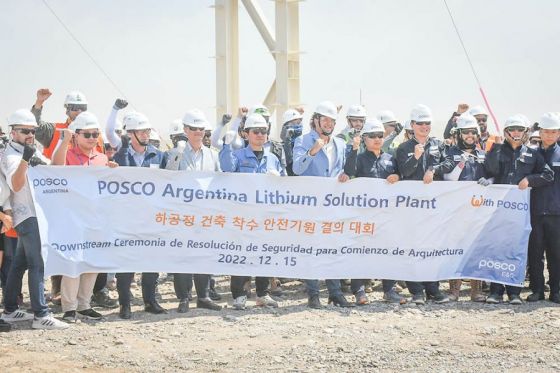
In the same week, two moves have taken place that sketch an embryonic map of what could become the first industrial lithium value chain with a territorial anchor in Argentina. On Tuesday, POSCO Holdings inaugurated its second production plant near the Salar del Hombre Muerto. On Thursday, Foreign Minister Pablo Quirno confirmed from Singapore that BYD is considering setting up a battery plant in the country. And in the background of both events lies the key question we have been raising for some time: does Argentina retain intermediate links of that chain, or does it consolidate its role as an exporter of raw material?
POSCO: installed capacity and the missing link
The inauguration of the second South Korean plant near the Salar del Hombre Muerto shows a purely extractive investment. According to Yonhap News Agency, the new facility has an annual production capacity of 23,000 tonnes of lithium carbonate. Added to the 25,000 tonnes per year of the first plant, inaugurated in 2024, total capacity reaches 48,000 tonnes per year, which positions POSCO as the largest integrated lithium operator on Argentine soil.
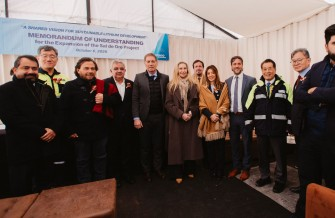
This good investment news, however, lacks local value added in production. The Yonhap News Agency notes that the lithium carbonate produced at the Argentine plants will be shipped to South Korea to be converted into lithium hydroxide, the higher value-added material that feeds secondary batteries. In other words, the link with the greatest technological density, and the highest market price, is processed outside the country. Argentina extracts and concentrates; Korea refines and manufactures. This extractive model follows a global value chain logic in which the mineral-producing country contributes the resource and the extractive infrastructure, while the industrial country retains the technical know-how, the skilled employment and the highest commercial margin. POSCO makes this explicit: the company stated that, with all of its plants in Catamarca, it would complete its own lithium hydroxide production system of 50,000 tonnes, an integrated circuit designed in Seoul, not in Catamarca. The company also announced that it plans to reach a capacity of 100,000 tonnes per year by 2033 through the construction of a third and fourth plant, each with 25,000 tonnes of capacity. At the inauguration ceremony, POSCO Group Chairman Chang In-hwa signed memoranda of understanding with the provinces of Salta and Catamarca. These instruments, whose specific scope regarding local content or employment commitments has not been publicly detailed, will be decisive in assessing whether the provinces manage to bring together industrial suppliers around the operation or whether the production linkages remain abroad.
BYD: the most important signal is also the vaguest
While the POSCO inauguration is a concrete fact, the BYD announcement is, for now, a geopolitical but still imprecise signal. Foreign Minister Quirno, following a meeting in Singapore with Stella Li, Executive Vice President of BYD, posted the following statement on his X account:
"The company is analyzing investment opportunities in Argentina linked to the lithium value chain, particularly in the production of batteries and energy storage systems. Argentina is positioning itself as a platform for projects aimed at both the domestic market and exports, within the framework of the investment promotion and mining development policies fostered by the policies of President Javier Milei."
The statement contains no investment amount, geographic location or timeline. However, the strategic relevance of the contact should not be underestimated. BYD is, to date, the world's largest producer of electric vehicles, with growing investments in Brazil, one of the main beneficiaries of the tax exemption on vehicle registration taxes and on imports of electric cars in Argentina, and one of the world's leading manufacturers of lithium iron phosphate (LFP) batteries. A potential energy storage or cell production plant on Argentine soil would represent an unprecedented qualitative leap in the local value chain: for the first time, the mineral extracted in northern Argentina could end up as a component of a manufactured product with an Argentine identity, with export potential to markets in the region.
As we noted in previous analyses of Chinese investments in the Argentine mining sector, the presence of capital from China in the country's critical resources follows a logic of securing supplies that goes beyond the specific profitability of each project. For BYD, locating part of its battery production close to the source of lithium carbonate makes sense both in terms of logistics costs and of geographic diversification in the face of potential tensions in the context of the de-risking being pushed by the United States and the European Union with respect to Chinese supply chains.
The key question: which link does Argentina retain?
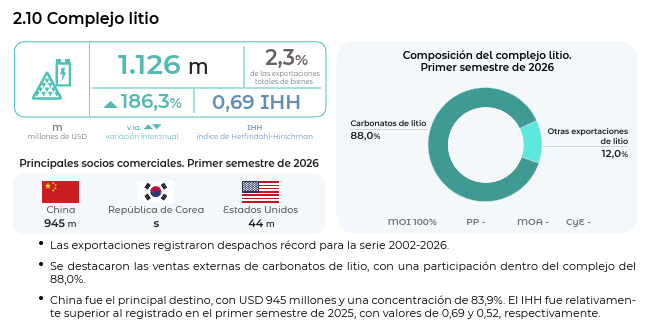
The map taking shape this week has three layers. At the base, lithium extraction at a growing scale, led by operators such as POSCO with projections of 100,000 tonnes per year by 2033. In the intermediate link, the conversion of carbonate into hydroxide, which today takes place entirely in South Korea and which Argentina does not retain. In the upper link, the manufacture of batteries and storage systems, where BYD could eventually set up. According to INDEC, the main export destination of the lithium complex in the first half of 2026 is led by China, with USD 945 million and an 88 % share of lithium carbonates.
Does the RIGI promote investment?
The gap between regulatory ambition and concrete execution is the central sticking point here. The RIGI, the Large Investment Incentive Regime (Régimen de Incentivos a las Grandes Inversiones) included in the 2024 Bases Law, offers fiscal stability and tariff reductions for large-scale projects, and it is the framework that Foreign Minister Quirno invokes in general terms when he speaks of "investment promotion policies." However, the specific conditions Argentina is offering BYD to locate a manufacturing plant, beyond the reference to the RIGI, have not been disclosed publicly. For Argentine industrial suppliers and for the local auto parts companies that might aspire to join that chain, that information is decisive. It is also decisive given the need to establish strategies that take national security into account with respect to RIGI investments. In this context, coordination between the national government and the provinces takes on a critical dimension. The MOUs signed by POSCO with Salta and Catamarca are the instruments on the table that come closest to a formal commitment, but their content, in particular whether they include local content requirements or employment commitments, remains undisclosed in the available sources. Without that information, it is impossible to assess whether productive linkages with local suppliers are a concrete priority or a declaratory aspiration.
Argentina has the resource, it has the attention of two of the most relevant players in the global energy transition, POSCO and BYD, and it has a regulatory incentive framework that, at least on paper, is competitive. What it still lacks is an explicit policy for retaining intermediate links: a roadmap defining which stages of the chain, such as refining, cell manufacturing and battery assembly, it intends to have carried out in the country. Without that definition, the concrete risk is that it will be exported as raw material, processed on another continent, and returned to the country as a higher-value manufactured product. The favorable geopolitical moment for foreign direct investment is clear; the decision to industrialize is not, as yet.
Sources
- Infobrisas — BYD considers lithium-related investments in Argentina (October 8, 2026)
- Yonhap News Agency — POSCO builds its 2nd lithium plant in Argentina (October 8, 2026)
- Pulso Internacional — Chinese investment in Argentina's mining sector
- Pulso Internacional — Argentine auto parts companies
- pulsointernacional.com
Director of Pulso Internacional
Lawyer specializing in international trade and productive investment, with more than 25 years of experience in international trade negotiations as an adviser to governments and to companies going international. At Pulso Internacional we analyze foreign trade, bringing clarity and international context so that your company can export and invest more.
Related analysis

European Assessment of the EU-Mercosur Agreement: In 4 Months, European Exports Grow 9%
November 5, 2026 · 2 min
Why Has the US Increased Its Investment in Germany?
November 3, 2026 · 5 min