An Opportunity to Defend Argentina's Textile Sector, Thanks to the US
Translated from the Spanish original. Read the original

Director of Pulso Internacional
In our previous article we discussed the foreign trade measures (higher tariffs) that the US is taking in relation to forced labor, on the grounds that it produces unfair competition against American products.
We also noted the concerns of Argentine producers over the massive import of Chinese products, above all in the textile sector, as well as in apparel and footwear and in the electric vehicle sector.
As the clothing manufacturer Sergio Collati, head of the brands This Week and O'Assian, rightly points out in the article by Azul Martínez Lo Re in the newspaper La Capital: “You can't bring in goods by courier without paying taxes, but they end up coming in anyway, with no controls. The anti-dumping law doesn't apply, and that creates unequal competition” (1)
For its part, in February 2026 Argentina concluded with the US an Agreement on Reciprocal Trade and Investment in which it reaffirmed its commitment to the protection of internationally recognized labor rights and also undertook to adopt and implement measures to prohibit the import of goods produced through forced or compulsory labor, and to strengthen the enforcement of labor legislation. (2)
Preliminary findings of the US investigation
On June 2, 2026, the Office of the United States Trade Representative (USTR) published the preliminary findings of an investigation that singles out Argentina among 60 countries for deficiencies in controlling imports of goods produced with forced labor.(3) Among the investigations offered as examples are cotton exports between the US and China in each of the selected countries. Cotton products from China are often exported to intermediate manufacturers of textiles, apparel and other derived products. And the report concludes that "Given that the vast majority of cotton produced in China comes from Xinjiang, it is likely that at least some, if not a significant volume, of Chinese exports of cotton products to intermediate producers in third countries is manufactured in that region and is therefore presumed to have been produced through forced labor".
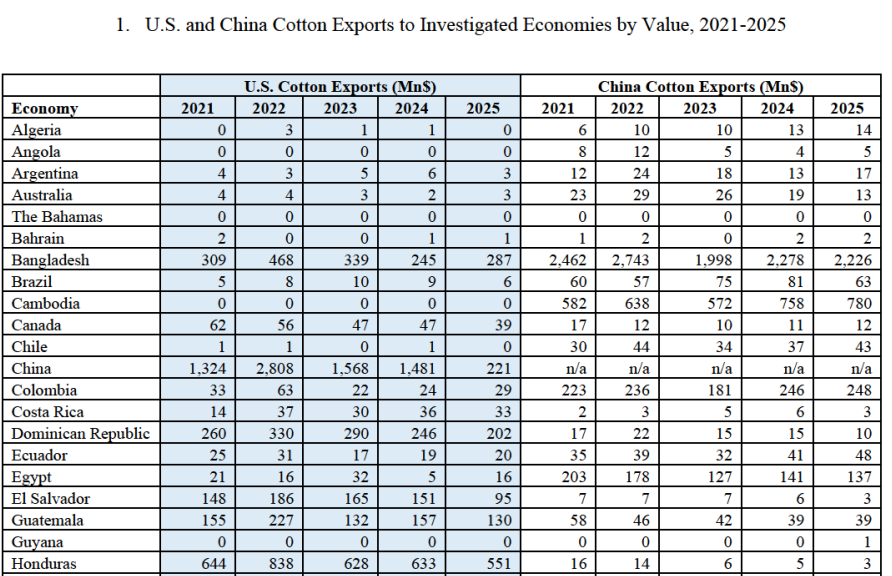
(the list continues)
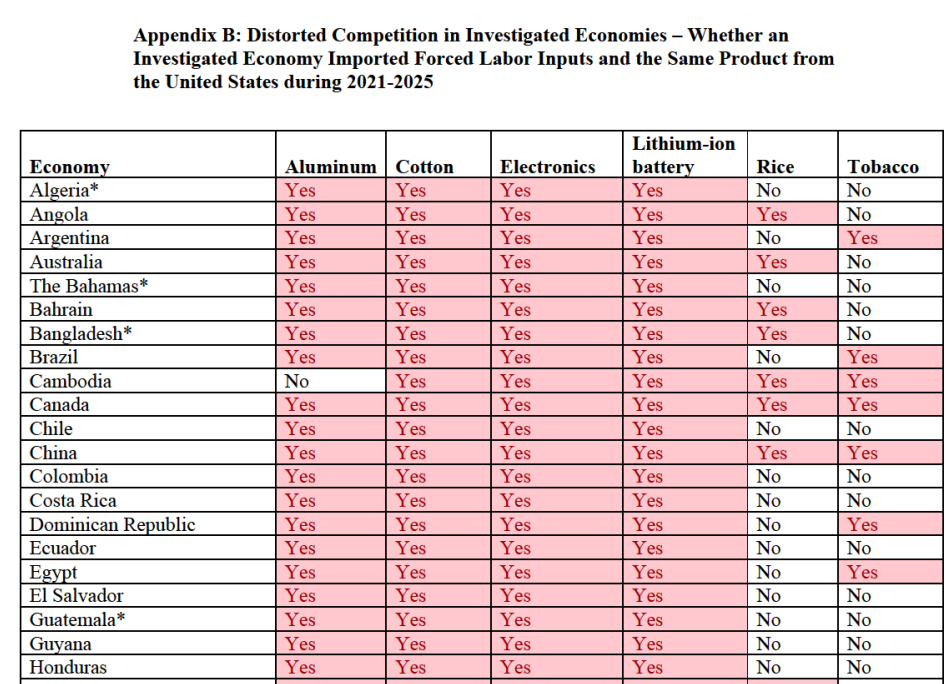
But also to other products such as aluminum, electronics, lithium batteries, rice, and tobacco.
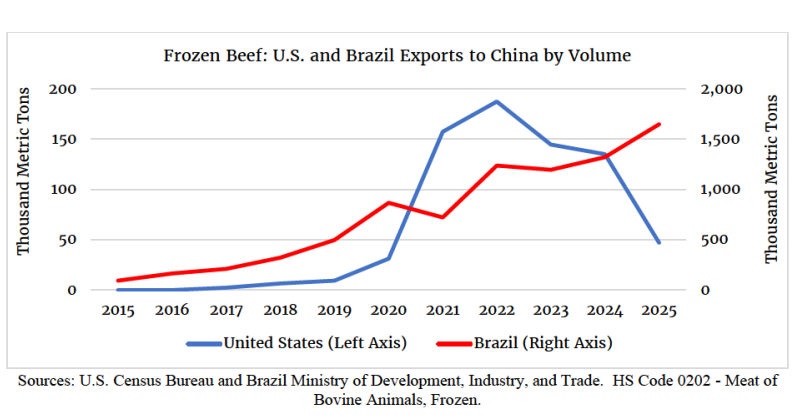
Brazil is presented as a case study, and its beef production, which competes with the US in third markets, is called into question. The report notes that, in terms of volume, Brazilian exports of frozen beef to China increased more than 17-fold, from 94,000 tons in 2015 to almost 1,650,000 tons in 2025. Brazilian exports of frozen beef to China far exceeded US exports to China, which have followed a downward trend in recent years. Brazil's share of Chinese imports of frozen beef also increased substantially (from 38% in 2021 to 53% in 2025), while the US share declined over that period (from 6% in 2021 to 2% in 2025). The report clarifies that "not all Chinese imports of frozen beef from Brazil are necessarily produced through forced labor, the prevalence of forced labor in beef production in Brazil clearly suggests that at least some of China's imports were produced wholly or partly with forced labor".
Possible consequences
The US investigation, which could result in tariffs additional to those already applied to each product of 10% or 12.5%, sets a precedent for the extraterritorial application of US labor standards and reveals a reconfiguration of trade rules under the Trump administration that points toward bilateral negotiations.
Two large groups can be distinguished in the USTR's proposal for additional tariffs:
1) Countries that impose a ban on imports of products made with forced labor (in a deficient manner): Canada, Ecuador, the European Union, Indonesia, Mexico and Pakistan. Countries that have made commitments in their respective reciprocal trade agreements regarding bans on imports of products made with forced labor: Argentina, Bangladesh, Cambodia, Ecuador, El Salvador, Guatemala, Indonesia, Malaysia and Taiwan; and for economies that have imposed a partial regime with the effect of preventing the import of certain products made with forced labor, the United Kingdom, the tariff is 10%
2) For all other economies that have neither imposed nor effectively enforced a ban on imports of products made with forced labor, the tariff is 12.5%.
An opportunity to defend the Argentine textile sector and promote investment
The US measures and the commitment assumed in the Agreement on Reciprocal Trade and Investment concluded with the US could serve not only to prevent forced labor in our country but also to protect sectors in Argentina that are genuinely affected by imports, above all from China, that are suspected of being produced with forced labor, as is the case in textiles, and as a way to foster the industrialization of lithium through battery manufacturing in our country. To that end, Argentina should implement effective customs control mechanisms to prevent the entry of products made with forced labor. This includes regulations, the development of traceability systems, the training of customs officials and coordination with international bodies to verify labor standards in global supply chains. The 180-day investigation period established by the Section 301 procedure creates a window of opportunity for Argentina to demonstrate concrete progress in strengthening its regulations and control mechanisms that deter the entry of products, such as textiles, that are manufactured in, or with inputs from, places where forced labor is used, while at the same time avoiding the application of additional tariffs in the US on Argentine products, thereby gaining a competitive advantage over the rest of the countries.
Sources:
(1) "Producing in Argentina when importing costs less: Sergio Colatti's challenge" La Capital - Azul Martinez Lo Re lacapital.com.ar
(2) Argentina-US Agreement on Reciprocal Trade and Investment: "Article 2.9: Labor 1: Argentina shall adopt and effectively implement a prohibition on the importation of goods mined, produced, or manufactured wholly or in part by forced or compulsory labor as defined by the relevant International Labor Organization (ILO) instruments to which it is a party. Argentina shall consider U.S. government determinations on entities under Section 307 of the Tariff Act of 1930 and the prohibition of importation of goods from those companies."
(3) US - USTR "Report in Section 301 Investigations of the Acts, Policies, and Practices of Various
Economies Related to the Failure to Impose and Effectively Enforce a Prohibition on the
Importation of Goods Produced with Forced Labor"
Director of Pulso Internacional
Lawyer specializing in international trade and productive investment, with more than 25 years of experience in international trade negotiations as an adviser to governments and to companies going international. At Pulso Internacional we analyze foreign trade, bringing clarity and international context so that your company can export and invest more.
Related analysis

European Assessment of the EU-Mercosur Agreement: In 4 Months, European Exports Grow 9%
November 5, 2026 · 2 min
Why Has the US Increased Its Investment in Germany?
November 3, 2026 · 5 min