Which Rivals Does Mercosur Face in the EU Market
Translated from the Spanish original. Read the original

Director of Pulso Internacional
Mercosur's Competition in the European Market
When we analyze the application of the MERCOSUR-EU Interim Agreement since May 1, 2026 and its prospects, we must keep in mind how the EU is integrating into the various international markets, since it is setting aside multilateralism and prioritizing bilateralism, embodied in preferential trade agreements. That is why, in addition to the omnipresent competition from China, despite the European Commission's attempts to limit it, it is necessary to identify which countries compete with Mercosur for preferential access to the EU, so that the supply of products can be oriented toward that market with prior knowledge of the potential competitors.
What Are the European Union's Preferential Trade Agreements?
At the end of 2025, the European Union had 44 preferential trade agreements in force with 76 partners. Together they accounted for 46.3% of the EU's total foreign trade. Trade with those partners reached 2,390 billion euros: 1,340 billion in exports and 1,050 billion in imports. The surplus with them rose from 276 billion euros in 2024 to 289 billion in 2025. These figures come from report COM(2026) 506, the Commission's sixth consolidated report on the implementation and enforcement of the EU's trade and economic security policy, presented on September 28, 2026.
What Are the EU's New Agreements? Mercosur, Mexico, Indonesia, India and Australia
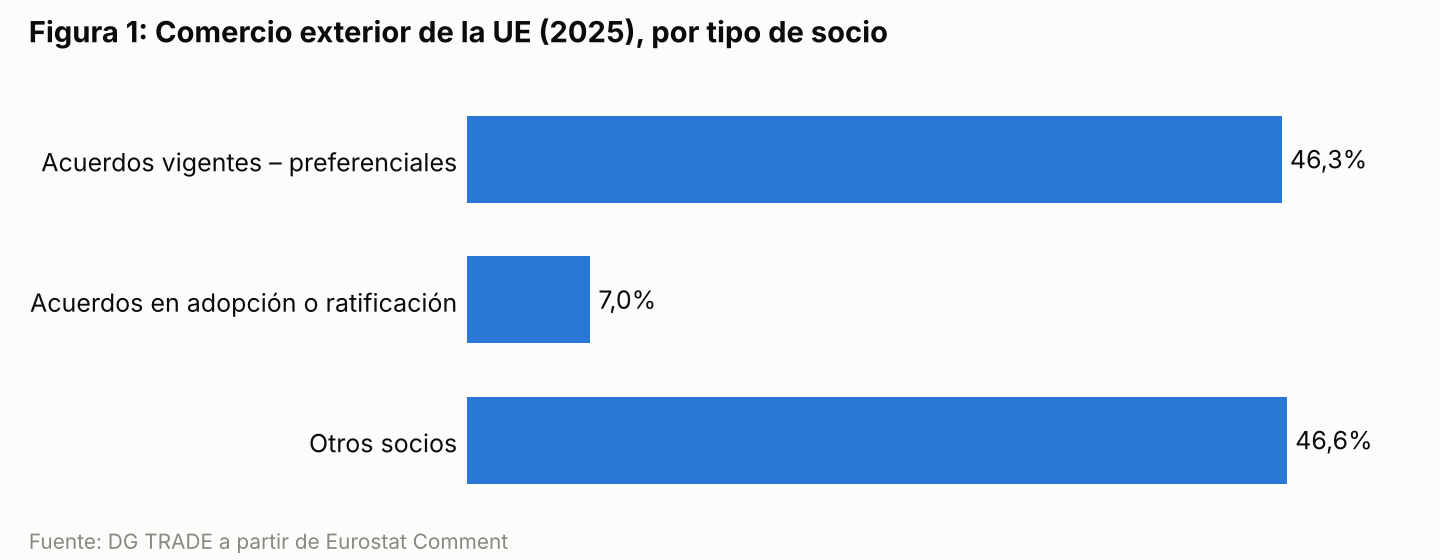
The EU has pursued an active trade policy on trade agreements under the umbrella of so-called "European economic security," formally launched in 2023 and reinforced in 2025. This is partly to diversify its foreign trade and partly because of the weakness that the WTO multilateral trading system is showing, which the EU has criticized. In 2025 and the first quarter of 2026, agreements were concluded with Mercosur, Mexico, Indonesia, India, Australia, and the four countries of Eastern and Southern Africa (Comoros, Madagascar, Mauritius and Seychelles). With them, the share of preferential trade in the EU's total would rise to 53.3%. Let us recall that the agreement with Mercosur has been applied provisionally since May 1, 2026. As Figure 1 shows, 46.3% of the EU's foreign trade is conducted under agreements already in force, 7.0% under agreements in the process of adoption or ratification, and the remaining 46.6% with partners without a preferential agreement. The EU is currently negotiating trade agreements with Malaysia, the Philippines, Thailand and the United Arab Emirates.
Source: DG Trade
Who Are the EU's Most Important Partners?
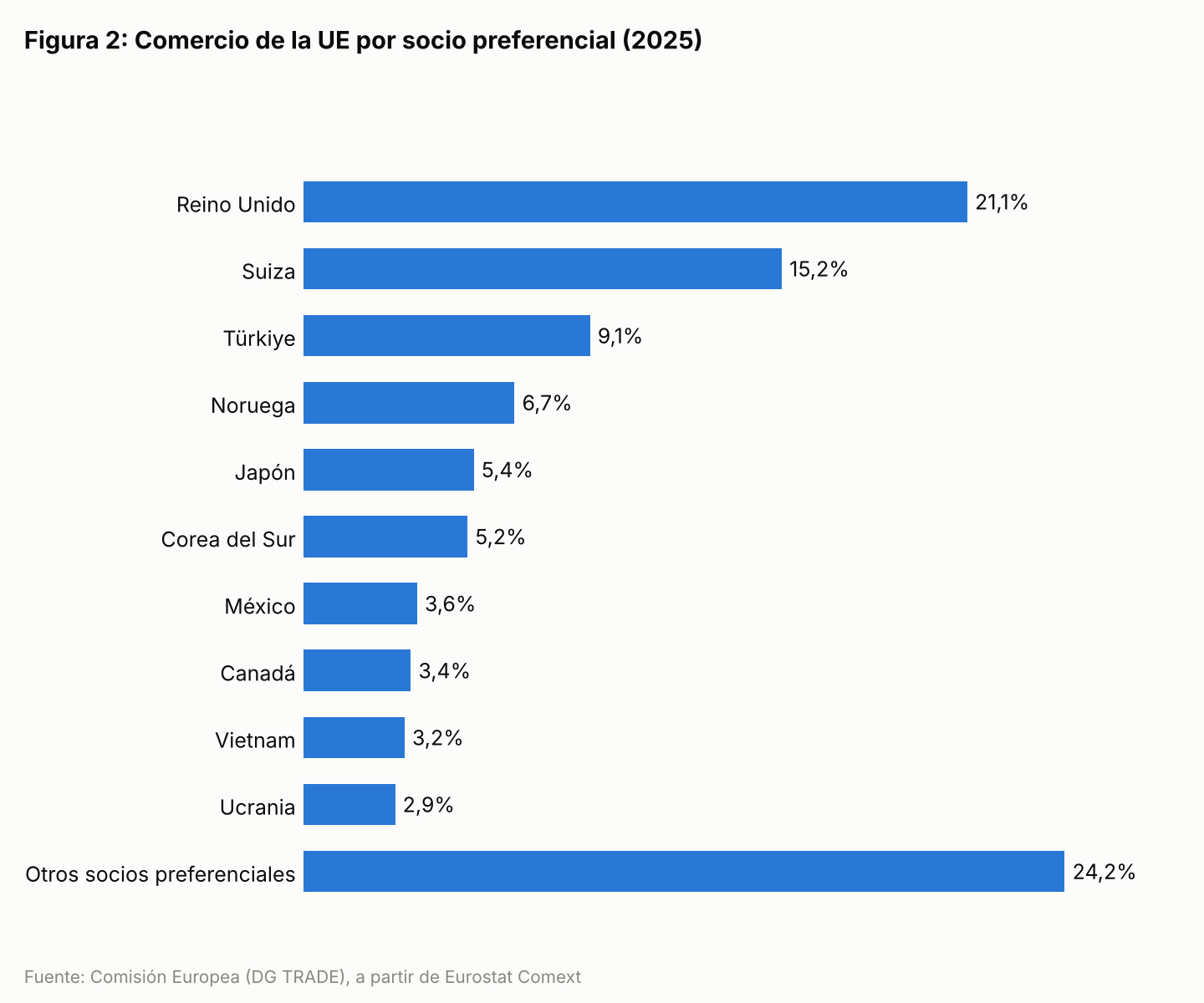
Excluding the US, which has a specific agreement, the United Kingdom remains the main partner with a preferential agreement, accounting for 21.1% of the EU's preferential trade. It is followed by Switzerland (15.2%), Türkiye (9.1%), Norway (6.7%) and Japan (5.4%). Together, these five concentrate almost 60% of preferential trade. Some trading partners such as South Korea, Japan, Canada and Vietnam already enjoy consolidated tariff advantages with Brussels, which progressively erodes the competitive differentiation that the Mercosur-EU agreement offers.
Among the countries of the region, Chile stands out, where the EU-Chile Interim Trade Agreement (ITA) illustrates the immediate and positive impact that a new trade agreement can have. Total bilateral trade amounted to 20.8 billion euros in the first eleven months since its entry into force on February 1, 2025, 3% more than in year-on-year terms. EU exports of machinery and appliances grew 9%, chemical products 8%, and optical and photographic instruments 17%. These are sectors that compete directly with Mercosur products and limit their access to the Chilean market. In turn, in the first 4 months of the Mercosur-EU Interim Agreement, European exports to the South American bloc grew 9%, confirming the immediate impact of the tariff reduction on industrial and high-value-added consumer goods.
Source: DG Trade
Preferential Agreements Boosted Agrifood Trade in the EU
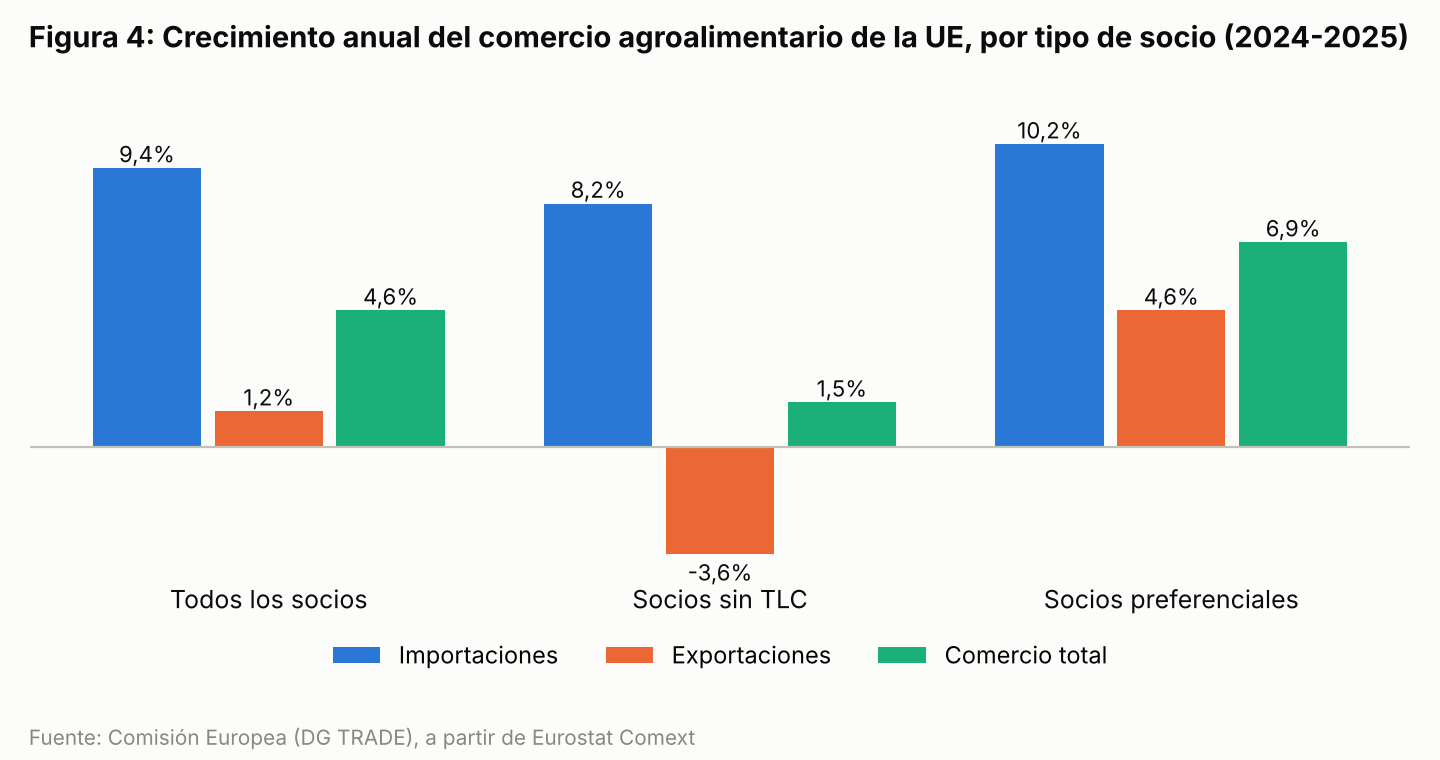
The agreements gave a greater boost to agrifood trade. With preferential partners, trade grew 6.9%, compared with 1.5% with partners without an agreement and 4.6% with all partners. The agrifood sector accounted for 9% of the EU's total exports and explained 37% of its overall trade surplus. Agrifood exports to preferential partners rose 4.6%, while those to partners without an agreement fell 3.6%. The United Kingdom is the main destination, with more than 55 billion euros (+3%). In the case of CETA with Canada, wine exports grew on average 39% in the period following the provisional application of the agreement, and extra virgin olive oil exports rose 46%.
Source: DG Trade
Services, an Expanding Market for the EU
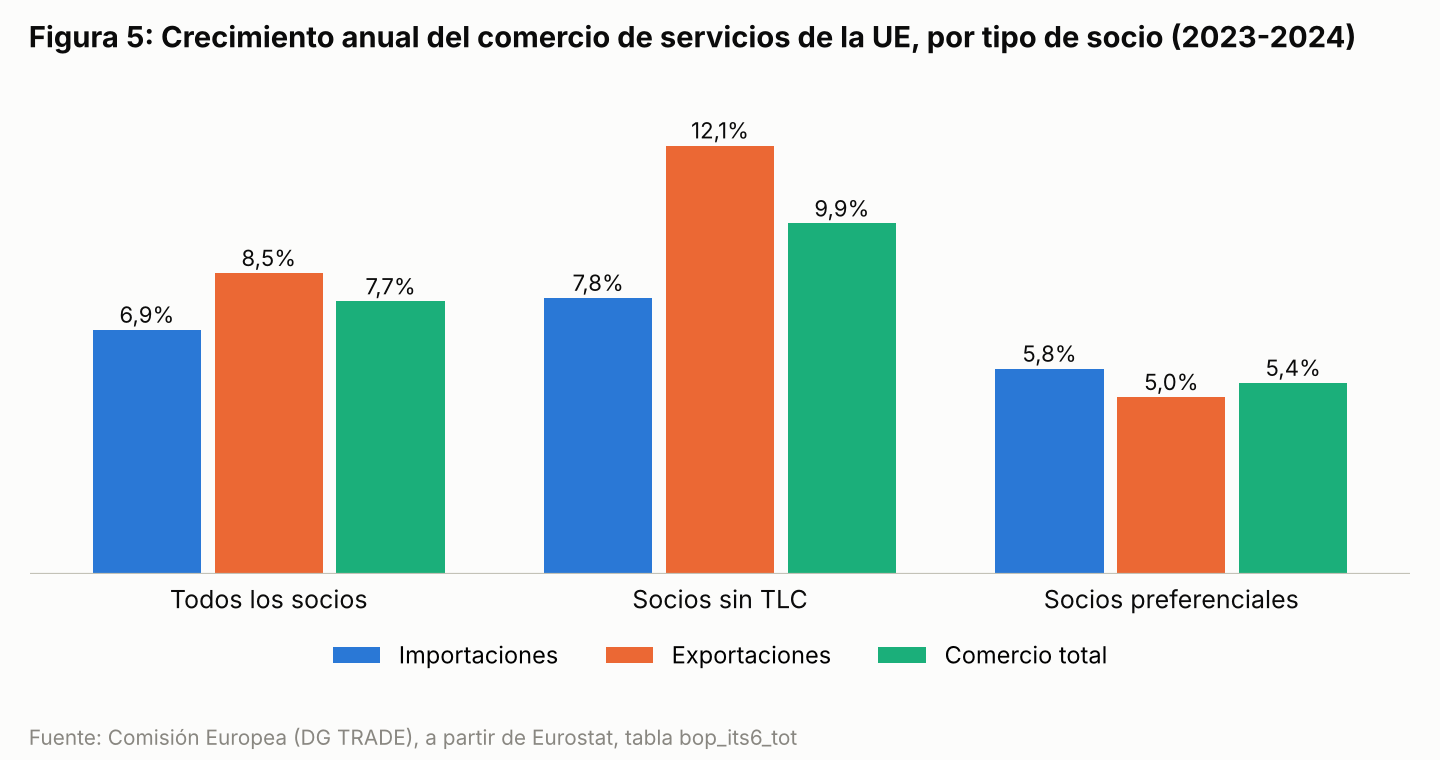
Trade in services with preferential partners reached almost €1.4 trillion in 2024, 47% of the EU's total in services, and grew 5.4%. With Canada, bilateral trade in services has increased 97% since the provisional application of CETA in 2017. In December 2025, an agreement on the mutual recognition of professional qualifications for architects entered into force.
Source: DG Trade
The EU's new-generation agreements: digital trade and investment
In May 2025, the EU signed its first digital trade agreement with a non-European country, Singapore. On June 10, 2026, it signed one with the Republic of Korea, and in March 2026 it launched negotiations with Canada. In November 2025, it signed its first clean trade and investment partnership (CTIP) with South Africa. In April 2026, it concluded negotiations on an investment facilitation agreement with Ecuador, the first of its kind with a Latin American country.
Knowing in advance the potential competitors, the main trading partners and the advantages they have is key for any company that wants to enter a market successfully. To export to the EU, MERCOSUR companies have the MERCOSUR-EU Interim Agreement as their baseline, which must be analyzed in the context of the other preferential trade agreements signed by the EU. We can help your company achieve this.
Director of Pulso Internacional
Lawyer specializing in international trade and productive investment, with more than 25 years of experience in international trade negotiations as an adviser to governments and to companies going international. At Pulso Internacional we analyze foreign trade, bringing clarity and international context so that your company can export and invest more.
Related analysis
Argentina Climbs to Fifth Place Among Peru's Suppliers, Overtaking Mexico
November 22, 2026 · 11 min
Indonesia Signs Trade Agreement with the EU and Competes with Mercosur in That Market in 2027
November 22, 2026 · 4 min