World Textiles and Cotton Market Outlook 2027
Translated from the Spanish original. Read the original

Director of Pulso Internacional
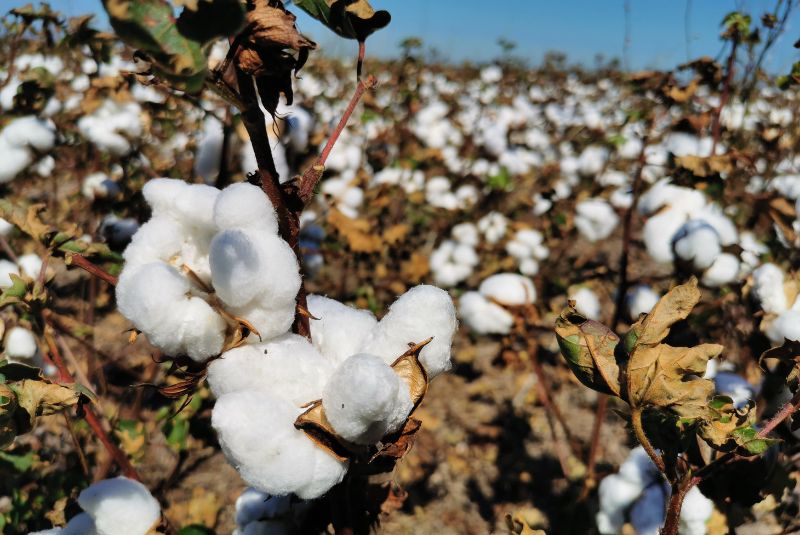
World cotton production is heading toward 25.9 million tonnes in the 2026/27 season, according to projections by the International Cotton Advisory Committee (ICAC), while consumption would reach 26.1 million tonnes over the same period. The gap between the two may seem small, but it reflects the tension in the global fiber market, with demand growing steadily, driven by the large Asian manufacturers, and a cotton supply that is unable to expand its yields at the necessary pace.
For Latin America, and particularly for Brazil and Argentina and Bolivia, this scenario represents an export opportunity in which volume, traceability and specialization must be coordinated to optimize the region's potential.
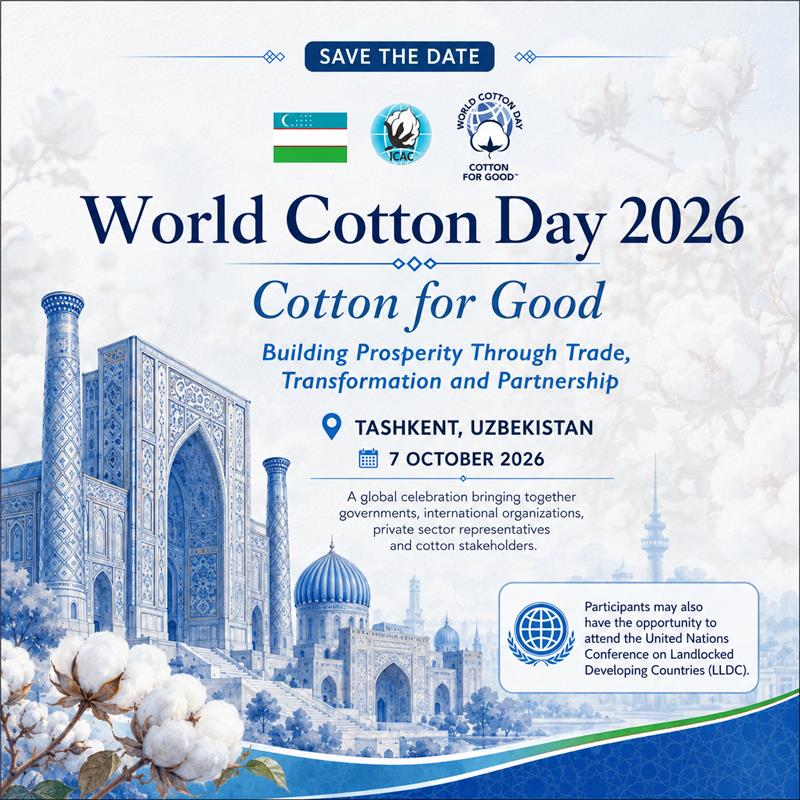
World Cotton Day
The production map: China, India and Brazil's rise
These were some of the conclusions that specialists discussed on October 26 in meetings on world cotton market trends and the future of the sector, following the World Cotton Day commemoration in Uzbekistan earlier this month.
China retains its global production leadership, followed by India and Brazil, which over the past five years has consolidated its position as the world's third-largest producer and, in many seasons, the leading fiber exporter. China and India remain the world's largest consumers, followed by Pakistan, Vietnam, Bangladesh and Turkey. World cotton trade is expected to maintain an upward trajectory through 2029. The largest exporters in 2026/27 are expected to be Brazil, the United States, Australia and the West Africa region, while the three largest importers will be China, Vietnam and Bangladesh.
Source: ICAC / WTO, October 2026. Projected data.
The problem of yields and the agricultural frontier
The ICAC has pointed out that much of the production growth of recent decades was explained by the expansion of cultivated area, not by substantial improvements in yields per hectare. In India, for example, yields average barely 450 kilograms of fiber per hectare, far below the 2,000 kilos recorded by Australia or the 1,800 that Brazil achieves in its best producing regions.
In Argentina, cotton from Chaco, Santiago del Estero and Santa Fe operates with yields ranging between 900 and 1,100 kilos of fiber per hectare under normal conditions, competitive with India but far from regional values. The question we ask ourselves is whether investment promotion instruments such as the RIGI, the infrastructure financing promised by the US EximBank, or the economic complementation schemes under ALADI can catalyze private investment in transport infrastructure, irrigation, certified seed and ginning, to close that gap before the export window closes.
Source: WTO
COTTON IN ARGENTINA: PLANTED AREA, FIBER YIELD, PRODUCTION
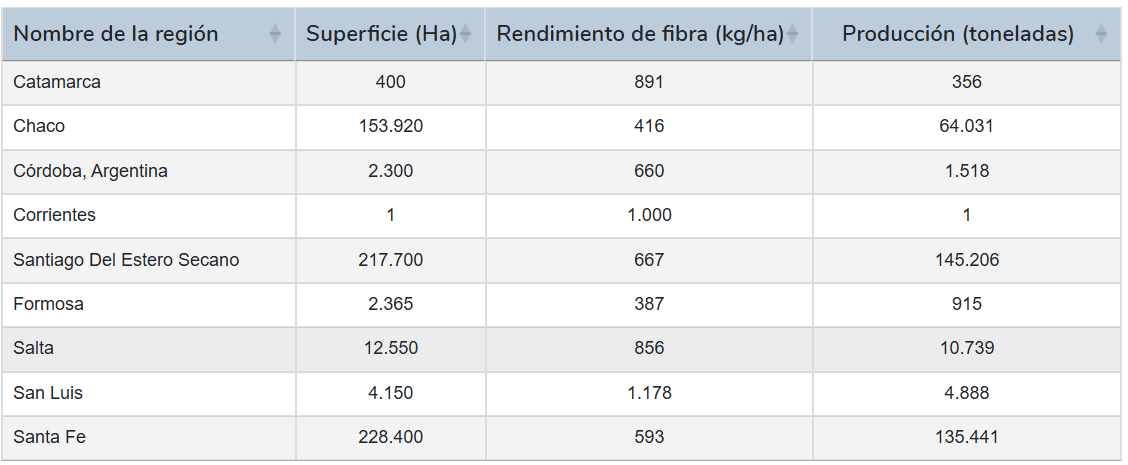
Source: ICAC 2025
COTTON IN BRAZIL: PLANTED AREA, FIBER YIELD, PRODUCTION
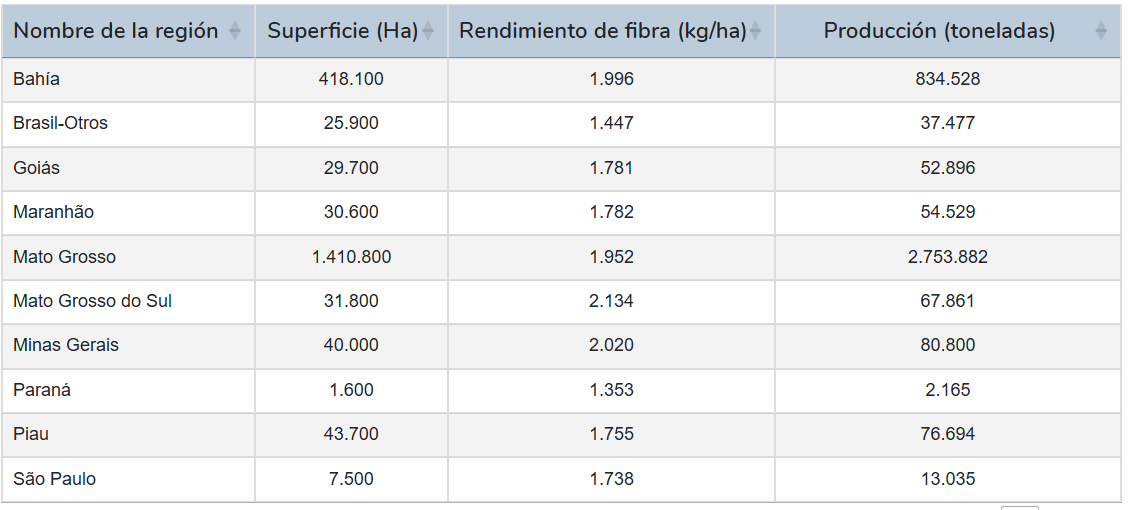
Source: ICAC 2025
Textile friend-shoring: Vietnam and Bangladesh as demand drivers
The post-pandemic reconfiguration of global textile value chains has accelerated the shift of part of apparel manufacturing from China to Vietnam, Bangladesh, Cambodia and Turkey. This friend-shoring, phenomenon, driven by trade tensions between the United States and China and by the traceability pressures imposed by European due diligence regulations, or by the US rules against forced labor , has turned Vietnam and Bangladesh into the two most dynamic importers of raw fiber of the past decade. Both countries depend almost entirely on imported cotton to supply their spinning and weaving industries, which makes them natural destinations for the exportable surpluses of Brazil, Australia and West Africa.
From a trade policy standpoint, this trend opens a concrete opportunity for Latin American exporters. World cotton trade maintains an upward trajectory projected through 2029, which suggests that the window will not close in the short term. However, competition among suppliers will intensify:
Textile projections 2026-2030
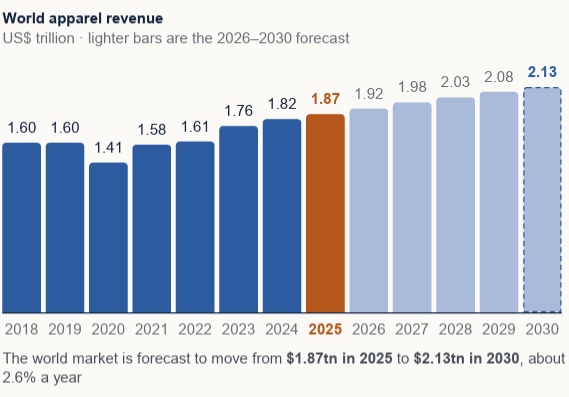
Source: WTO 2026
Implications for Mercosur: intra-regional competition and possible complementarity
Brazil's rise into the top five cotton exporters creates a particular tension within MERCOSUR. However, within the framework of the economic complementation agreements in force under ALADI, there is room to build intra-regional value chains in which Argentina contributes differentiated fiber, Brazil contributes volume and logistics infrastructure, and both jointly access Asian markets under MERCOSUR rules of origin. The practical question is whether there is the political will and technical capacity to put that complementarity into practice.
The global cotton market of 2027 shows sustained demand, a supply that is growing more through planted area than through productivity, and a logistics reconfiguration that favors suppliers able to guarantee volume, quality and traceability. All of this requires a deeper dialogue in the textile and apparel sector, and decisions that go beyond the agricultural cycle and fit within a medium-term strategy for MERCOSUR's international integration. In this regard, the commitments Argentina has made in the G20 against forced labor represent a production advantage that should be leveraged to access demanding markets, including markets such as Vietnam , to ensure that apparel originating there enters the US market with the required traceability.
Sources
Director of Pulso Internacional
Lawyer specializing in international trade and productive investment, with more than 25 years of experience in international trade negotiations as an adviser to governments and to companies going international. At Pulso Internacional we analyze foreign trade, bringing clarity and international context so that your company can export and invest more.
Related analysis

European Assessment of the EU-Mercosur Agreement: In 4 Months, European Exports Grow 9%
November 5, 2026 · 2 min
Why Has the US Increased Its Investment in Germany?
November 3, 2026 · 5 min